
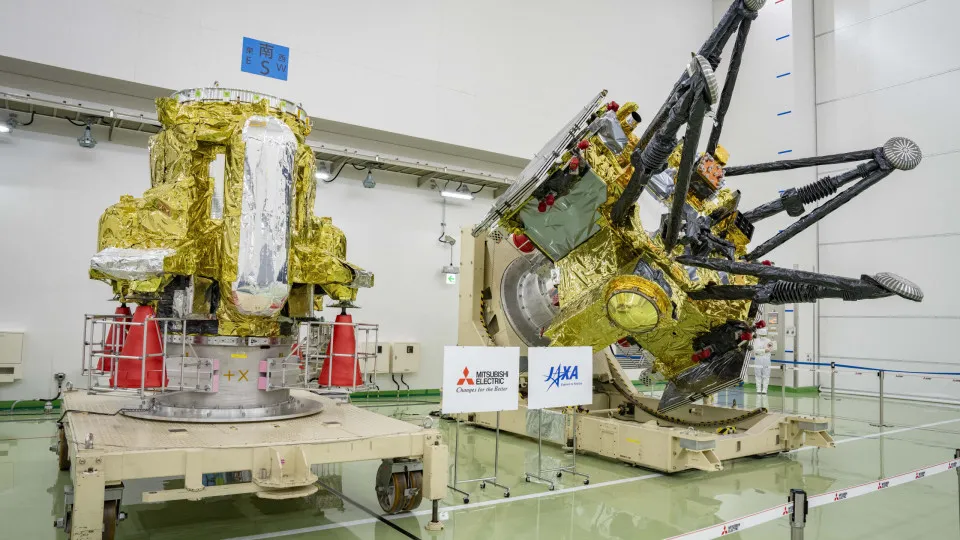
The Japanese space agency announced today that the MMX probe, which intends to be the first to take samples from one of Mars' moons, is on its way to the Martian region.
© Getty Images
20/10/2026
by
Lusa
Miguel Patinha Dias
The Martian Moons eXploration (MMX) probe, the result of a collaboration of the Japanese space agency (Jaxa) with the National Center for Space Studies (Cnes), NASA, the European Space Agency (ESA) and the German Aerospace Center (DLR), may also contribute to laying the foundations for future human exploration.
The rocket H3 that transports MMX, as well as two French contributions – a rover and a spectrometer – took off from the space center of Tanegashima (south of Japan) Tuesday at 04:41 (19:41 GMT Monday), according to a live transmission from the Japanese space agency.
Although very early, thousands of Japanese followed the event live and published encouraging messages online.
After a journey for about a year, the probe will remain three years in the vicinity of the red planet, orbiting around Phobos, one of the two moons of Mars, about 6,000 kilometers from this planet.
Then you will land on this satellite to collect at least 10 grams of matter. The rover called Idefix, in a reference to the dog of the Asterix comic book, will make first observations of the surface and will serve as explorer for the probe, ensuring it a safe landing.
Mirs is a spectrometer developed by the Cnes and the Paris-PSL Observatory “which will help scientists choose the most interesting sites for sample collection,” sums up the astronome Antonella Barucci, who is responsible for Mirs’ science.
“ The collection of samples in Phobos will be the first worldwide,” AFP said the head of project MMX, Yasuhiro Kawakatsu.
Jaxa indicated that the mission would also study the possibility of using Phobos as a “natural space station”, defining the requirements for a return trip to Mars, a “essential element for human exploration” of this planet, she added.
The mission must also observe the other moon, Phobos, without landing there, before returning to Earth.
Jaxa expects the mission to reveal how Mars and its two moons formed, crucial information to understand the birth of the Solar System.
One of the theories, that of the “giant impact,” suggests that they formed after the collision of a celestial body with Mars.
The hypothesis called “capture” considers, on the other hand, that they may have been asteroids captured by Martian gravity.
“MMX will clarify the transport mechanisms that led water, volatile elements and organic compounds from the outer regions of the Solar System to the inner rocky planets (Mercury, Venus, Earth and Mars), processes that may have “a key role in the habitability of these worlds,” French news agency AFP explained in August French astrophysicist Patrick Michel, CNRS research director. “If Phobos and Deimos are in fact traces of these early transport systems, they may contain clues about the very origins of life or, more precisely, about the transport of materials, a determinant for the emergence of life on rocky planets,” he added during the preparation of this mission.
China also announced that its Tianwen-3 spacecraft should be launched around 2028 in order to bring back samples from Mars by 2031, potentially before the return of MMX.