
Three presidential candidates from Bosnia-Herzegovina, whose office is tripartite between ethnic groups, declared victory in today's elections, although only about 90% of the votes are still counted.
© AFP via Getty Images
04/10/2026
by
Lusa
O bosnian Serbian nationalist Milorad Dodik, a firmly pro-Russia politician, declared his party's victory, attributing the electoral gain to the “magnificent victory” of American President Donald Trump in 2024, and the support of Russian President Vladimir Putin.
Although not included in the ballot, Dodik dominated the campaign with separatist rhetoric, which generated fears of renewed instability in the country.
Former President of Republika Srpska, the Serbian majority in the country, Dodik was forbidden from exercising public office after he was sentenced last year for disobeying the decisions of the international envoy who overseeed the 1995 peace agreement, which ended the three-year war.
With almost 90% of the votes cast, Zeljka Cvijanovic, an ally of Dodik and the Right-wing Alliance of Independent Social Democrats (ASI), had more than 55% of the votes, guaranteeing one of the three seats in the tripartite presidency of the country and leading the race against his closest opponent by about 30 percentage points.
At the same time, candidate Darijana Filipovic of the Croatian Democratic Union of Bosnia-Herzegovina declared victory with a significant advantage in the Croatian race in the presidency, while current Bosnian President Denis Becirovic of the Social Democratic Party welcomed the leadership of the race against his closest opponent, Bakir Izetbegovic, for less than three percentage points.
Around 3.4 million voters were able to choose the three members of the country's multiethnic presidency, the national parliament members and the heads of the institutions of the two entities of the country: the Federation of Bosnia-Herzegovina, a Muslim majority, and the Serbian Republic, dominated by ethnic Serbs.
However, according to the Bosnian Central Electoral Commission, 1,432,269 votes were counted in total, representing 42%, around 8 percentage points less than that of the last elections in the country in 2022.
Bosnia has a complex network of government institutions set up by a US-mediated peace agreement in 1995, in an attempt to manage ethnic divisions between Bosnian Muslims, Orthodox Serbs and Croatian Catholics, which gave rise to war.
However, Dodik has constantly tested these limits, openly challenging the Bosnian national government in the capital, Sarajevo, and taking steps to get the Serbian Republic to separate from the country.
At the last election rally of his party on Friday night in Banja Luka, the administrative capital of the Serbian Republic, Dodik told his supporters that Bosnia “is dead”.
“It’s an impossible country. It makes no sense,” he said at the rally, which also had the presence of the Russian ambassador, Igor Khalabukov.
These political and ethnic divisions — in which Bosnians, Serbs and Croatians vote largely in accordance with their ethnic groups — have blocked Bosnia's progress towards EU membership, despite the efforts of the bloc to encourage the country's divided leaders to work together for reforms.
One of Europe's poorest countries, Bosnia-Herzegovina, is still struggling to recover from the war that started in 1992, after the country declared the independence of the former Yugoslavia led by the Serbs and the ethnic Serbs took up arms to create their own state and join Serbia.
The conflict killed over 100,000 people and dislodged millions.
The wounds of the war were recently reopened by a public tribute in Serbia and among Bosnian Serbs to the wartime army commander Ratko Mladic, who died in late August while serving a life sentence for genocide and other war crimes.
The Bosnian Serbs consider Mladic a hero, despite his condemnation by a UN court for the massacre of over 8,000 Muslim men and boys in Srebrenica in 1995 and other atrocities.
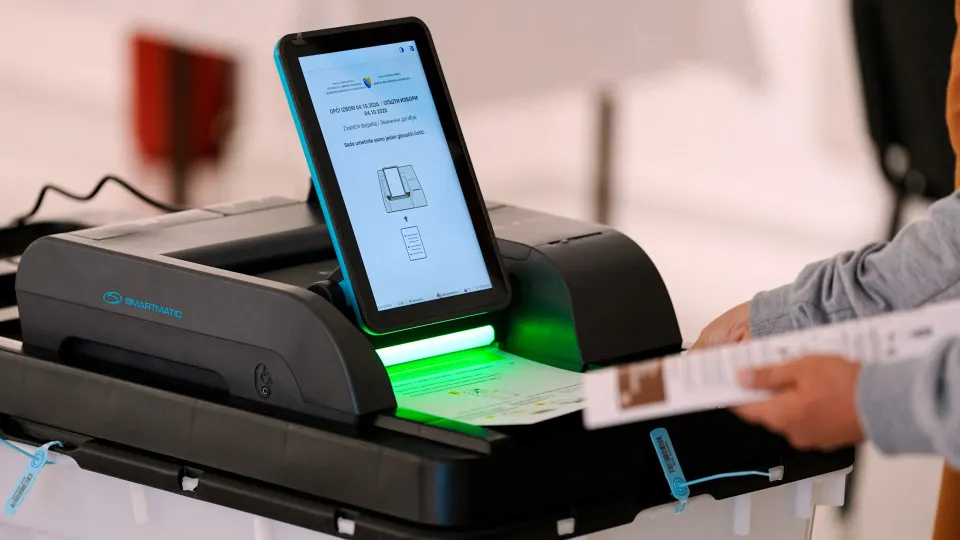
Today's election was the first in which Bosnia used the electronic identification of voters and ‘scanners’ of voting papers to avoid irregularities or organised manipulation of voters, which cast doubt on the smoothness of previous elections.