
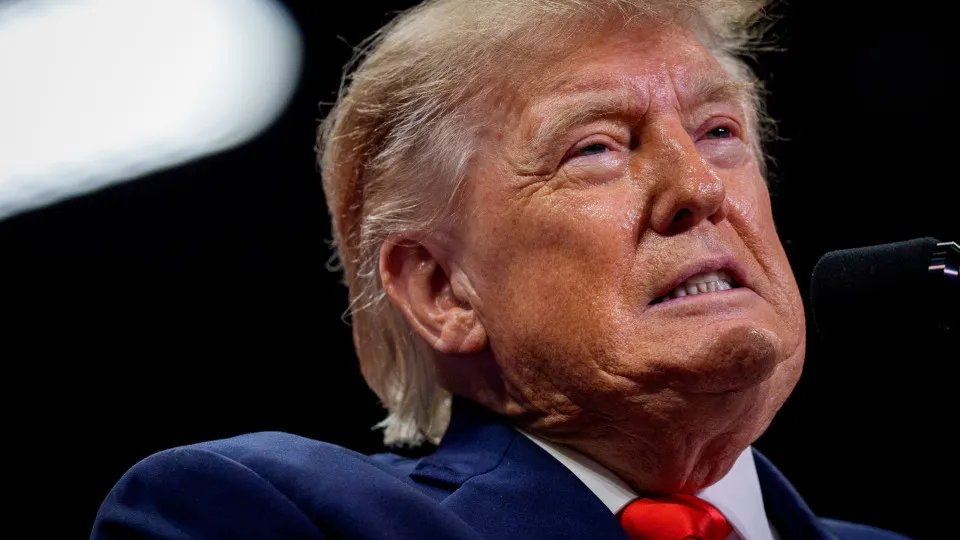
The President of the United States, Donald Trump, said today that he could become the “Mr. Veto” if the Democrats, ahead in the polls, won the majority in Congress in mid-term elections on Tuesday.
© Andrew Harnik/Getty Images
01/11/2026
by
Lusa
O president of the United States, Donald Trump, said today that he could become “Mr. Veto” if Democrats, ahead in polls, won the majority in Congress in mid-term elections on Tuesday.
“ I think I will become ‘Mr. Veto’,” said the President to the Fox News television channel, about his strategy in the face of a scenario in which the opposition would control the two legislative chambers – House of Representatives and Senate.
According to the Republican leader, their initial plan would be to systematically block legislative initiatives promoted by a democratic majority, and then force them to negotiate agreements.
“It wouldn’t be the first time. You have a President who does not have the House of Representatives or the Senate, they send proposals, veto them and finally, after a month or two vetoing everything, they come here and you close an agreement,” Trump argued about the negotiation dynamics he plans to implement, in a video published today by Fox.
Despite delineating this institutional confrontation roadmap, the US President expressed confidence that the Republicans would maintain legislative control after the mid-term elections, thus avoiding having to resort to this blocking strategy.
A national poll published today by NBC News gives Democrats a seven-percent advantage over Republicans in the fight for control of the US Congress, motivated by the discontent of voters and a historical disapproval of President Donald Trump's administration.
The poll shows that 52% of registered voters prefer a legislature under democratic control, compared to 45% that opt for Republicans and 3% that are undecided.
Among the independent electorate, the difference in favour of democrats is 21 points.
The poll places Trump's disapproval rate on historical 60%, the highest level in its two mandates in this poll, compared to 40% approval.
Similarly, 64% of respondents say that the president did not meet their expectations, while 70% consider that the direction of the country is wrong.
The economy and cost of living remain the main concerns of the electorate. In this sense, almost three quarters of respondents declare dissatisfaction with the state of the economy and, for the first time in three decades in this survey, 51% are dissatisfied with their own personal financial situation.
The survey was conducted between 28 and 30 October with 1,000 registered voters and has an error margin of 3.1 percentage points.