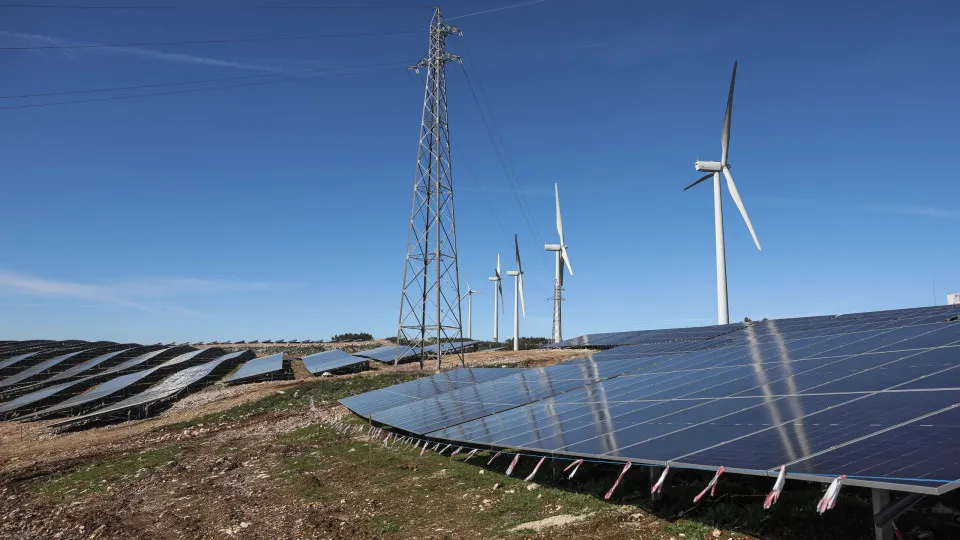
The European Parliament and the Council of the European Union (EU) have today agreed on a new directive that speeds up and simplifies the licensing of renewable energy projects, electricity networks and storage facilities.
© Lusa
18/11/2026
by
Lusa
O European Parliament and the Council of the European Union (EU) agreed today on a new directive that speeds up and simplifies the licensing of renewable energy projects, electricity networks and storage facilities.
In a statement, the EU Council argues that this new directive will “help accelerate Europe’s electrification” and ensure that the continent becomes less dependent on fossil fuels.
“ We need network infrastructure to provide clean, affordable and produced energy in Europe, and to reduce our dependence on imported fossil fuels,” said Darragh O’Brien, Irish Minister of Climate, Energy and Environment, a country currently holding the rotating presidency of the EU Council.
In turn, the European Parliament (EP) points out that this new directive, by simplifying the development of renewable energy infrastructure in Europe, will “contribute to reducing energy prices”.
In practice, the new directive reduces the deadlines for approving projects in this area.
As soon as the Directive enters into force, licensing procedures for solar energy equipment and associated storage facilities shall not exceed three months.
The deadline will be six months for autonomous storage facilities and loading stations and two years for hydroelectric pump storage facilities.
In order to avoid “administrative strangulation” in intermediate stages of licensing procedures, the Directive provides that Member States may decide that a failure to respond by the authorities is considered tacit approval.
The deadlines for linking these projects to the network are also reduced: they are now three months, “may be extended to six in duly justified cases” and a derogation for “insulated systems or small interconnected systems” as in the outermost regions of the EU, including the Azores and Madeira.
The directive also reinforces the idea that renewable energy projects and electricity networks are considered to be “superior public interest”, allowing the elimination of “several administrative obstacles to their implementation”, the EP states in its statement.
However, the EU Council notes that Member States may decide “not to apply this principle when protecting security and defence interests and cultural heritage”.
The EP also points out that during the negotiations it managed to increase the threshold from which a permit is required for small-scale solar installations, energy storage facilities (except hydrogen) and loading stations.
While a permit was previously required for installations with a power of more than 100 kilowatts, this threshold now passes to 200 kilowatts.
The agreement also provides that administrative licences are no longer required for the installation of loading stations with a total power equal to or less than a megawatt.
The new rules also provide for greater involvement of local communities, establishing new principles that include the need to “promote dialogue” with citizens through the “voluntary appointment of an independent facilitator”.
In this context, the two institutions also agreed to reduce from ten to seven megawatts the threshold from which the so-called “benefit sharing” is mandatory, i.e. the redistribution of the economic benefits generated by the project to the local communities that welcome it or are affected by it.
The European Commission has already welcomed this agreement, considering that it ‘is sending a clear signal that the EU is committed to strengthening and accelerating the expansion of clean energy infrastructure’.
The agreement will now have to be adopted in plenary session of the European Parliament (EP) and the EU Council in order to enter into force.