
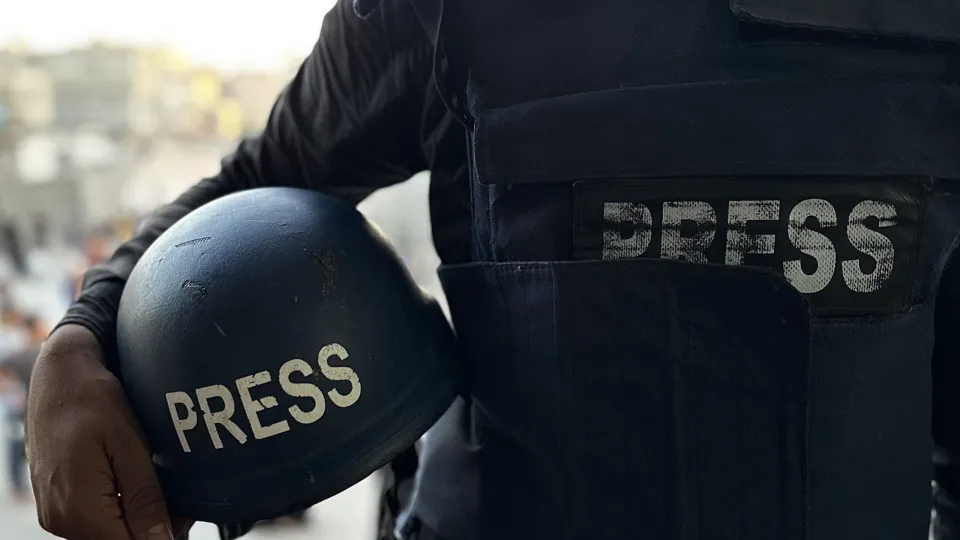
The impunity of the murders of journalists is increasing for the first time since 2012, according to a UNESCO report released today on International Day of the End of Impunity of Crimes against Journalists. The overall rate of impunity rose by 1 percentage point, reaching 86%.
© Doaa Albaz/Anadolu via Getty Images
02/11/2026
by
Lusa
A impunity of the murders of journalists is increasing for the first time since 2012, warns UNESCO in a report published today on the occasion of International Day of the End of Impunity of Crimes against Journalists.
This year, “the general rate of impunity for the murders of journalists has increased by one percentage point, reaching 86%,” says the report.
Since 2012, this rate has been steadily falling from its 95% to 85% by 2024.
The impunity rate includes murders whose investigations have not been completed or are still ongoing.
Six out of seven perpetrators of journalist murders will have escaped justice.
“ Investigations and prosecutions concerning the murders of journalists in war zones remain particularly inadequate,” said UNESCO Deputy Director-General for Communication and Information, Mariya Gabriel.
Clarifying that the international organization “is not a court”, the responsible ensured that this “is pressing the judicial system to ensure that justice is done”.
The report, published every two years, accounts for 189 journalists, media professionals and content creators for social networks involved in journalistic activities that were killed in 2024 and 2025, including 14 women.
The number of journalists killed rose between January 1, 2024 and January 31, 2025, a 20% increase over the previous two years.
This increase is attributed to a wave of murders in conflict zones, particularly in Palestine, UNESCO reported on Monday.
In this new issue of the report on the safety of journalists and the impunity of crimes against them, the United Nations Educational, Scientific and Cultural Organization found that 92 journalists were killed in 2024 and 97 in 2025.
The deaths in conflict zones during this two-year period accounted for 127 (67% of the total), deepening the upward trend initiated in 2023 and largely related to drone attacks, responsible for more than a quarter of all deaths.
In war zones, there has been an increase in the number of journalists killed “in a group”, which may indicate that they were “deliberate targets”, a “war crime,” said Mariya Gabriel.
This is the most deadly two-year period for journalists in the last 10 years.
Two thirds of them (67%) were killed in conflict zones, such as in the Palestinian territories, Yemen or Ukraine.
“ This marks a major change in the overall risk scenario for journalists,” says Mariya Gabriel.
The organisation underlines that journalists continue to be killed in their homes or while wearing vests that identify their profession.
A total of 1,641 journalists have been killed worldwide since 2006, when UNESCO began monitoring it, which represents an average of one death every four days.
Some figures reported by UNESCO in this report differ from those published by the Committee for the Protection of Journalists or by the Organization Reporters Without Borders.
UNESCO explains these differences citing “the circumstances of a death, which are sometimes difficult to assess due to the constantly evolving nature of conflicts”.
In addition to the deaths, the risks to journalists have also increased with the general deterioration of press freedom worldwide, with increased attacks, harassment (e.g. abusive prosecutions), arbitrary arrests and intimidation.
According to data collected by civil society organizations and released by UNESCO, between 98 and 160 journalists disappeared between 2024 and 2025.
The arrests, according to data from Reporters Without Borders and the Committee for the Protection of Journalists (CPJ), ranged from 938 (according to RSF) to 466 (CPJ).