
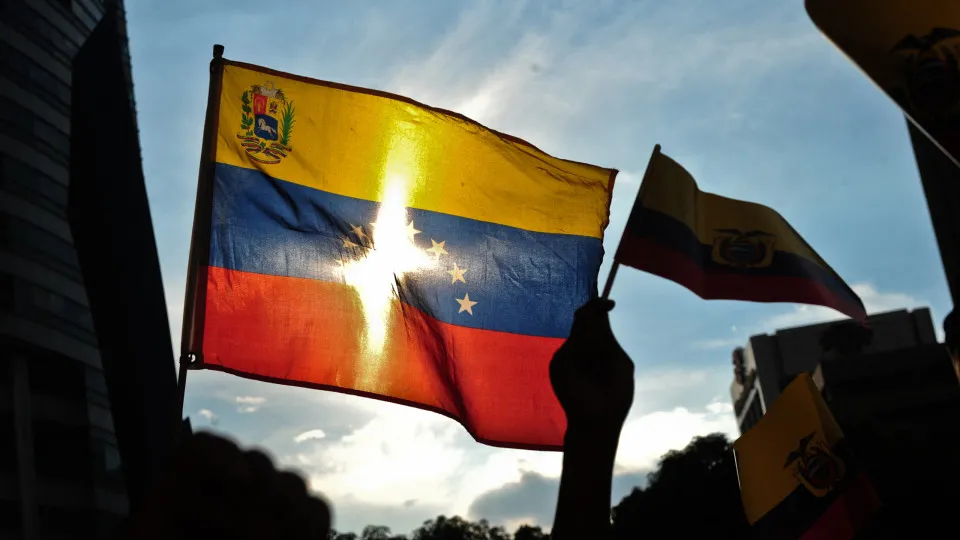
Venezuela’s Vice President for the Economy, Calixto Ortega Sánchez, announced that the country is focused on reducing inflation, restructuring public debt and strengthening bolívar, while seeking to normalize relations with international financial institutions.
© MIGUEL GUTIERREZ/AFP via Getty Images
14/10/2026
by
Lusa
O vice President for the Economy of Venezuela, today indicated that the country is focused on reducing inflation, restructuring public debt and strengthening bolívar, while seeking to normalize relations with international financial institutions.
In the first participation of a Venezuelan delegation in the annual meetings of the International Monetary Fund (IMF) in about 20 years, Calixto Ortega Sánchez presented a recovery strategy based on economic growth, fiscal discipline, monetary stability and institutional strengthening.
“ We see this participation as a step forward in the normalization of Venezuela’s relations with the international financial system,” he said.
The former president of the Central Bank of Venezuela acknowledged that the country has been through one of the worst economic crises in its recent history, with the economy contracting by about two thirds over the last decade due to the fall in oil prices, sanctions and the collapse of oil production.
“ We now have 22 consecutive quarters of economic recovery,” Ortega said, attributing the result to the “resilience” of Venezuelans and an economic plan implemented in particularly adverse circumstances.
Recovery comes at a time when the IMF expects a growth of 5% of the Venezuelan economy in 2026 and 7% in 2027, according to the latest World Outlook Report. However, the body estimates annual average inflation of 467.9% this year, which is expected to slow to 174% by 2027.
The Vice-President acknowledged that inflation remains one of the biggest challenges of the Venezuelan economy, but argued that the solution does not depend solely on the central bank's actions.
“ Without production, without a solid fiscal position and without a normal economy, it is impossible to achieve lasting stability”, he said.
“ We hope to develop a framework of inflation targets in the near future,” he said, adding that the aim is to reduce inflation to two-digit levels “as soon as possible”.
Ortega explained that the government's economic strategy is to increase oil and mining production to generate revenue in foreign currency, and to use part of this revenue to finance long-underinvested sectors such as electricity and water supply systems.
“ Then the reduction of inflation, exchange rate stabilisation, reconnection of the banking system with international markets and resolution of public debt, and strengthening institutions and improving governance to facilitate economic activity,” he added.
Since the capture of President Nicolás Maduro by the United States in January, oil production in the country has increased, reaching about 1.2 million barrels a day, against three million in the late twentieth century.
After the capture of Maduro and his wife Cili Flores, the United States restored diplomatic relations with Venezuela and strengthened ties with the Government of Delcy Rodríguez, with which they reached an oil agreement to control part of the country's reserves.
The leader pointed out that the country intends to avoid “committing past mistakes” during previous cycles of oil prosperity, when abundant revenues did not translate into a more diversified productive fabric.
“ Additional oil and mining yields should be channelled to sectors such as agriculture, manufacturing and other productive activities,” he said
In addition to economic diversification, Caracas seeks to deepen cooperation with the BRICS block and to strengthen its participation in multilateral institutions, in a strategy aimed at expanding trade, investment and financing opportunities.
Ortega also highlighted the plans to increase gold production and incorporate part of this metal into the central bank's reserves, arguing that more robust reserves could strengthen investors' confidence and improve expectations about the economy.
“Our goal is to improve people’s lives,” he concluded. “It’s a people-centered program.”