
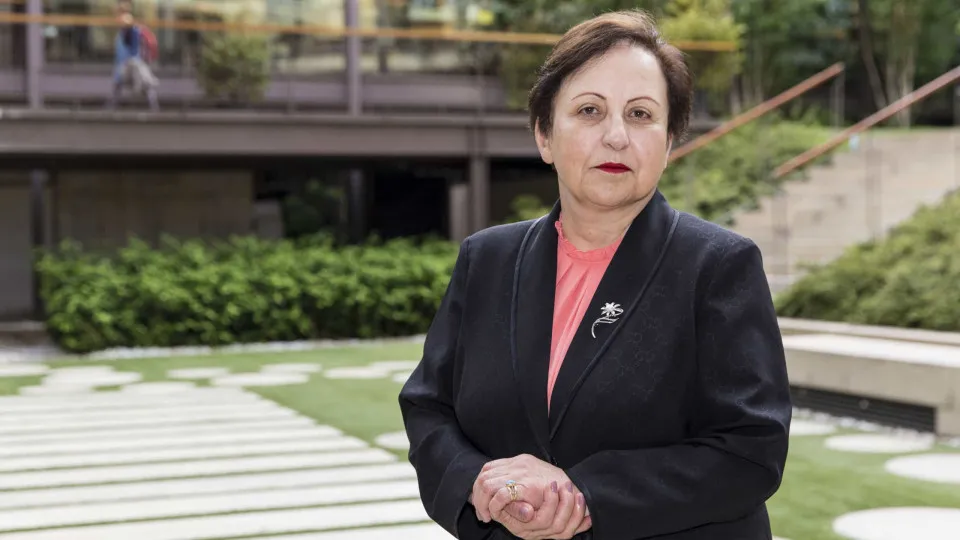
The Iranian Nobel Peace Prize lawyer in 2003 today considered that the human rights situation and repression in Iran are “worse than ever” and that the war with the United States only worsened them.
© Angel Manzano/Getty Images
14/10/2026
by
Lusa
Shirin Ebadi
A iranian lawyer Nobel Peace Prize in 2003 today considered that the human rights situation and repression in Iran are “worse than ever” and that the war with the United States only worsened them.
In a written interview with the Lusa agency, Shirin Ebadi, one of the guests to participate, as speaker at the 10th edition of the Estoril Conferences, which take place on 29 and 30 this month at the Nova SBE Carcavelos Campus, regretted that the death of Ayatolla Ali Khamenei on 28 February following the attacks of the United States and Israel did not cause any fundamental change in the structure of the regime.
“ The human rights situation in Iran is worse than ever. In addition to discriminatory laws and the continued application of medieval punishments, such as amputation for theft and stoning, repression and the use of violence by the government reached unprecedented levels,” he said to the woman who was the first judge in Iran, removed from office following the Islamic Revolution of 1979.
At the age of 79, the Nobel Peace Prize in 2003, also a writer and human rights activist, pointed out that only this year, “the authorities [of Tehran] killed more than 30,000 people on the streets in just two days.”.
“ The protesters demanded changes. They were unarmed and went out on the street with nothing but their fists. Today, the division between the Iranian people and the government is greater than ever. In this regard, the government is extremely weak, having lost confidence and legitimacy with the people it claims to represent,” he said in an interview with the help of an interpreter in English, as Farsi only speaks.
For Ebedi, with the new Iranian ayatole, Mojtaba Khamenei, Iran's third supreme leader since 1979 and Ali Khamenei's son, nothing has changed in the country.
“ On the contrary, the Islamic Revolutionary Guard Corps (IRGC) gained even more power, partly due to the war situation. The repression continues to intensify, becoming more severe every day.
According to Ebedi, political repression and systematic persecution of women “continue without slowing down”, with the case of five political activists facing death sentences confirmed simply by having participated in street protests.
“The Iranian people are doing everything in their power to prevent the execution of these sentences. Despite the application of the laws imposing the mandatory use of ‘hijab’, women who do not use it continue to be arrested. But they continue to go out on the street without the 'hijab', fully aware of the risks they are taking. Consequently, it is increasingly common today to see women without a veil alongside women wearing the 'hijab' in Iran. It is no longer something that surprises people”, he observed.
Greeting that Narges Mohammadi, also Nobel Peacekeeper of 2023 and also human rights activist, had been out of prison for seven months, having resumed his normal life after years of detention, Shirin Ebadi criticized prison conditions in Iran, which are “deteriorating significantly”, largely due to the increase in the number of political prisoners.
“ Prisons are overcrowded and some inmates are forced to sleep in the corridors at night because there are not enough beds for everyone. Food quality has also decreased considerably. The reasons are easy to understand: in addition to the deliberate mistreatment of prisoners, Iran faces a steep rise in prices and an increase in food costs, which further exacerbates the situation,” he said.
On the conflict with the United States, the co-founder of various human rights organisations, including the Defenders of Human Rights Centre in Tehran, Shirin Ebedi insisted that the war allowed the Iranian Government to use national security as a pretext to further suppress dissent.
“ Even the granting of interviews to Persian-speaking media based outside Iran, in particular the BBC Farsi, can be considered a criminal offence and result in several years in prison. Censorship is more severe than ever. The government justifies these restrictions on behalf of national security, to further limit freedom of expression and silence independent voices”, he explained.
Shirin Ebedi is the author of several books, including two published in Portugal – ‘Awake of Iran: Memories of Revolution and Hope’ (in 2007 by Editora Guerra e Paz) and ‘The Gold Cage: Three Brothers in the Nightmare of the Iranian Revolution’ (in 2009 by the publisher The Sphere of Books).