
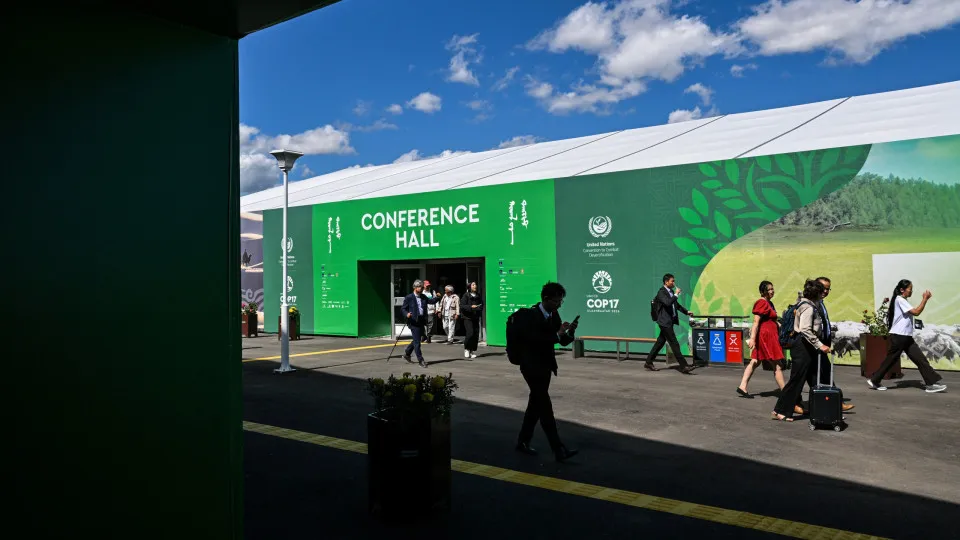
Environmentalist association Zero today considered that the outcome of the 17th Conference of the Parties on Biodiversity (COP17) in Armenia shows a lack of political will, with countries recognizing that the 2030 targets are failing.
© Hector RETAMAL / AFP via Getty Images
31/10/2026
by
Lusa
COP17
A environmental association Zero today considered that the outcome of the 17th Conference of the Parties on Biodiversity (COP17) in Armenia shows a lack of political will, with countries recognizing that the targets for 2030 are failing.
“COP17 has shown that the world knows what needs to be done to stop biodiversity loss: the problem is not the lack of knowledge or commitments, but the lack of political will, funding and concrete decisions,” Zero said in a statement.
According to the association, the conference ended “with technical advances and important decisions, but with some difficult political issues postponed and even some setbacks”.
After two weeks of intense negotiations in Erevan, Armenia, the approximately 200 member countries of the United Nations Convention on Biological Diversity (CDB), which includes Portugal, reached an agreement on fundamental texts for nature protection, starting with a “global analysis” of the Kunming-Montreal Biodiversity Agreement adopted in 2022 and often compared to the Paris Climate Agreement of 2015.
The Kunming-Montreal Agreement sets 23 targets to be met by 2030, including the protection of 30% of land and oceans, the fight against pollution and the restoration of degraded ecosystems. However, the implementation of virtually all these targets is behind schedule.
From the perspective of the Zero environmental association, the last hours of text approval at COP17, which ended on Friday night, were “great tension”, with a speed that “has called into question transparency and discussion”, and with important issues that do not meet consensus, by objection of some countries, including “the Russian Federation blocking mentions of several significant aspects and in some cases causing setbacks”.
The texts approved on the global review of meeting the targets for 2030 and on the mobilization of resources “confirm the diagnosis of delay”, highlighted Zero, adding that, however, they refer to COP18 in 2028, which will take place in Ecuador, the decision on the future architecture of biodiversity financing.
Regarding the achievement of the goals set out in the Global Framework of Biodiversity of Kunming-Montreal, the environmental association highlighted the deep concern that “without a rapid acceleration of implementation, the targets for 2030 will not be achieved, also compromising the goals for 2050”.
With regard to funding, Zero regretted that it would refer to COP18 the choice between creating a new entity or confirming existing ones, indicating that the Global Environment Fund will have “less money”, after donor countries committed around $4 billion between July 2026 and June 2030, of which 35% will have “about 17% less than in the previous cycle”.
“ No one has won and no one has lost: a break between North and South has been avoided, but at the expense of two more years without a decision, four years from 2030. The 1.8 billion dollars announced in the high-level segment do not compensate for this delay: it is essential to meet the 30 billion dollars annually of international funding by 2030 and to ensure that the money reaches those who protect nature ", defended Zero.
According to the United Nations, for every dollar invested in the protection of nature 30 are spent on its destruction, he recalled.
According to the environmental association, “in Portugal there is progress that deserves recognition”, namely the recent conclusion of the conservation instruments of the 61 Special Conservation Areas of the Natura 2000 Network, “but the country should not expect Erevan’s decisions to take effect, nor should those that were postponed be closed in COP18”.
For Zero, Portugal should already incorporate into its policies the themes that marked this conference, such as integrating biodiversity into health policies and articulating the National Strategy for Conservation of Nature and Biodiversity with the National Plan for Energy and Climate, and should ensure “supply funding” for the National Nature Restoration Plan.