
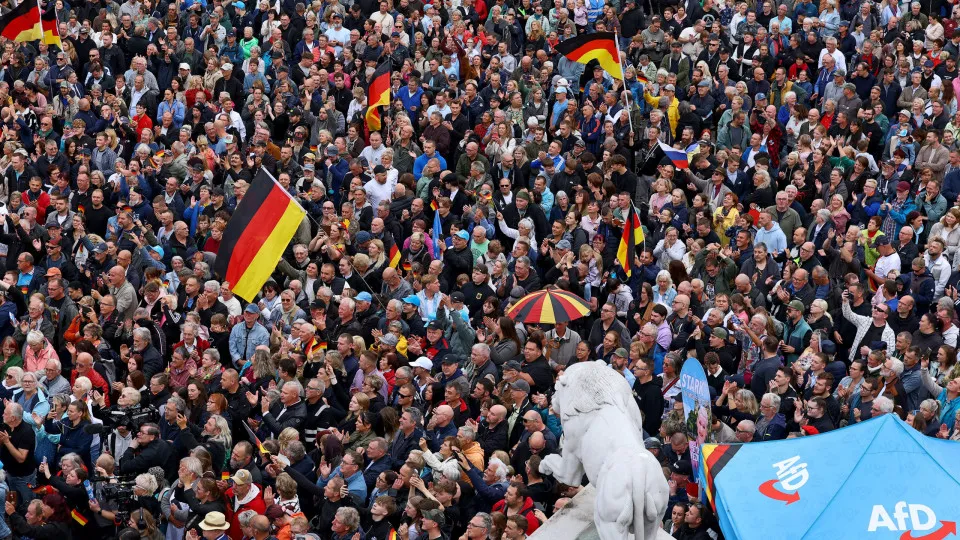
Germany will have five regional elections in 2027, in a year when the rise of the AfD far-right party and the fall in popularity of the conservative Chancellor, Friedrich Merz, will put traditional parties to the test.
© Reuters
01/11/2026
by
Lusa
A Germany will have five regional elections in 2027, in a year when the rise of the AfD far-right party and the fall in popularity of the Conservative Chancellor, Friedrich Merz, will put traditional parties to the test.
The election calendar begins on April 18, with elections in Schleswig-Holstein and Saarland, and continues on April 25 in North Rhine-Westphalia. Bremen votes on 30 May and Lower Saxony closes the electoral cycle on 26 September.
Regional parliaments are elected for five years, with the exception of Bremen, where the term of office is four.
The national context is unfavorable to the federal government, formed by the conservatives of the Christian Democratic Union (CDU) and Christian Social Union in Bavaria (CSU) and the Social Democratic Party (SPD, centre-left).
According to recent data from the TV channel ARD, only 10% of respondents were satisfied with the work of Merz and the executive. In a possible federal election, the Alternative for Germany (AfD) collected 27% of voting intentions, against 20% of the CDU/CSU and 13% of the SPD.
However, the situation varies from state to state. The AfD is growing in several territories, but the results of 2027 will also depend on the performance of regional governments and the capacity of parties to form coalitions.
In Schleswig-Holstein, in northern Germany, the CDU rules with the Greens under the leadership of Daniel Günther. Despite continuing ahead in the polls, the party is below 43.4% that it obtained in the elections of 2022.
The AfD, which then remained outside the regional parliament, now appears with about 16.5%, according to an average of July polls, four times as much as the 4.4% achieved in the last elections.
The state still has one particular feature: the presence of a Danish and Frisian minority, represented by the SSW, which is not subject to the 5% electoral barrier.
In the Saarland, near the French border and with a long tradition in the coal and steel industry, SPD rules alone, led by Anke Rehlinger.
The Social Democrats won an absolute majority in 2022, with 43.5%, but an average of surveys of December 2025 already attributed them 27%. The CDU appeared with 25% and the AfD with 23%, in a dispute that could call into question the dominant position of the SPD.
In North Rhine-Westphalia, the country's most populous state, with the largest Portuguese community in Germany, and one of its main industrial centres, the CDU and the Greens rule under the leadership of Hendrik Wüst.
The CDU won the 2022 elections with 35.7%, while the SPD had one of its worst regional results. In the polls available in October, conservatives collected around 29%, AfD 20% and Social Democrats 16.3%.
The evolution of the AfD will be particularly relevant in this state of western Germany, where the party obtained 5.4% in 2022 and now comes up with much higher support.
In Bremen, a city-state that includes Bremen and Bremerhaven, SPD rules with the Greens and the Party The Left (Die Linke), in a coalition led by Andreas Bovenschulte.
The August surveys put the CDU slightly ahead, with 22.5%, followed by the SPD, with 21%, and the AfD, with 16%. The difference between the first two parties is reduced, leaving open the dispute for leadership.
In Lower Saxony, where agriculture coexists with important industrial poles, including the automotive sector, SPD rules with the Greens.
A September poll attributed 26% to Social Democrats, 22% to CDU and 21% to AfD. The radical right-wing party thus approached the two largest parties, having achieved 10.9% in the elections of 2022.
The results will be important for both the CDU and the SPD, which will have to assess the extent to which discontent with the federal government affects their support in the states.
For the AfD, elections represent an opportunity to confirm at the polls the rise in polls and to strengthen their presence in regional parliaments.
The evolution of the intention to vote in the coming months will help to understand whether Merz's lack of popularity translates into an electoral penalty for conservatives and social democrats. But the weight of local issues and the differences between the five states make it uncertain that the national trend should be repeated in the same way in all votes.