
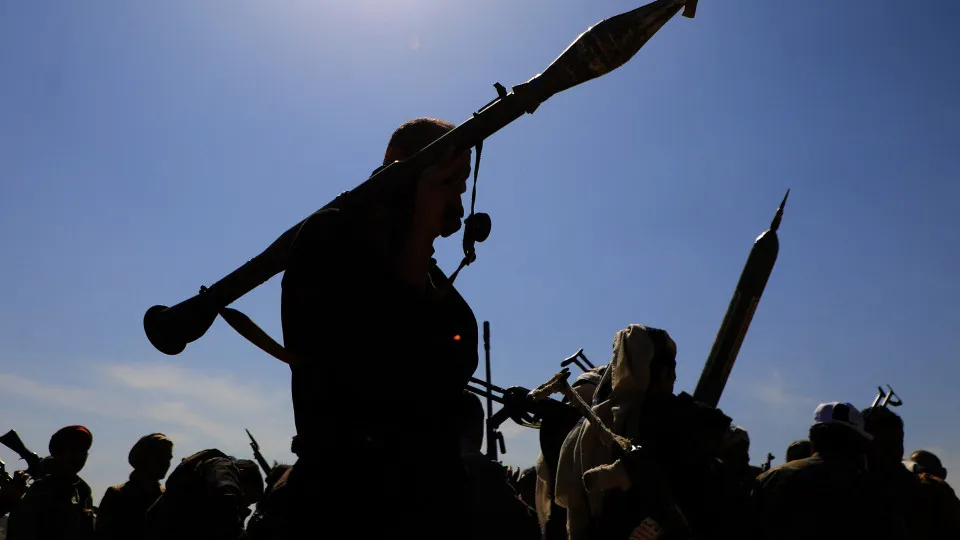
Egypt authorized President Abdel Fattah al-Sisi to provide military support to Saudi Arabia in the Yemen conflict, which the Houthis rebels considered a declaration of war.
© MOHAMMED HUWAIS/AFP via Getty Images)
27/10/2026
by
Lusa
Othe Yemeni Houthis rebels today qualified as a declaration of war the authorization given to the Egyptian president to provide military support to Saudi Arabia, which fights the pro-Iranian movement alongside the Yemeni government.
The Egyptian parliament authorized on Monday Abdel Fattah al-Sisi to “take the necessary measures to support the Saudi kingdom”, according to an official statement, in which the exact nature of this assistance was not specified.
Egypt and its parliament “so declare the war on the Republic of Yemen, simultaneously rendering an immense service to Israel,” said Mohammed Ali al-Houthi, a member of the political office of the Houthis, quoted by the French agency AFP.
Al-Houthi denounced that Egyptian support was announced at the time that the Saudi, Pakistani and Turkish Defense Ministers were in Tehran to present themselves as a “peaceful force concerned with peace in the region”.
Saudi Arabia, Pakistan and Turkey concluded in August a defense agreement known as the Mecca pact, for having been signed in the most sacred city for Muslims.
“An armed attack on one of the founding states should be regarded as an attack on the three,” the pact establishes, according to its website, as in Article 5 of NATO.
“We are not afraid of any alliance,” added Al-Houthi on social networks.
The conflict between the internationally recognized Yemeni government and the Houthi began in July, after years of calm, opening a new front in the Middle East war.
Hostilities gained intensity in September, with the capture of the Yemeni coast in the Red Sea by pro-Iran fighters and attacks of an unprecedented size against the kingdom, in particular oil infrastructure and airports.
The Houthi offensive allowed them to control the Bab el-Mandeb Strait area in the Red Sea, linking Europe and Asia via the Suez Canal.
Bab el-Mandeb assumed greater strategic importance for oil producing countries, in particular Saudi Arabia, after Iran blocked the Strait of Ormuz on the eastern end of the Arabian peninsula.
The blockade of Ormuz, through which one-fifth of the world's oil products moved, was one of Iran's responses to the war that the United States and Israel initiated against the Islamic Republic in late February.
Saudi Arabia is the largest supporter of Yemen's legitimate government and actively participates in the ongoing war against the Shiite Houthis rebels since 2014.
Egypt has not joined the Mecca defence pact, but Saudi Arabia, which has so far called for aid from the United States in vain, is also an essential support from Cairo.