
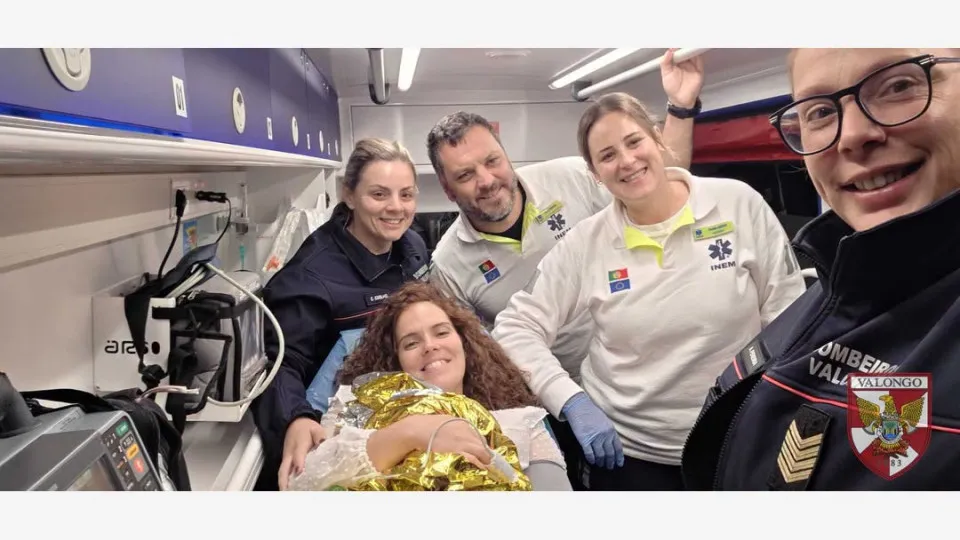
A baby was born in an ambulance from the Valongo Volunteer Fire Department early on Wednesday. The little Duarte did not wait for the arrival of the hospital and the delivery ended up in the barracks of the corporation.
© Valongo Volunteer Firefighters/Facebook
04/11/2026
by
Um baby “did not want to wait for arrival at the hospital” and was born in an ambulance of the Volunteer Firefighters of Valongo, during the early hours of Wednesday.
“ Tonight, we had a very special occurrence... those that don’t happen every day!”, started by highlighting the corporation in a publication on social network Facebook.
“The little Duarte decided he didn’t want to wait for the hospital and that the best place to come to the world was really our barracks!”, he adds.
The baby was born at 5:05 on Wednesday in an ambulance of the Volunteer Firefighters of Valongo, “making this morning unforgettable” for all operatives.
“ And so, without having to take admission tests, Duarte won the title of the youngest fireman of Valongo!”, reads in the note.
The firefighters left the “congratulations and best wishes in this new stage” to the parents of Baby Duarte, whom they desired a “life full of health, joy and adventures”.
“P.S.: Duarte, when you grow up, you know where the barracks are... your first visit is already marked!”, they played.
Parted in ambulances more than doubled in 2025
At least 60 babies were born in ambulances in Portugal in 2025 alone. This is an increase of 114%, since in 2024 28 births had been registered in these circumstances, according to data from the National Institute of Medical Emergency (INEM) sent to the public. There's still 23 births on the public road.
Of all deliveries in ambulances and public roads, almost half (36) occurred in the region of Lisbon and Vale do Tejo.
In January, however, the Minister of Health, Ana Paula Martins, argued that the number of births outside the hospitals in Portugal is similar to that of the last decade, most occurring at home.
“ The numbers are similar to the last years, except for the pandemic in which there were more extra-hospital deliveries, for the reasons that are understood. Therefore, there is no major change in the number of out-of-hospital deliveries. That is, the number is significantly the same as in the last decade,” the minister said after attending the “Future Health in Europe” conference in Porto.
According to Ana Paula Martins, “most of the out-of-hospital deliveries do not occur on the public road, fortunately, nor do they occur in ambulances. It occurs at home”, adding that, for this reason, “INEM [National Institute of Medical Emergency] ends up being called to solve situations that are complicated”.