
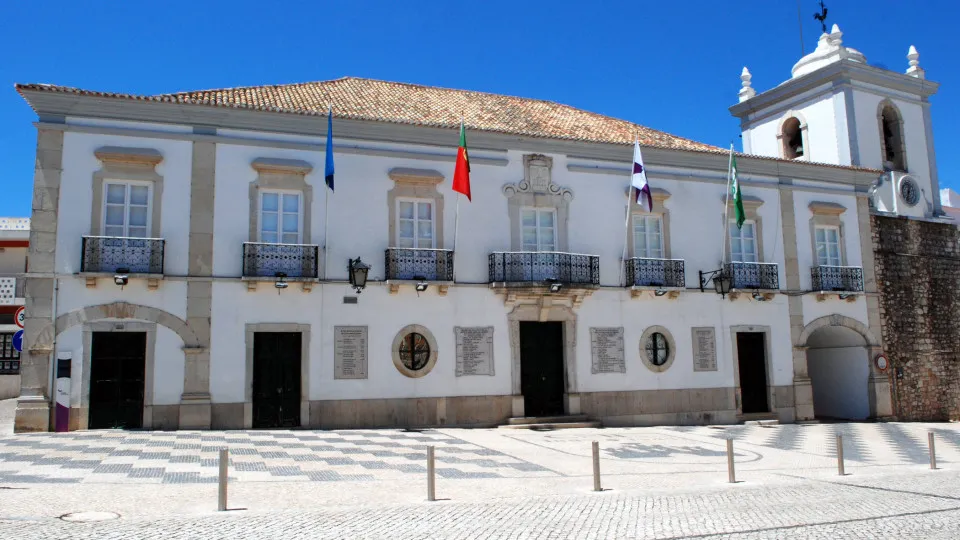
The House of Loulé communicated to the Government its “frontal opposition” to the installation of a waste incinerator in the municipality, demanded an independent verification of the Sotavento Sanitary Land and wants to avoid negative impacts of the future desalinationist of the Algarve.
© Loulé City Hall
02/11/2026
by
Lusa
Camera of Loulé
A Câmara de Loulé informed the Government of its “frontal opposition” to the installation of a waste incinerator in the municipality, demanded an independent verification of Aterro Sanitário do Sotavento and wants to avoid negative impacts of the future desalinationist of the Algarve.
In a formal position sent to the Minister for Environment and Energy, Maria da Graça Carvalho, Mayor of Loulé, Telmo Pinto, refused the impact of these three regional infrastructures and rejected the “successive concentration of equipment with relevant impacts on the same territories, without assessing the cumulative effects, the load capacity of each municipality and the fair distribution of the charges”.
The Minister of Environment announced that the Portuguese Agency is studying the best solution to create an energy recovery unit for waste in the Algarve, but the House of Loulé wants a meeting with the guardianship and technicians about the installation of a new incinerator in the municipality or the strengthening of the co-incineration of municipal waste in the production center of the CIMPOR already existing in the municipality.
The autarca also wants to know how the waste is treated in the Aterro Sanitário do Sotavento, located in the parish of Salir, also in the municipality of Loulé, and on the effects that the future Essalinização de Água do Mar do Algarve, under construction in the neighboring municipality of Albufeira, will have on the louletana coastal front.
“Loule is not, or will be, a territory of unlimited availability to receive what no one else wants. We have already welcomed the landfill of the region for more than two decades, we have a desalinizer next to us whose effects on our sea are still to be demonstrated and now they want us to accept burning the waste of the Algarve”, criticized the mayor of Loulé, quoted in a communiqué of the municipality.
The municipality expressed its “injunction” to the installation of a waste incinerator in the municipality, considering that it would cause more “air emissions, more heavy trucks crossing the county, waste storage, fire risk, water consumption in a region in water scarcity, noise and public health”.
The Algarve municipality advocated a greater focus on prevention, selective collection, biowaste and recycling, arguing that “burning does not solve what has not been separated”, and recalled that “this is also the way Europe points out,” requiring 65% of municipal waste to be recycled by 2035, a year when landfilling cannot exceed 10% (currently in the Algarve is 85%, above 56% of the national average).
The House also wants an independent verification of how waste is deposited in Sotavento’s Sanitary Landfill, where over the years the House “identified discharges of leachates, problems in water quality, treatment capacity and geotechnical stability, dispersed waste, odors and heavy traffic”.
“The Environmental Impacement Declaration, which is conditional on the new D Cell issued on May 27, 2026, does not in itself prove that the required measures are implemented. Loulé therefore asks for an external and independent entity verification and access to all documentation: contracts and reports of independent supervision, minutes of the Monitoring Committee, monitoring data and the state of play of each conditioner, with responsibility and deadlines”, he called.
Loulé also defended the need for the Algarve’s new desalinizer “to protect the beaches, the fishing and the economy of those living from the sea”, demanding a “founded response” on its impact on the coast of the “principal tourist destination of the country”.
“ We ask for solidarity, but mutual solidarity. We do not accept that the benefits are distributed throughout the region and the costs are always on the same side”, the municipality was positioned, stressing that it is necessary to leave “a greener, cleaner and more sustainable Algarve” to the next generations.