
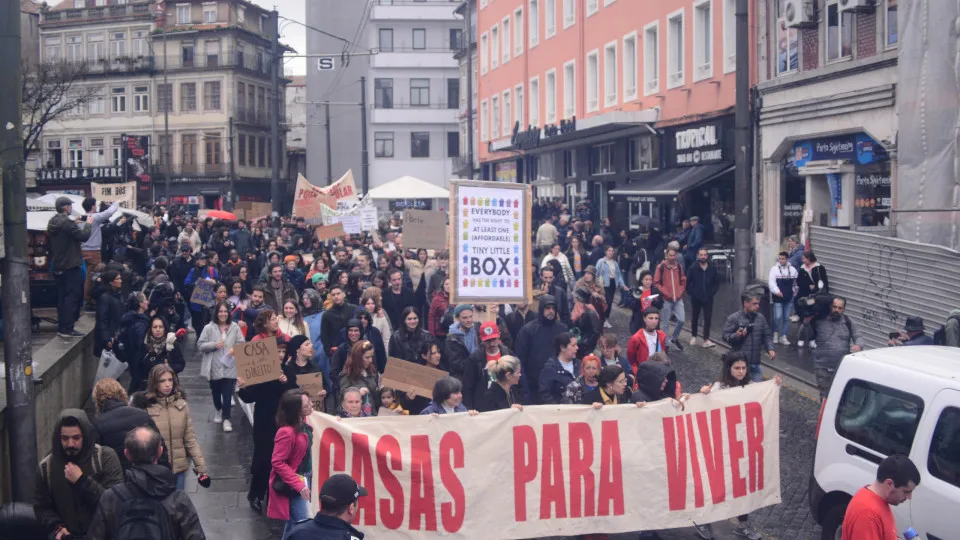
Just minutes from the start of the march by the right to housing, hundreds of people are already concentrated in Batalha Square, in Porto, in an initiative of the movement that has promoted camped in the city center.
© Getty Images
31/10/2026
by
Lusa
A minutes of the start of the march by the right to housing, hundreds of people are already concentrated in Batalha Square, in Porto, an initiative of the movement that has promoted camped in the city center.
“Fighting for housing, defending the Constitution (Article 65)” is one of the phrases of the banners that protesters display, a phrase that summarizes the claims that have led to the streets, for several weeks, thousands of people in various cities of the country.
Ambrosio Vaz, 94, was the first to arrive. Bring a sign with the phrase “We fight against rent law. Our fight is serious. If we do not stop them, we will all go to misery” and Lusa confessed that she has a home, “even lives more or less” but is present “for all the children and grandchildren of this country”.
Alongside two young men give the last adjustments to a tent. The green cloth reads: “Real estate land” and “Being a landlord is not a profession”.
John (who did not reveal the surname) was the author of the sentences. A few minutes after the start, he added a new game of words “AL = Threat to the Site”, and told Lusa that he gave up searching for a house in Porto and now lives in the surroundings and left because of the increase in rents.
On the floor there are bombs ready to mark the step, in the lapels red carnations, some helmets on the heads, flags of Portugal and posters with an order: “+ Housing – Stick”.
In Porto, where protests and camps began on the 10th, the start of the march is scheduled for 4:30 p.m., walking the streets of the city to D. João I Square, where, by 7:30 p.m., the usual popular assembly should take place to decide whether or not tents will be set up to stay overnight in the square.
The protesters demand the reversal of the new rental law, the end of demolitions and evictions without an alternative housing, a stop to the purchase of housing by real estate funds, the increase in public housing, the recovery of vacant buildings for housing purposes and ceilings “truely accessible” to income.