
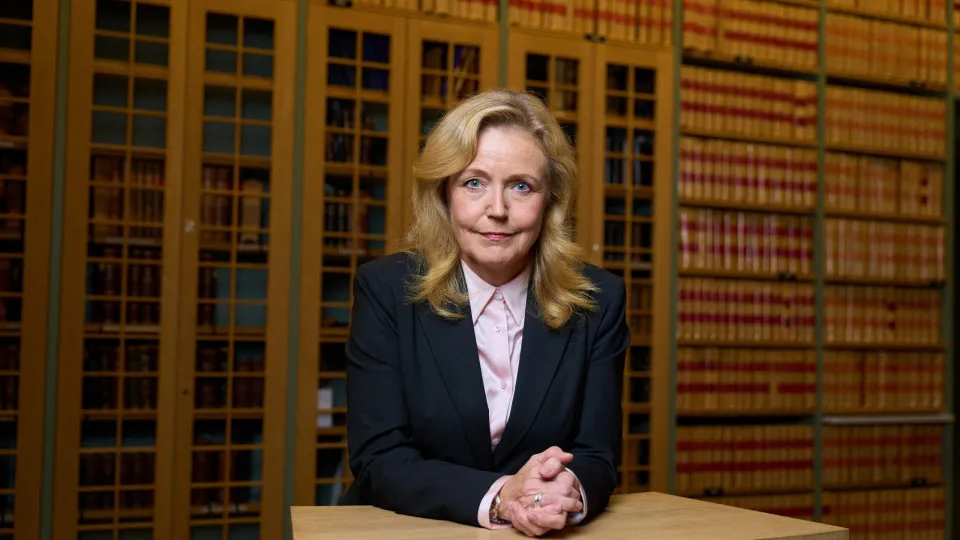
Swedish Members vote again next Tuesday to elect a prime minister, based on the candidacy of Elisabeth Thand Ringqvist, after the September elections, won by the left by narrow margin.
© Erik Flyg/Bloomberg via Getty Images
29/10/2026
by
Lusa
Oswedish Members vote again next Tuesday to try to elect a prime minister, based on the candidacy of the leader of the Centre Party, Elisabeth Thand Ringqvist, after the legislation of September, won by the left by a narrow margin.
While Ringqvist is likely not to get a majority, Parliament’s president, Andreas Norlen, said that it is essential to move forward and “take a vote”.
Norlen added that, if the vote is not successful, he will appeal to the outgoing Prime Minister, Ulf Kristersson, who takes office temporarily, to see if he can form a new government.
The left-wing opposition bloc won three more parliamentary seats than the right-wing bloc, led by Ulf Kristersson, in the September 13 parliamentary elections.
However, opposition leader Magdalena Andersson twice tried to form a government and gave up.
To try to overcome the impasse, since none of the coalitions, left or right, obtained a majority, the President of Parliament asked Thand Ringqvist to explore the conditions for a “centre option”.
Ringqvist presented the idea of a “central” government that included traditional parties, but excluded the Left Party and the Swedish far-right Democratic party, hostile to immigration.
The Centre Party refused to cooperate with the Swedish Democrats, making it virtually impossible for the right-wing bloc to obtain a majority in parliament.
In addition, the Centre Party also refuses to support an executive including the Left Party.
The President of the Swedish Parliament may propose a candidate for the office of Prime Minister up to four times; after that limit, new elections must be convened.
A first attempt failed on October 15, when Magdalena Andersson, leader of the Social Democratic Party, failed to obtain support from the deputies.
The President of Parliament may also ask certain candidates to monitor the possibilities of forming a government without immediately submitting them to a vote in plenary.
Political analysts predict that parties will be under increasing pressure to yield to their “red lines” policies as they approach the risk of new legislative elections.
Sweden is accustomed to these long negotiations: it took 37 days to form a government after the elections of 2022, and 134 days in 2018.