
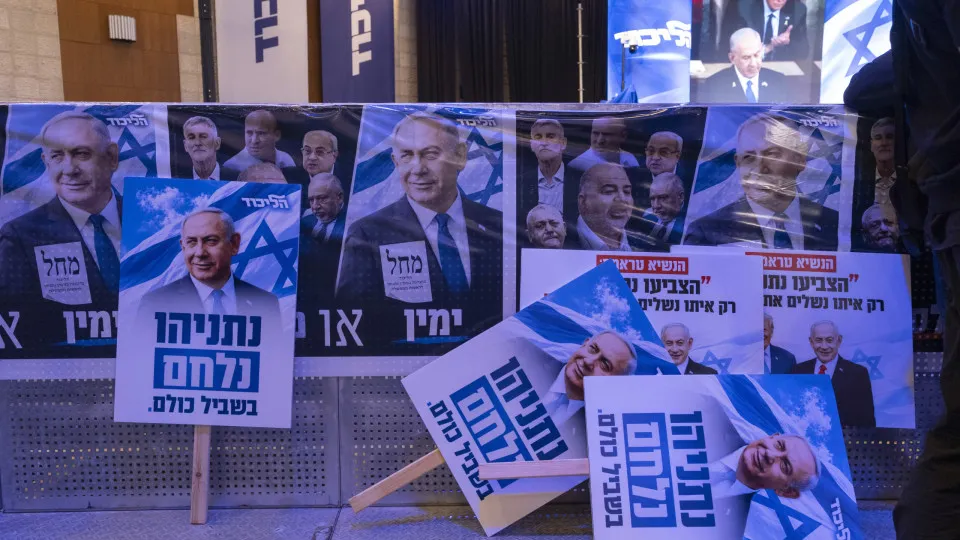
The parliamentary elections in Israel ended with the two tied blocks, paving the way for scenarios such as coalition, minority government, national union or new elections.
© Katrine Dige Houmoller / Middle East Images / AFP via Getty Images
27/10/2026
by
Lusa
Otwo competing blocs in the elections in Israel are almost tied, according to the first projections, with a slight advantage to the opposition, which was in a better position to raise any new partners.
With 52 seats estimated for the so-called block of change, led by the Yashar party! of former General Gadi Eisenkot, and 50 for the pro-government bloc, led by Prime Minister Benjamin Netanyahu, are far from the 61 needed to get the majority in the Knesset (parlamento), composed of 120 seats.
Here are the four main possible scenarios cited by the French agency AFP:
A coalition is formed
After the official proclamation of the results, within a few days, the President of Israel, Isaac Herzog, will instruct a candidate to form a government — the one considered the best placed to gather at least 61 deputies.
Negotiations will then begin, usually long and arduous. At the end of the previous elections in 2022, Benjamin Netanyahu took 58 days to form a coalition.
If Netanyahu's Likud is once again the party that gets the most seats (24 or 25, according to the projections), it will also be the one whose block will have more difficulty in expanding beyond its far-right and ultra-orthodox allies.
The Gadi Eisenkot camp, on the other hand, can count either on desertions in the prime minister's camp or on the votes of the Arab parties.
The two Israeli Arab lists will in fact be able to win a record number of seats, according to the first polls at the mouth of the polls, with an estimated number of Members from 17 or 18.
Israeli political history is rich in twists, so desertions or other changes in alliance cannot be excluded.
A minority government
If no bloc can bring together the “magic number” of 61 parliamentary seats, a minority government can be formed, with the punctual support of some deputies.
Also in this scenario, the two Israeli Arab lists stand out as possible decision-makers.
The Ra’am party (United Arab List) of Mansour Abbas (with a seven-seat forecast) expressed its willingness to collaborate with the Gadi Eisenkot bloc, and the Joint List (which brings together three Arab majority parties) proposed, for its part, to provide a “security net” to any coalition that would drive Netanyahu away from power.
However, the main figures of the opposition bloc were reluctant during the campaign to assume this hypothesis publicly due to the hostility of much of the Jewish electorate towards any form of alliance with the Israeli Arabs.
Netanyahu is well aware of this and has therefore focused his campaign on a possible cooperation between the Eisenkot bloc and the Arab parties, which he presents as the alliance of the “left and Muslim Brotherhood” that threatens the survival of the State of Israel.
A Government of National Union
This hypothesis seems unlikely, given the extreme polarisation of the political landscape in Israel. However, the union of the so-called “Zionist” parties, excluding the Arab and ultra-Orthodox formations, is regularly referred to by analysts.
A poll published in mid-October indicated that 55% of respondents would prefer a government of national union to new elections if the elections did not result in a clear majority.
This scenario has a recent precedent: in 2020, Netanyahu and centrist Benny Gantz, despite their deep enmity, reached a power-sharing agreement after three elections in less than a year, which anticipated a rotation in the position of Prime Minister. But the alliance broke down after a year, leading to new elections.
In recent days, some media have said that President Isaac Herzog would be working behind the scenes on an approach between Netanyahu and Eisenkot with a view to repeating the experience in the event of an impasse.
But this hypothesis would face a strong rejection in both camps, particularly in the Eisenkot-led bloc, which turned this vote into a referendum against the outgoing Prime Minister.
An impasse and new elections
If no candidate can form government, the Israeli population will have to return to the polls.
The country held four elections between April 2019 and March 2021 due to the inability of the political forces to agree on a common sustainable project.
The candidate appointed by the President shall in principle have 28 days to form a coalition with a possible extension of 14 days. In the event of failure, further procedures may be initiated before any dissolution of the Knesset.
A new campaign would prolong political instability in a country still marked by the consequences of the attack by the Palestinian extremist group Hamas on 7 October 2023 and the various fronts of conflict that Netanyahu's executive has opened in the last three years.
In the meantime, Netanyahu would remain interim prime minister.
Today's elections were the first electoral act since Hamas attacks that in 2023 struck Israel and destabilized the Middle East.