
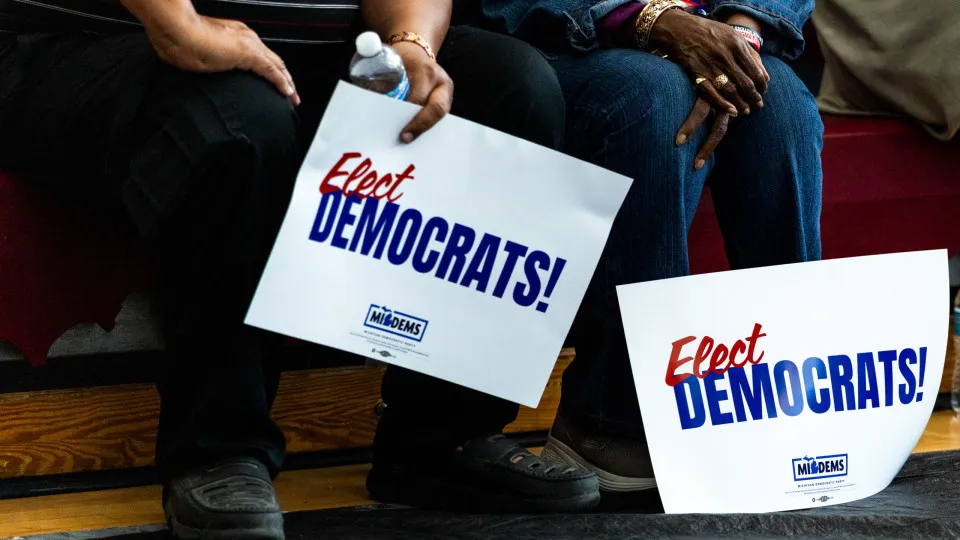
A court suspended a court order that prevented the government from demanding the disposal of votes and criminal proceedings against election officials in mid-term elections.
© Emily Elconin/Bloomberg via Getty Images
03/11/2026
by
Lusa
Ua u.s. court of appeal decided today in favor of the government, suspending a provisional judicial order that prevented the authorities from demanding election officials to dismiss votes and threaten with criminal actions arising from the interim elections.
A few days after a district judge had banned the Departments of Justice and National Security from demanding that election officials from any state “separate ballots, remove voters from electoral records or interrupt the processing of votes”, the Court of Appeal of the Ninth Circuit blocked this decision today, while voting for the decisive mid-term elections.
The Department of Justice had requested the blocking of the decision, Friday, which prevented Donald Trump’s administration from “threating” or “intimidating” state and local election officials.
The district judge’s decision arose after a lawsuit brought by a coalition of trade unions and civil rights groups — including the League of Latin American Citizens.
These groups claim that the conduct of Donald Trump’s government violates the Law of Voting Law and constitutes an “unconstitutional interference in state control over the electoral administration”, which is the responsibility of the states.
The goal, according to the government itself, is to prosecute electoral officials for “not doing enough to prevent illegal voting”, by non-citizens.
The Republican government has made the search for non-citizen voters a priority this year, although the problem is extremely rare. The Justice Department has accused about 90 people of various types of electoral irregularities to date, including 50 suspected of voting without being citizens.
In the presidential election of 2024 there were over 227 million registered voters in the country.
In July, Homeland Security Secretary Markwayne Mullin sent letters to California, Nevada, New Jersey, and Pennsylvania authorities, claiming that up to 250,000 non-citizens were registered to vote in those states. At the time, the local electoral authorities received the claim skeptically, including the California Secretary of State.
In the same month, the Republican administration claimed that Nevada had 1,500 non-citizen voters in its records. However, after identifying these people by the state, it was found that the real number of non-registered citizens was zero.
To identify non-citizens on voters' lists, the Justice Department has asked states for detailed information about voters — including birth dates, addresses, driving licence numbers and parts of Social Security numbers.
Some states governed by Republicans provided information, crossed with a database of the Department of Homeland Security.
The Department of Justice filed lawsuits against 30 states and the District of Columbia to obtain this information, but to date it has lost its proceedings.
On Monday, the Supreme Court rejected a request for the annulment of thousands of correspondence votes in California, which Donald Trump's government claimed were from individuals without citizenship.
On the eve of the crucial interim elections, the country’s highest judicial institution refused to intervene in a case involving 20,000 people that the Republican government pointed out as non-citizens present in the state’s electoral records — a mostly Democratic bastion.
Today's interim elections will determine the composition of Congress during the last two years of the current presidential term.