
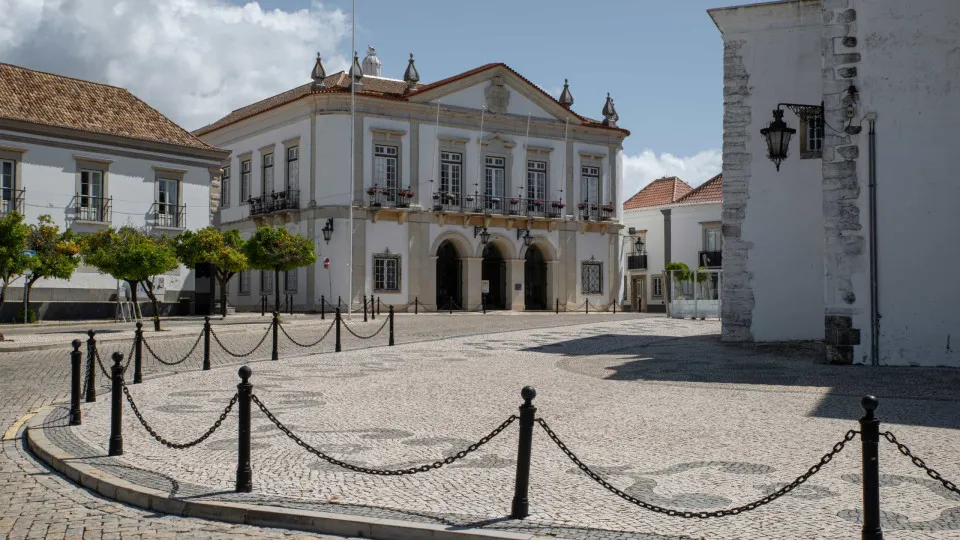
The House of Faro wants to invest EUR 15 million in implementing a plan to mitigate urban floods, especially in critical areas, in a project that also includes replacing part of the water distribution network.
© ShutterStock
23/10/2026
by
Lusa
A This appropriation is intended to cover the financing of the European Regional Development Fund (ERDF) for the period 2014-2020.
The implementation of the general plan for drainage of rainwaters in Faro, presented today, will take place in two phases, the first being “technically much more complex,” said the mayor, António Miguel Pina.
“[The plan] consists of a connection from the São Luís area to the Ribeira das Lavateiras and then, in a second phase, also in the treatment of this area of Ribeira das Lavateiras. This is the project. There are, in a first phase, 10 million, in a second phase, another five million”, detailed the mayor.
The second phase, whose project is being completed, will be linked with the project of Alameda 21, which includes the creation of an urban park in the Penha area, next to the Ribeira das Lavateiras, added.
The aim of the plan is to eliminate systematic flooding in the São Luís area, where there are several small businesses that suffer losses frequently, and to help mitigate the problem of water accumulation also in the Penha area.
During the presentation, listing the floods registered in that area of the city since 2021, the specialist José Saldanha Matos considered that the sum of the damage already caused in these years reaches values “relatively close to the 10 million euros”, which is the investment planned for the first phase.
The professor of education, founder of Hydra, company responsible for the preparation of the plan, stressed that this is an integrated and strategic plan, recalling that it is not a plan whose execution is completed in two years (estimated time of the work), pointing to its total achievement in a period of 10 years.
Asked by journalists about whether their execution ensures that floods do not occur again in São Luís, Saldanha Matos replied that, in a return period of 100 years, given the forecast effect of climate change and rising sea level, there is a “practically absolute” guarantee that the intervened area will have no more floods.
But he left a warning: “Now, what does that imply? It also implies that the system is maintained. [...] Therefore, maintaining this security is guaranteed. Now, what we are doing here is part of the plan, the plan does not end here ", stressed.
On the occasion, the expert Filipa Ferreira noticed that it is a “difficult to do” work and to a very high depth, so the goal is to “open and close” as the works advance, to “not leave the city gutted”, noting that it is expected in São Luís the placement of “many large grids, from walk to walk”, to intersect the water and make it reach the collector.
Present at the session were also traders with business in Rua de São Luís, who, although they have been waiting for years for the situation to be resolved, were concerned about the timing of the works and the impact it will have on their business.
Owner of a pastry shop in Rua de São Luís, Elisabeth defends the urgency of the work, but remembers that it has to be done in the shortest possible time for the businesses that exist there do not disappear.
“(...) Because if not, small businesses will die, if the work is not completed as long as possible”, he insisted, remembering that in order to manage his business, it is necessary to know the duration and timing of the work.