
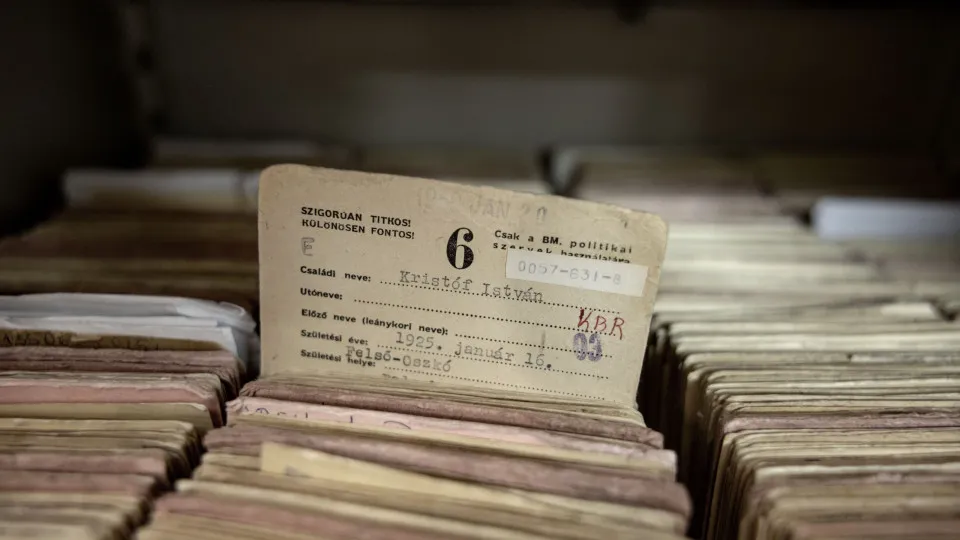
Hungary has opened access to the political police archives of the Communist era, revealing the names of 50,000 informants and allowing analysis of the repressive past of the country.
© Janos Kummer/Getty Images
04/11/2026
by
Lusa
A Hungary today opened access to the archives of the political police of the Communist era, containing names of tens of thousands of informants, allowing us to analyze the repressive past of this country of the Warsaw Pact controlled by the Soviet Union.
“ After 36 years, we finally fulfilled one of the fundamental promises of the 1990 regime change, a promise that was later renegade,” said 45-year-old Hungarian Prime Minister Peter Magyar, who defeated Nationalist Viktor Orbán in the April parliamentary elections.
A digitized database, which contains the names and processes of between 50,000 and 60,000 former informants, was made available online on an Internet site created for this purpose at 10:00 a.m.
“Better late than never. We now have access to much more information than before about those the authorities have recruited,” said historian Laszlo Eorsi of the 1956 Institute Foundation, quoted by the French news agency AFP.
A second series of files, which provides more details on about 9,000 of these informants, will be available in February — the time required for the removal of certain information, such as sexual orientation.
“ A significant portion of the dossiers of the late 1970s and the 1980s is incomplete, mainly because these people were still active” at the time of the democratic transition, explained Bendeguz Gergo Cseh, the director of the archives.
Some public figures — including political authorities, clergy members and television personalities — were identified in the register.
However, according to Cseh, “a large part” of the informants were probably “people who had no prominence in national public life but who worked as drivers of tractors, bar owners or weavers”.
The Hungarian Government will create lines of assistance to provide psychological support to the affected.
“ After today’s revelations, a large number of families will have to deal with information difficult to bear,” Peter Magyar admitted, asking the population to receive this information with “dignity and humanity.”.
Hungary lived between 1949 and 1989 under a single party regime that suppressed any dissent.
As in other countries of the former Communist bloc, the authorities used a wide network of informants to monitor the population.
These individuals were often recruited under duress and charged with reporting any sign of disloyalty between colleagues, friends and even their own families.
According to estimates from the national archives, the secret police used 150,000 informants over four decades; however, only about a third of them remain.
It is believed that many dossiers were destroyed during the 1956 uprising or at the fall of the regime.
This sensitive theme has generated unrest in Hungary since the fall of communism.
In 2002, a few weeks after he took office, socialist Prime Minister Peter Medgyess found himself in a compromising situation after the revelation that he had worked as an agent.
The case triggered new calls for transparency and, in 2003, the Hungarian parliament passed a law that allowed people who were being watched to find out who had provided information about it.
For the rest, access to the dossiers was limited to researchers, subject to authorisation.
Historians warned against the temptation to judge people only on the grounds that their names are on lists of informants.
“ I know several cases where a person was recruited, but did not provide information and took a huge risk turning against the authorities,” Eorsi noted.
The opening of the dossiers is expected to create tensions in the coming months in Hungary.