
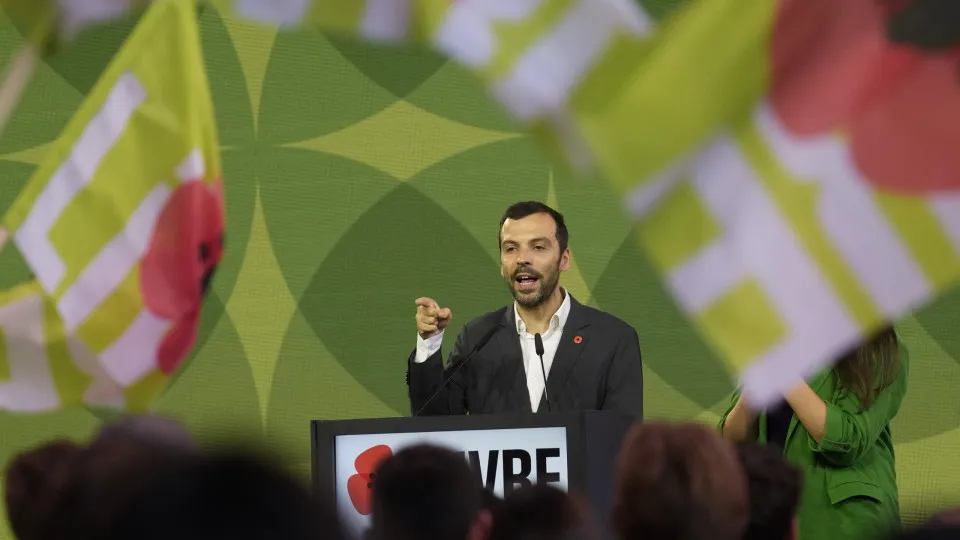
Free co-voice, Jorge Pinto, defended the reduction of the normal VAT rate from 23% to 21%, claiming that it is an effective measure to benefit the middle class.
© Horacio Villalobos#Corbis/Corbis via Getty Images
14/10/2026
by
Lusa
O the free co-voice holder, Jorge Pinto, today insisted on defending a measure that lowers the normal VAT rate from the current 23% to 21%, claiming that this is an effective way to benefit the middle class.
In his speech in plenary, during the period of political statements, Jorge Pinto recalled that the normal VAT rate remains in the current 23% since the governments of José Socrates (2005/2011) and considered that the path to its reduction is feasible and, above all, essential in a country with “an increasingly compressed middle class”.
The former presidential candidate supported by the Free advocated that it was possible, in terms of public finances, to lower the normal rate of VAT “progressively”. A progressive decline by 0.5 percentage points each year, until it is finally set at 21%. It also claimed that most European countries have a normal VAT rate of 21%.
On the other hand, the Free Co-President criticised the government’s decision to go “blindly” and cross-sectionally down the IRC, extending this reduction to all companies, including the larger ones, instead of benefiting, for example, only small and medium-sized ones, and those reinvesting their profits.
In a speech dedicated to the question of “increasing the cost of living”, Jorge Pinto made an allusion to the thesis defended by Luís Montenegro, when he was the parliamentary leader of the PSD, in a government headed by Pedro Passos Coelho. The current Prime Minister then said that “the country was better, but the Portuguese did not.”.
Jorge Pinto, in his speech, introduced a change. He said: “The country is not better and people are even worse.”.
On the political level, the Free Co-President sought to associate the Aquist, the Liberal Initiative, PSD and CDS. He then invoked that Mr Melo recently said that small and medium-sized enterprises do not contribute to the increase in national productivity.
Jorge Pinto also criticised the Government's proposal to revise the lease law, considering that it will facilitate evictions by disprotecting tenants and benefiting landlords, but also the process of privatization of TAP.
“ Being able to think of a public TAP in the service of the country, world-class and leading the ecological transition effort in the aviation sector, the government chooses the easiest: Sell”, he said.
Faced with this speech, PSD deputy Martim Syder took Jorge Pinto’s criticism of TAP’s current privatization process to speak of “lack of notion” by Livre. In the same sense, the Member of the Liberal Initiative Jorge Miguel Teixeira referred with irony to the idea that TAP exclusively public company is a “launch point” of an energy transition model.
“ But whose money is all this? Who pays?” asked the Member of the Liberal Initiative, addressing the presidential candidate who was supported by the Free.
For his part, João Tilly referred to Jorge Pinto as “a deputy of the extreme left”. In his question, the Member elected by the circle of Viseu took Free's criticism of the government's proposal to revise the rental law.
“ The culprits of the housing crisis are you. They put about two million immigrants here, who have to live somewhere,” he said.
João Tilly also accused the Free of wanting to lower productivity with “the four-day week” in the public service and with the decrease of weekly hours from 35 to 30 hours a week. Jorge Pinto contrasted that existing data prove that productivity increases when these measures are taken to review working times.
The deputy of the CDS João Almeida accused the Free of wanting to “level down in the economy”, contrasting that the largest national companies are precisely “the ones that pay better wages and create more jobs”.