
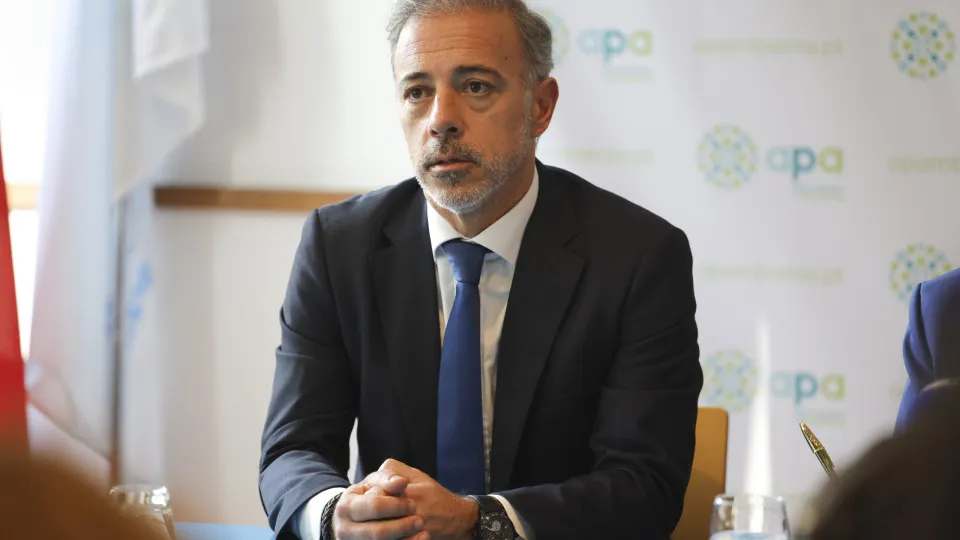
The mayor of Porto, Pedro Duarte, said today that “democratic normality” was restored in the city after the withdrawal of protesters from Praça D. João I, in Porto, after an ultimatum of PSP for its demobilization.
© Getty Images
20/10/2026
by
Lusa
O mayor of Porto, Pedro Duarte, said today that “democratic normality” was restored in the city after the withdrawal of protesters from Praça D. João I, in Porto, after an ultimatum of the PSP for its demobilization.
“ Yes, the information that I have is that everything has actually taken place within a normalcy that must be welcomed and, therefore, I commend this fact, I think that democratic normality, so to speak, is restored in the city of Porto”, said the mayor to journalists outside the City Hall.
Pedro Duarte (PSD/CDS-PP/IL) also said that “the right to the demonstration remains intact, as it has always been”, and stressed that the withdrawal of protesters took place “orderly and that they followed the orders of the authorities”.
“ We do not fail to listen to what is the concern of many people, particularly about the problem of housing, but all this is done within a framework of normality and legality”, he stressed.
Pedro Duarte said he hoped that the square, however subject to cleaning and sanitizing work, would return quickly to be available for public enjoyment, although, at the beginning of the morning, access to the site was sealed with bars.
The mayor acknowledged as legitimate the concerns expressed regarding the housing crisis, but said he had difficulty understanding some of the criticisms addressed to the House, despite being available to hear proposals.
“ I'm ready for a work meeting to hear proposals, listen to suggestions. The municipality has not yet received a response from the movement to the proposal for a meeting ", said.
He stressed that the municipality of Porto is “by far what has in fact the biggest bet in terms of public housing”.
“ We have about 13% of our population living in public housing, namely municipal, with an average income of around 78 euros, while the national average is 2%,” he said.
The mayor has still stated that he does not recognize democratic legitimacy to the popular assemblies, “or something like this”, saying that they are not part of the Portuguese constitutional framework.
Asked about the possibility of the demonstrators returning to the square at 7:00 p.m., as they announced, said they expected the completion of the cleaning work by that time, noting that the decision depends on the authorities responsible for the work and the security assessment by the police authorities.
On the police charge in the early hours of Thursday, he said he had confidence in the authorities, but pointed out that inquiries are taking place to ascertain what happened.
“The police have to submit to this,” he said, adding that it is not up to him to judge the police action, since he did not protect the PSP and was not present.
Pedro Duarte reiterated that “the aim of the House is to ensure that the square remains a public space accessible to all”, stressing that the way in which the withdrawal of protesters was carried out “is not the direct responsibility of the municipality”.
The protesters in favour of more housing were surprised, this morning, by the order given by the PSP to demobilize from Praça D. João I, stating that the police gathered a large number of agents of the intervention body.
“ We were surprised [about 5:00 a.m.], we could do nothing else, it was not our intention not to follow orders. Even obeying what happened” last week, when the PSP “brought violence on the way out of the young people”, Lusa told one of the protesters who did not want to identify.
The same young woman added that those present this morning were all very young and did not intend to keep “criminal record” at this stage of her life.
“Our cause is just and peaceful,” he added.
A total of 35 people voted on Monday, in a popular assembly, to remain camped in Praça D. João I, where for more than a week there is a protest for housing.
Instead, votes for solidarity were approved with the camp in Lisbon and other parts of the country, as well as the articulation with associations of university students in the struggle for housing and tuition, which were unanimously accepted.
It was also approved by a majority of about 300 people present, a joint vote for an Iberian general strike.