
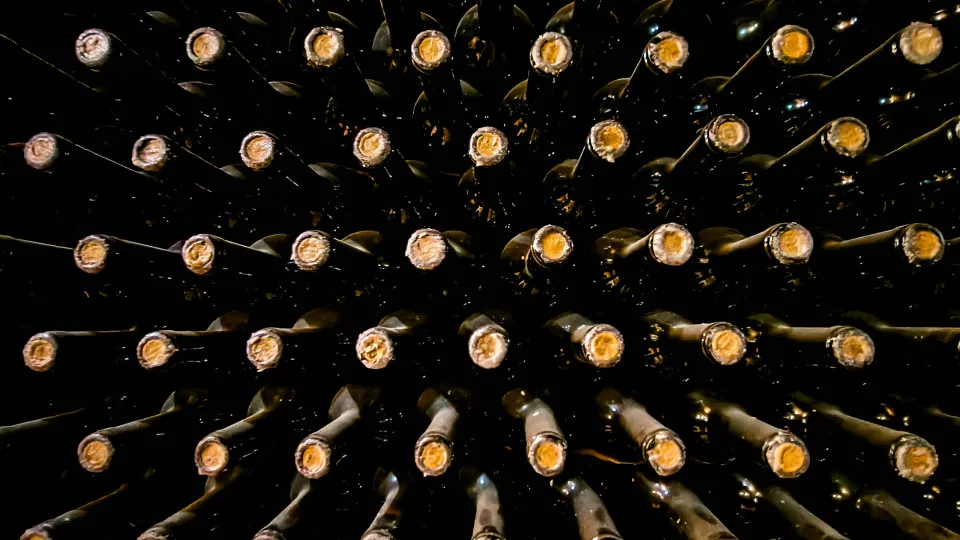
A lighter bottle of wine that aims to reduce costs to producers and carriers and reduce environmental impact should be on the market next year, the Alentejo Regional Wine Commission (CRVA) announced.
© Shutterstock
23/10/2026
by
Lusa
Uthe Committee on Agriculture, Fisheries and Rural Development has announced that the Commission will be able to take account of the need for a more flexible approach.
The “Level Bottle of Alentejo” is a 390 gram glass bottle developed by CVRA in partnership with the Portuguese subsidiary of the Spanish glass company Verallia and producers of the region.
The project used as a reference the maximum weight of 420 grams that retailers and world producers subscribing to the Bottle Weight Agreement of the Round Table of Sustainable Wine determined as desirable for a glass bottle of 750 milliliters of wine, against the current average of 550 grams.
“ It is a guarantee that supermarkets are looking for and it is even lower, so it is a commercial argument that is an advantage,” said the president of CVRA, Luís Sequeira, during a presentation event in London.
The responsible added that “the novelty is that it is a region that assumes this goal”, seeking effects of scale difficult to achieve by a single producer and that can particularly benefit small wine growers.
The new packaging was designed to be compatible with high-performance bottling lines, i.e. with more than 10,000 bottles per hour, allowing savings in the consumption of raw materials and energy, as well as in greenhouse gas emissions.
If the annual target of 50 million bottles is reached, this measure can save about 1.5 tons of glass and 1.2 tons of carbon footprint per year, the CVRA estimates.
A market study indicated that most respondents (72%) did not associate bottle weight with quality, a “myth” in the sector.
However, the CVRA Sustainability Coordinator, João Barroso, said that a lighter 310 grams model was rejected by producers for being lower, a characteristic associated with lower quality wine.
The Director of Production and Quality of Adega de Borba, Helena Ferreira, revealed that the cooperative already uses lighter bottles and that the reduced weight “was an important point” to win a contract with the Lidl supermarket in the UK.
“ The most important thing in this project was to have a commercial bottle that works with distribution. This bottle is the balance between both, a lighter but marketable bottle ", vincou.
The tests to assess bottle strength on long logistics channels, namely the risk of breaks, will begin in the first quarter of next year.
The idea of the “Little Bottle of Alentejo” is part of the Alentejo Wine Sustainability Program, whose members have averaged a reduction of up to 30% in water consumption and 20% in energy consumption in the last five years.
Last year, CVRA launched another initiative, ‘Re:Boxed’, a transport box from the recycling of wine label tapes, in partnership with Particle Verde.
In the future, I look forward to the end of the use of the cork protection capsules, having embossed in relief in the marisa (front in the neck just below the mouth) the inscription “Vinhos do Alentejo” – only visible without the capsule.
While recognizing some resistance in some markets, Luís Sequeira pointed out that “things are changing very quickly.”.
“The CVRA has an obligation to give clues, which then economic agents follow or not, in the sense of saying: this is the path we think we can take,” he said.