
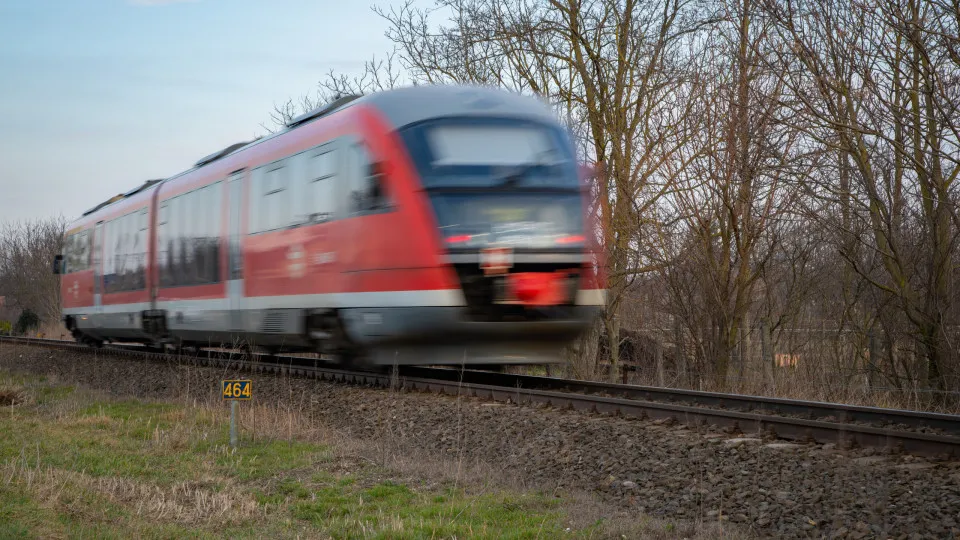
The Government announced that the works of the High Speed Line have already begun, which will allow Porto to connect to Lisbon at about 1:15 a.m. This is an historic step towards mobility in the country.
© Shutterstock
13/10/2026
by
Beatriz Vasconcelos, Lusa
O Government announced, at the end of Monday, that they have already started high-speed works, a link that will enable Porto to connect to Lisbon at about 1:15 a.m. The Executive stresses that this is a “historical step”.
“They started the works of the first section of the High Speed Line, between Campanhã (Porto) and Oiã (Aveiro). One historical step to transform mobility in the country“you can read in a publication shared on social networks.
The government notes that, “with this new railway link, the journey between Porto and Lisbon will last about 1:15, bringing people, businesses and regions closer together“.
“ More than reducing travel times, High Speed will strengthen the link to the future Lisbon Airport and prepare Portugal for further integration into European transport networks, including the future link to Madrid”, adds the Executive of Luís Montenegro.
It also reveals that “in a context where Europe is committed to the railway to meet the challenges of sustainable mobility, this investment will strengthen competitiveness, bring closer territories and prepare Portugal for future generations“.
Minister alerts on costs of “non-decisions” at airport and railway
The Minister for Infrastructure and Housing said, also on monday, that the “no decisions” regarding the new Lisbon airport and at high speed, “had astronomical costs for the Portuguese”.
“ Today we have an airport in Lisbon that is bursting through the seams. We have a country with a railway that suddenly we are making all the necessary investments and who suffers are the Portuguese who use the railway. Those who suffer are the companies that have to use the railway ", said.
Miguel Pinto Luz spoke in Aveiro, during the opening ceremony of the works of the High Speed Line (LAV) between Porto and Oiã (Oliveira do Bairro, Aveiro district).
The minister said it is a day of great happiness, advancing that “with so many decades of indecision, zigzags, inability to realize, this moment is of particular importance“.
“ Nothing is achieved with indecision. We have to find consensus platforms, ability to balance positions, find balances also with the mayors, have the ability to generate around mobilizing projects the necessary and sufficient political will to carry out these projects,” he said.
Shortly before, Portugal’s President of Infrastructure (IP), Paulo Carmona, also touched on this issue, stating that Portugal has “lacked a capacity to decide” in recent years.
“ We all discussed the airport goes to 50 years, the high-speed line 30 years, at least 25 years discussing accessibility to Lisbon, the railway bridges, roads, 25 years with IP3, we had several speeches, the thong, the captivations ", he recalled.
The President of the IP therefore considered that this is above all a tribute to the decision-making capacity and the entry of Portugal into the modernity of the European railway network.
The construction of the Porto – Oiã section benefits from Community support of EUR 450 million and is part of a first phase of the Porto-Lisbon high-speed line, which has already secured around EUR 813 million of European funding.
The future High Speed Line will substantially reduce travel times between the two main metropolitan areas of the country. The global project aims to allow a direct port-Lisbon link at about 1:15 a.m.