
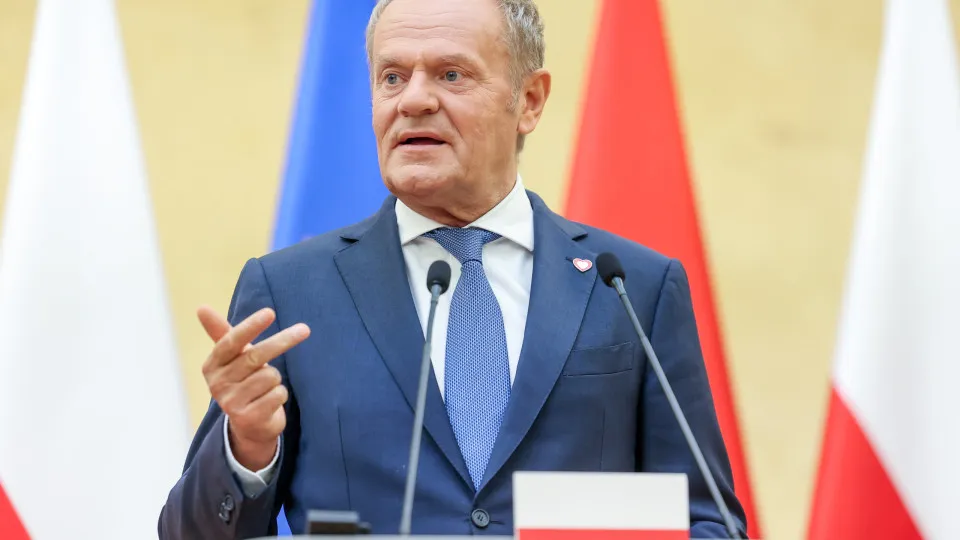
The Prime Minister of Poland announced today that the authorities of the country frustrated, during the night, a further provocation at the border with the Russian enclave of Kaliningrad and initiated a preventive military operation in the area.
© Photo Olimpik/NurPhoto via Getty Images
03/11/2026
by
Lusa
O prime Minister of Poland today announced that the authorities of the country frustrated, during the night, a further provocation at the border with the Russian enclave of Kaliningrad and initiated a preventive military operation in the area.
Donald Tusk said that Polish and NATO secret services have been warning for several weeks of the possibility of “more serious diversions or provocations” taking place at the border with the Russian enclave, including the possibility of “intrusion of armed individuals in Polish territory”.
Tusk claimed to have been informed shortly after midnight of a suspected activity on that border in the north of the country.
Kaliningrad is a Russian territory in the Baltic Sea, separated from the rest of Russia and surrounded by two NATO member countries, Poland and Lithuania.
“ We quickly mobilized the necessary forces and means (...). We managed to prevent attempts at provocation, if that was the intention,” said the Polish Prime Minister at a press conference in Warsaw after the Council of Ministers.
As the Polish leader explained, the detachment includes “a large number of police forces, border guard reinforcements and anti-terrorist forces”.
Tusk, who said he was concerned about the threats, “since they increase month after month”.
The Prime Minister added that the extraordinary deployment will extend until at least 8 November to which soon army personnel, military intelligence services (SWW) and special forces ROM will join, specialising in assaults and command operations.
Considering that “the tension” and “the escalation by Russia” could persist, Tusk called for the maintenance of the level of surveillance of security forces in order to prevent possible sabotage operations or provocations.
The whole operation will be directed from a special state in Warsaw.
The aim of this mobilization is to protect strategic facilities near the Suwalki corridor, the 65-kilometre strip of territory linking the Baltic countries (Estonia, Latvia and Lithuania) to Poland and which is considered a weak point on the eastern flank of NATO.
Poland has denounced multiple attempts at sabotage attributed to Russian secret services against key infrastructures and important points in the military logistics of sending aid to Ukraine, a country with which it borders.
Poland has become the main transit point for Western military and humanitarian aid to Ukraine.
In September, Donald Tusk warned that Russia's plans in the war against Ukraine included hybrid drone and missile attacks against the Allied states of Kiev.
In early October, Russian President Vladimir Putin threatened to use “all the arsenal” available to Russia in the event of an attack on Kaliningrad.
The warning arose at a time when tensions were increasing around Kaliningrad, the former East Prussian Konigsberg, annexed by the Soviet Union in 1945 and which has no direct border with Russia.
In recent months, NATO countries have carried out several military exercises at the Kaliningrad borders, which led Moscow to send them a document condemning an “unprecedented increase in the Alliance’s military activity” along the “Western borders”.
There have also been incidents on the Russian side from this enclave, such as the violation of Polish airspace by a Russian military helicopter at the end of September.