
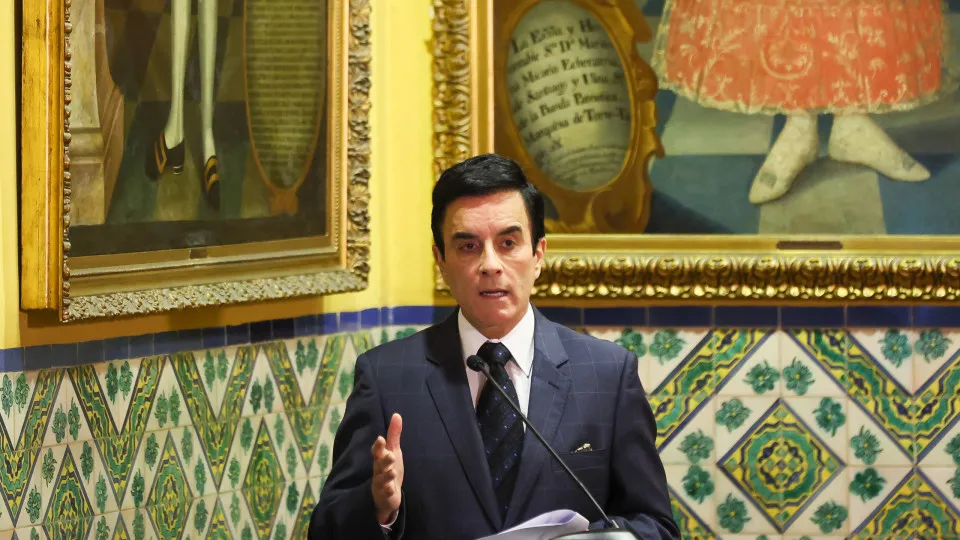
The Peruvian Foreign Minister said today in Lisbon that his country can learn a lot from the security policy implemented by the Government of El Salvador in combating transactional criminal organizations, including drug trafficking.
© Getty Images
03/11/2026
by
Lusa
O minister of Foreign Affairs of Peru today said in Lisbon that his country can learn a lot from the security policy implemented by the Government of El Salvador in combating transactional criminal organizations, including drug trafficking.
Last week, “during a visit with President Keiko Fujimori [who took office in July] to El Salvador, we were gratefully impressed by the Salvadoran prison system,” Carlos said. Espa to the Lusa agency, in the margins of the EuroAmerica Forum 2026, held in Lisbon.
Espá explained that the prison system built by the Salvadoran President's government, Nayib Bukele, is not restricted only to the Terrorism Confining Center (Cecot), which is a maximum security prison.
Cecot eventually became one of the symbols of Salvadoran security policy, which is marked by mass arrests and the hardening of measures against criminal organizations.
Non-governmental organisations (NGOs) criticize the Salvadoran public security model, arguing that they violate human rights, promoting arbitrary prisons, torture and other types of violations.
Cecot also received Venezuelan immigrants – later sent to Venezuela – and Salvadorans expelled from the United States, in an agreement agreed between the Government of the President of the United States, Donald Trump and Bukele, widely criticized by international organizations.
“ There are also other prisons, which the international press does not give much visibility, which work the recovery of prisoners and their social reintegration with activities, introducing professions such as carpentry, through which they manufacture furniture for schools. Very beautiful”, declared Espa.
According to the Peruvian minister, “the government of El Salvador separates prisoners of maximum security – who belong to criminal organizations – from those who are potentially recoverable.”.
“ It is not only the construction of prisons, because it is not only good to build prison centers, they must be accompanied by a prison policy, a reform of the penal code and a series of accompanying policies, such as the accountability of mobile telephony companies so that there is no signal in prisons, imposing very heavy fines. We have much to learn from El Salvador”, he said.
“ In El Salvador we also have a prison policy, educational policies and health policies. For example, in the PISA exam – international examination of the students coordinated by the OECD –, in a short time, there was a great leap [at the educational level] of the children”, he assessed.
For Espa, each country has its realities, its policies, its own actions, “but that does not mean that one cannot take advantage of the positive things of other countries”.
Carlos Espá stated that the Peruvian Government also sees the United States’ security policy with great enthusiasm.
“ For the first time, it is not just a role, there is a more attentive vision and concern from the United States to Latin America in the face of a new form of threat to international security, which are transnational criminal organizations. The multilateral initiatives currently taking place reflect this concern,” he said.
Peru is part of the Shield of the Americas – a group created in March 2026, under the auspices of Donald Trump and integrated by Latin American countries and the United States – which aims to combat drug trafficking organizations and other criminal groups on the American continent, 24 in total, including two Brazilian groups: the First Command of Capital (PCC) and Red Command (CV).
Brazil and Mexico are not part of the group, demonstrating that they are not aligned with the American security policy, which was called the Donroe doctrine, referring to the former Monroe doctrine [implemented by US President James Monroe in 1823], in which Latin America would be a zone of influence of the Americans.