
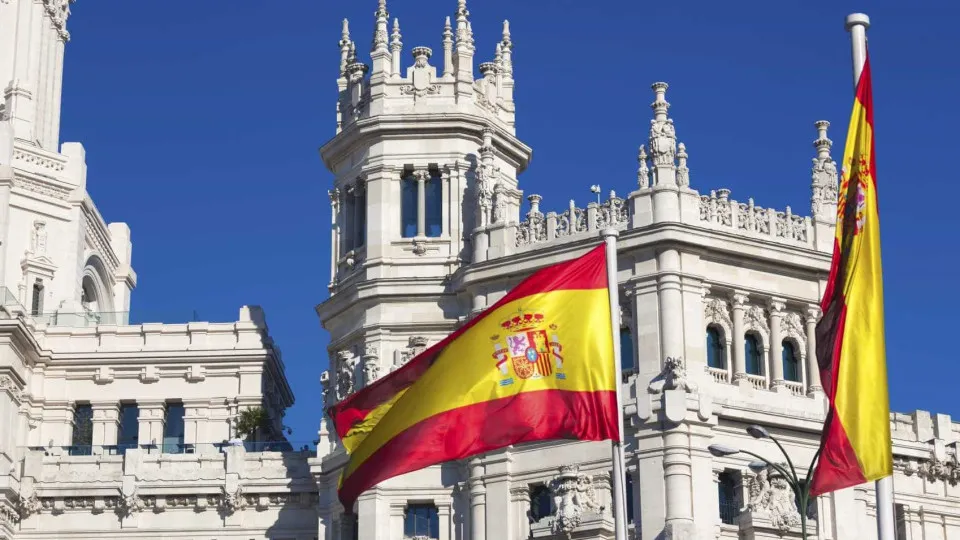
This week’s Ibero-American Summit in Madrid will have 10 out of 22 community countries represented by Heads of State and Government and will close “five large” agreements, the Spanish Government, host and organizer of the meeting, said today.
© Getty Images
03/11/2026
by
Lusa
A This week's Ibero-American Summit in Madrid will have 10 out of 22 community countries represented by Heads of State and Government and will close “five large” agreements, the Spanish Government, host and organizer of the meeting, said today.
The countries represented “at the highest level” are Andorra, Argentina, Bolivia, Chile, Costa Rica, Guatemala, Honduras, Portugal, Dominican Republic and Spain, and the presidents of Brazil (Luiz Inacio Lula da Silva) and Mexico (Claudia Sheinbaum), the two largest member states in terms of population, will not be in Madrid.
Another absence confirmed today is that of the interim President of Venezuela, Delcy Rodrigues.
Portugal and Spain are the two countries that will be represented both by the Heads of State and by the leaders of governments at the 30th Ibero-American Summit, which takes place on Wednesday and Thursday in the Spanish capital.
Colombia, Ecuador and El Salvador have motorcades headed by Vice-Presidents and the other countries by Foreign Ministers.
Sources of the Spanish Government highlighted, on the other hand, the presence, as “special guests”, of the Secretary-General of the United Nations, António Guterres, and of the President of the European Council, António Costa, who aim to give “international projection” to the summit and the community, “connecting the Ibero-American space to the world and to the issues that affect everyone”.
The Madrid executive also expects “five great results” of this summit, materialized in various agreements such as what creates the Ibero-American network of reducing the risk of disasters and civil protection, a proposal presented by Portugal.
A “Ibero-American Alliance for Artificial Intelligence”, an agreement for “academic mobility”, another on care and social support for older people with specific needs and a new strategy for cooperation between the Ibero-American countries, which aims to update the previous one and put emphasis on “triangular cooperation and South-South cooperation”.
The Portuguese Government said today, regarding this week’s summit, that “Portugal will continue to contribute to strengthening the link between the Ibero-American Community and the African continent through the operation of the Portuguese-Latin American-Africa Triangular Cooperation Fund, which will have an allocation of EUR 1 million for the period 2026-2028”.
This fund, created and financed entirely by Portugal, already has two editions and is considered “an innovative model” that brings together three regions and “the first cooperation project with these characteristics” within this community of Ibero-American countries, according to the Ibero-American General Secretariat (SEGIB, in the official acronym).
The 30th Ibero-American Summit wants to reaffirm and relaunch this community of countries, an objective that the Government of Spain considers to be already achieved, said sources of the executive today.
Despite the absences of names such as Lula da Silva or Claudia Sheinbaum, the Spanish Government highlighted the number of countries represented “at the highest level” after the previous summit in Ecuador in 2024, which was marked by the lower ever participation of Heads of State or Government (there were only four: the presidents of Portugal and Ecuador, the Prime Minister of Andorra and the King of Spain) and for the first time it was not possible to reach a consensus for a final declaration.
In Madrid there will be a final political declaration, in addition to the “five large” agreements, highlighted the Spanish executive, who also stressed that in the last year there were nearly 30 ministerial meetings, from which 35 declarations came out, to prepare the summit.
One of the potentially controversial presences at the summit is that of the President of Argentina, Javier Milei, who last month was in Madrid and called “indecent dictator” or “corrupt thief”, among other insults, to the Spanish Prime Minister, Pedro Sánchez, during a conference.
The Spanish Government said today that Sánchez does not plan to have bilateral meetings outside the summit with other leaders and that it is customary that in the Ibero-American community plenary they feel leaders with very different convictions.
The Ibero-American summits take place every two years and Portugal proposed to host the 2030s, which will follow the 2028s in Honduras.
The community consists of three European countries (Portugal, Spain and Andorra) and 19 Latin Americans (Argentina, Bolivia, Brazil, Chile, Colombia, Ecuador, Paraguay, Peru, Uruguay, Venezuela, Mexico, Costa Rica, El Salvador, Guatemala, Honduras, Nicaragua, Panama, Cuba and the Dominican Republic).
In Madrid there will be 15 permanent observer countries, with the incorporation of Angola, India and Turkey into a group of which include Germany, Belgium, South Korea, the Philippines, France, Haiti, Hungary, Italy, Japan, Luxembourg, Morocco and the Netherlands.