
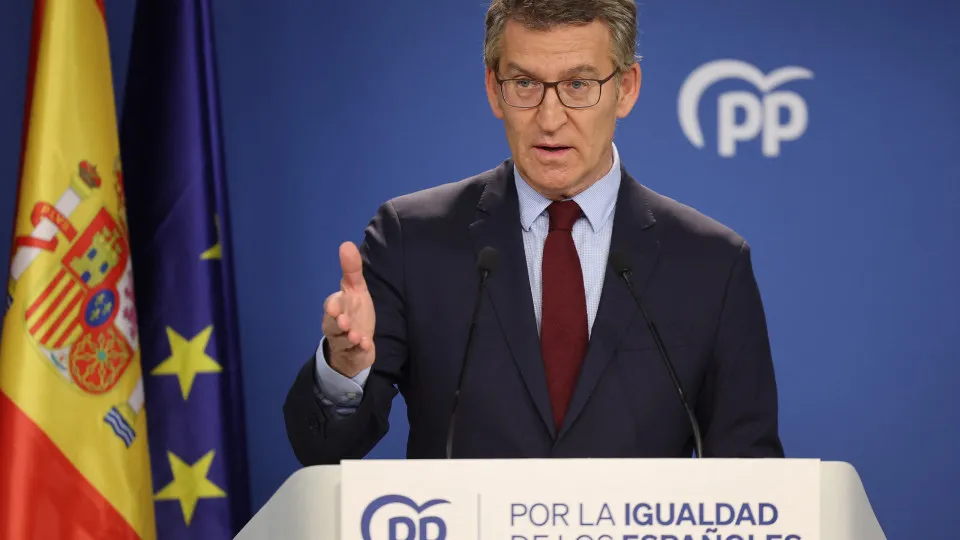
The leader of the Popular Party (PP), Alberto Núñez Feijóo, today demanded that political responsibilities be assumed in the case of the Wednesday train accident in Urda, Toledo, and criticized the Transport Minister for transferring the blame to an operator.
© THOMAS COEX/AFP via Getty Images
29/10/2026
by
Lusa
O opposition leader in Spain and the People's Party (PP, right) today considered that political responsibilities must be assumed in the case of the Wednesday train accident in Urda, Toledo.
“ Political responsibilities are essential from an ethical and moral point of view,” Alberto Núñez Feijóo said.
The president of the PP stressed that political responsibilities “are not optional” and cannot depend on investigations or judicial decisions.
Feijóo recalled that Spain had two accidents this year with high-speed trains, in the same corridor (between Madrid and Andalusia, in the south of the country), in which more than 100 people died, which makes the current railway system of the country question.
At least 69 people died in the Wednesday crash in Urda and another 46 in a January train crash in Adamuz, Córdoba.
Feijóo said today that the country needs answers about the Spanish high-speed network and that decisions are needed.
On the other hand, he considered that on Wednesday the Minister of Transport, Oscar Puente, “put the blame on an operator” of the control centre of the Spanish high-speed network, in a “frail and inappropriate” attitude of a ruler and executive, especially after two accidents of this size in eight months.
Feijóo spoke to journalists in Toledo after visiting the command center for response to the Urda accident.
Spain has early elections on November 29 and the PP, like the general party, canceled the entire agenda of its leaders, leaving the pre-campaign still.
On Wednesday, the PP leader – which polls indicate will be the most voted in the November 29 elections – had already demanded immediate government and judicial investigations to the crash in Urda.
Feijóo then argued that investigations take place “with all means and without interference”, refusing to discuss political responsibilities for considering that it was not the day for this.
The candidate for elections on 29 November also demanded a “complete and independent” revision of the railway network, stating that Spain “has the right to know what is happening to its infrastructure”.
Feijóo also argued that account should be taken of the investments announced after the Adamuz railway accident.
According to the leader, the Spanish are entitled to know the fate of “each euro” announced after that tragedy, including the amounts actually executed, received and implemented.
In statements to journalists today at the same place Feijóo was, the Prime Minister, socialist Pedro Sánchez, promised that “to the last detail” the causes of the accident will be clarified.
The Prime Minister also ensured a security reinforcement “so that it does not happen again”.
On Wednesday, Sánchez said that “it is not acceptable” that a country like Spain has two accidents with high-speed trains in one year and ensured that the authorities will “all the way” to find out the causes.
“If there was negligence, it will be known,” said the Spanish government’s chief, in statements to journalists on Wednesday at the scene of the accident.
The Transport Minister said on Wednesday that the accident in Urda is “actually untrue” and it happened after one of the trains had received an “inexplicable” order from the control center to advance when there was a red light and other compositions stopped on the same line.
At the origin of the Adamuz accident was the derailment of carriages of a train, which fell on the side line, which soon passed another composition, to the contrary.