
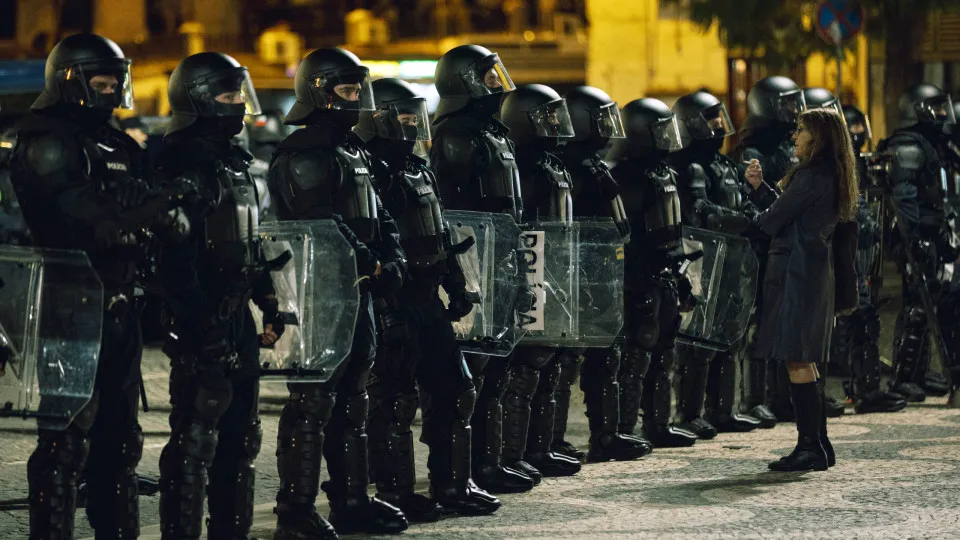
On Tuesday, PSP released on social networks a video to show that the agents were also the target of violence by demonstrators in the police actions carried out on Sunday morning in Lisbon and Porto. In response to the Minute News, the National Directorate of the PSP stressed that the disclosure “had the objective of contributing to public clarification about the events recorded.”.
© FRANCISCO ROMAO PEREIRA / AFP via Getty Images)
28/10/2026
by
A Public Security Police (PSP) clarified this Wednesday, October 28, that the disclosure of the video on social networks about the police actions in the camps in Lisbon and Porto aimed to make known “images that document situations of violence directed to police during the occurrences”.
“The dissemination of the video aimed to contribute to the public clarification about the events recorded on Sunday morning, making known images that document situations of violence directed to police during the occurrences”, said the National Directorate of PSP in response to the News to Minutes.
He also pointed out that “this initiative is part of the PSP’s duty of information and transparency to citizens, allowing contextualizing the police action in a scenario in which violent behavior and acts that have taken the security of police and third parties at risk”.
What criteria were there for selecting the images to show?
Asked what criteria were used for the selection of images, the National Directorate of PSP stated that “the images released were selected in order to illustrate concrete situations recorded during the occurrences and to make known violent behaviors directed to police”.
Were the images taken before or after the police charges?
Regarding the time frame, he indicated that “the determination of the exact moment of each situation and its temporal relationship with the different phases of police intervention depends on the analysis of the respective records and the operational context in which they occurred”.
On the other hand, it is considered that the images demonstrate the need and proportionality of all police interventions carried out, the PSP explained that “the assessment of the need, adequacy and proportionality of police action should take into account the concrete circumstances of each occurrence, the risks existing at the time and the evolution of the situation on the ground”.
“ The video released documents some of the recorded situations, not constituting in itself an integral representation of all occurrences or replacing the overall assessment of each intervention. The performance of the PSP is governed by the principles of legality, necessity, adequacy and proportionality”, stressed.
Who gave the order to publish the images?
Asked whether the initiative to publish the images was from the National Directorate of the PSP or resulted from an order from the Ministry of Internal Administration, the authority clarified that “the disclosure decision was made by the director of the Press and Public Relations Office and spokesperson of the PSP, with the authorization of the National Director of the PSP”.
What about the editing of the images?
One of the criticisms made about the dissemination of images has to do with the issue to which they were submitted. In this sense, Notícias ao Minuto also questioned whether the PSP considers that the publication of selected and edited images, without providing full recordings, allows the population to form a rigorous and contextualized perception of events – and, in a way, it sediments the “confidence” in that force.
“PSP recognizes the importance of public information being rigorous and contextualized. The publication of excerpts of images allows to illustrate concrete situations, but does not intend to replace the full analysis of occurrences or exhaust all the circumstances in which police interventions took place”it's good.
And he concluded: “Citizens’ confidence in security forces is built through legal, responsible and proportional action, as well as transparency in providing public clarifications. The PSP therefore considers it essential to report on the relevant events, without prejudice to the analysis of the facts and the concrete circumstances of each intervention”.
The video
It should be recalled that, on Tuesday, PSP released on social networks a video to show that the agents were also the target of violence in police interventions carried out in the early hours of Saturday for Sunday in Rossio, Lisbon, and in Praça D. João I, in Porto, following the demonstrations for housing.
The video, shared on social networks, argues that “violence cannot be tolerated”.
“The Public Security Police is always present to ensure, ensure and protect the fundamental right to the meeting and demonstration”, can be read in the legend that accompanies the images.
And he adds: “Our mission in the public space is to accompany and support those who exercise their voice, balancing this right with the freedoms of the whole community. For this to happen, we focus on constant efforts and dialogue, mediation and awareness among demonstrators”.
The PSP also ensures that it seeks “always understanding and reconciliation between everything”. “However, violence cannot be tolerated. Assaults directed at the police are unacceptable and will not be tolerated,” he said.
Luís Montenegro and António José Seguro broke the silence
Several political figures, parties and protesters demanded a firm reaction from both the Prime Minister and the President of the Republic.
First, the Head of State, in the margins of a visit to the European Maritime Safety Agency (EMSA) in Lisbon on Tuesday. In the afternoon, the head of government, by virtue of the first day of the debate in the general state budget for 2027, but where the theme of housing dominated both part of Louis Montenegro's initial speech and the questions of all parties.
Both confessed not to have liked what they saw, in a reference to the images of the police load from Saturday night to Sunday in the protests, but if Luís Montenegro praised the role of the security forces, António José Seguro called for “dialogue as a solution to the problems and never violence”.