
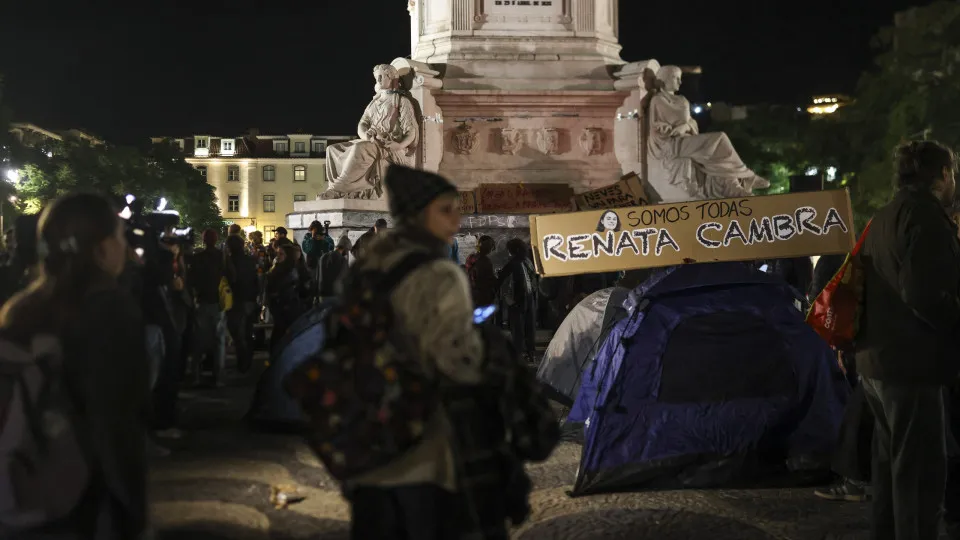
The Public Prosecutor (MP) appealed against the order of the Lisbon Administrative Court on the case brought by Renata Cambra against the Portuguese State. What does that mean? Can appeal hold tents or have “only a returnive effect? Lawyer Dantas Rodrigues explains.
© PATRICIA DE MELO MOREIRA / AFP via Getty Images
04/11/2026
by
Renata Cambra moved a subpoena for protection of rights, freedoms and guarantees against the Ministry of Internal Administration (MAI) and the Municipality of Lisbon and the Lisbon Administrative Court ruled in his favourConsidering you could keep a tent in Rossio in protest after 12:30.
The decision was read in different ways, diverting attention from the protest for the right to housing, as Renata Cambra herself pointed out this Wednesday.
However, after the protesters had sung victory and the Ministry of Internal Administration (MAI) had restricted the judicial decision on those camped in a single tent – Renata Cambra’s – and assumed that the order “saves the possibility” of police intervention, the Attorney General’s Office (PGR) revealed that it appealed to the decision of the Lisbon Administrative Court. What this means in practice is what the News to Minutes went to find out from attorney Dantas Rodrigues.
According to the case, “the appeal of constitutionality has a delimited object: whether it is constitutionally admissible to apply the time limit of 12:30 as an automatic basis for preventing the continuation of a peaceful demonstration”. This does not make it clear if the resource “has suspensive or merely devolutionary effect”.
It is known that the Public Prosecutor (MP) requested the suspensive effect, but that does not mean that it stops Renata Cambra's tent after 12:30, on the contrary.
“In my interpretation, there are legal grounds to argue that the appeal must have merely devolutionary effect, allowing the judgment to continue to take effect until the Constitutional Court has ruled“, highlights the lawyer, referring to Article 78(2) of the Constitutional Court Law.
“ In fact, Article 78(2) of the Law of the Constitutional Court refers, when verified, to the ordinary appeal system that would be the responsibility of the decision. However, in the case of a subpoena for the protection of rights, freedoms and guarantees, Article 143(2)(a) of the Code of Procedure in Administrative Courts establishes the merely devolutionary effect,” he adds.
Dantas Rodrigues admits “that the application of this rule to the specific moment when the appeal of constitutionality was brought raises interpretative doubts”. However, it underlines, “an interpretation that would lead to suspension of the sentence for almost the entire period in which the recognised right could be exercised would seriously compromise the usefulness of judicial protection”.
“ We must not forget that we are facing an urgent process, precisely to ensure the effective protection of fundamental rights ", shoots.
If, in spite of this, suspensive effect is fixed, “the effectiveness of the judicial protection granted to the citizen may be suspended while the appeal is pending”, he explains, adding that, in this scenario, “authorities may invoke the legal regime concerning the hours of demonstrations again, although any intervention will remain subject to constitutional requirements of legality, necessity and proportionality”.
Where are the tents?
The question of constitutionality referred to the Constitutional Court should also be distinguished from the other grounds of the judgment.
According to the lawyer, “the appeal does not necessarily cover all the questions assessed by the Administrative Court, namely the legal qualification of the tent used as an instrument of protest”. “The scope of a possible suspension must therefore be assessed according to the structure and content of the decision,” he says.
What's next?
As regards procedural procedures, “After the appeal has been accepted, the case shall be brought before the Constitutional Court, where the procedure is legally envisaged, including, where applicable, the submission of claims and the delivery of a judgment”.
Dantas Rodrigues recalls that “there is no guarantee that the Constitutional Court will decide before 24 November, a date until which the protection recognized to the protester was delimited”.
“ If the appeal is to be examined only after that date, the question of its procedural usefulness may be raised, although the passage of the time limit does not automatically determine the termination of the appeal”, he notes.
The lawyer further explains that if the Constitutional Court “confirms the judgment of unconstitutionality, the application of the rejected normative interpretation will be removed. If it decides otherwise, the Administrative Court will have to reform the decision in accordance with the constitutionality judgment.”.
And he reiterates: “The appeal of the Public Prosecutor is a legal consequence of the decision of the Administrative Court, not a repeal of the sentence.”.
In summary, the lawyer recalls that “a truly important issue is to determine whether or not this appeal suspends the judicial protection granted to the protester” and, in its interpretation, “having regard to the urgent nature of the process and the need to ensure effective protection of fundamental rights, there are consistent legal reasons to defend the purely devolutionary effect.”.
It is recalled that, at the origin of Renata Cambra’s lawsuit “there was the right to maintain its protest for the right to housing in Praça do Rossio, in Lisbon, guaranteeing legal permission for the assembly and stay of its tent on site, including in the early hours (after 12:30 a.m.). The court ruled in favor of the activist, considering that the time limit was not “absolute and automatic” to prohibit her presence.
After all, can only Renata Cambra stay after 12:30 with a tent in Rossio?
Several voices then raised themselves to question whether this decision was individual or covered all demonstrators, with the Ministry of Internal Administration (MAI) circumscribing the applicability of the order only to Renata Cambra.
Questioned about this doubt by News to Minutes, Dantas Rodrigues indicates that the court “clarified that it was not recognizing a collective right to camp in Rossio.” However, “although legally correct as to the effects of the sentence, this interpretation is restrictive if it ignores the scope of its reasoning”.
“ This means that, although the decision does not directly benefit other demonstrators, the legal grounds used by the court may be invoked in similar situations. Consequently, a new order of dispersion based exclusively on the time or the existence of tents may be judicially challenged,” he emphasized, adding that “the interpretation of the MAI is correct as to the individual effects of the sentence, but it becomes restrictive if it devalues the constitutional scope of the foundation adopted by the court”.
Can Renata put more than one tent in his name on Rossio?
Regarding the possibility of Renata Cambra being able to place more than one tent in Rossio after 12:30, the lawyer says that the sentence “is clear by limiting the installation to the structures strictly necessary for the expression of the demanding message, clarifying expressly that, in this case, it is a single tent”.
“ The recognised right is personal and is intended to protect the participation of the citizen in the demonstration, not to assign to it any right of occupation or unlimited use of the public space”, says Dantas Rodrigues, recalling that the “installation of 100 tents would represent a substantially different reality, constituting a collective occupation that the court did not appreciate or authorized” and that could “compromise the conditions of circulation, security and use of the public space expressly safeguarded in the sentence, justifying, in the face of concrete circumstances and legal terms, the intervention of the police authorities”.
“The court recognized the right of a citizen to manifest with a tent, not the right to turn Rossio into a camp”, concludes.