
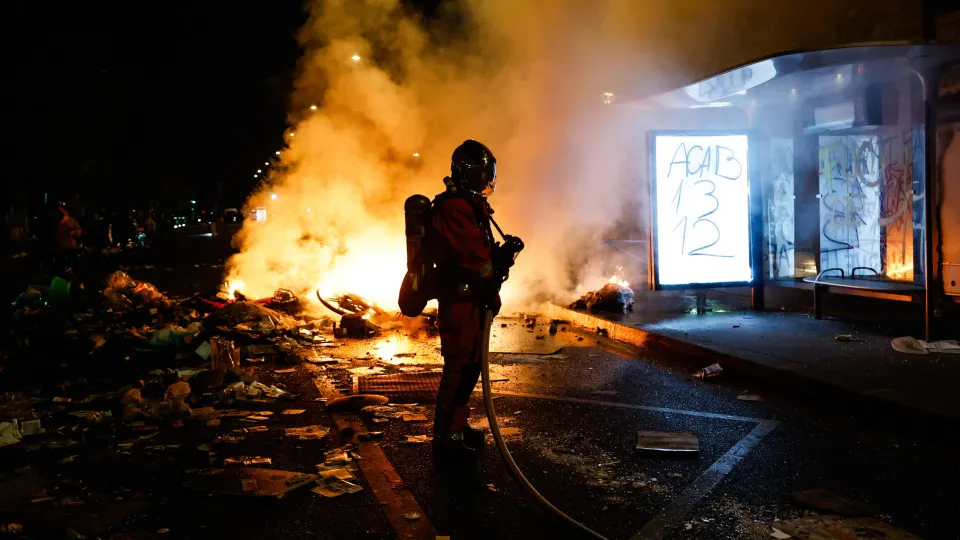
The French Senate approved and extended the bill known as “paying destroyers” in response to acts of vandalism committed during demonstrations against the high cost of living.
© Lusa
28/10/2026
by
Lusa
O The French Senate approved and extended today the bill known as “destructors-payers”, in a legislative response to acts of vandalism committed outside the demonstrations on 17th against the high cost of living.
To the main extent, the text establishes a civil liability for members of a group who have committed acts of vandalism, without it being necessary to prove that they are the authors of them. Subject to various conditions, this responsibility has a maximum of EUR 10,000.
Family allowances or housing allowances may be pawned on the basis of this text.
Senators made the text more rigorous, including other social benefits, but also adopting numerous security measures, such as the facilitated recourse to algorithmic video surveillance, mostly supported by the government.
The proposed measures include the use of drones for legal purposes, the suspension of accounts in digital services and the possibility of pawning certain social benefits to those responsible for damages. Maximum prison sentences can go from one to three years and fines from 15,000 to 45,000 euros.
The text also provides for the extension of civil liability to persons who remain at the site of disturbances despite an order of dispersion, in order to facilitate the repair of the damage caused.
The ceiling of EUR 10 000 for reimbursements for each person involved in the damages has raised criticism because it is considered insufficient, although some legislators argue that an increase in that amount could expose the law to a significant risk of unconstitutionality.
The Executive presented on Monday an amendment to the proposal in order to request the blocking of digital platforms that do not remove, within one hour, contents that encourage attacks, insurrections or the use of weapons against the State or against a part of the population.
The proposal also establishes a period of up to 24 hours for the removal of other contents that directly encourage serious crimes, such as assaults, thefts and acts of destruction that may cause serious disturbance of public order.
The government argues that social networks can contribute to the spread of violence by spreading messages and appeals that favor looting and confrontation.
The amendment may extend the competences of Pharos, the French police unit responsible for receiving complaints concerning illegal content on the Internet.
The initiative raises legal doubts. In 2025, the French Council of State disproportionately considered the blocking of the TikTok social network in New Caledonia during the disturbances of 2024, although it admitted the possibility of restrictions under exceptional circumstances.
The Minister of the Interior, Laurent Nuñez, has again today defended the text, which he classified as “good sense”, in the face of the “urgency” of responding by legislative means to the acts of vandalism of recent days, which affected more than 2,500 commercial establishments, according to the data of the Chambers of Commerce and Industry of France (CCI France).
The text, approved by 229 votes against 105, had been drawn up during the summer, after the disturbances that followed the winning title of the Champions League by PSG in late May.
The left strongly criticized the article, accusing the government of a “liberticide deviance”, which disrespects the “freedom of manifestation”.
Amnesty International urged the French Government to “renounce” the text, also describing it as a “project of liberticidal law, which seriously threatens the right of demonstration, by imposing on all demonstrators the risk of financial sanctions”, according to a statement by the non-governmental organisation.
The text is now referred to the National Assembly, the lower chamber of the French Parliament, where there is no majority, so the appraisal of the bill promises heated debates.