
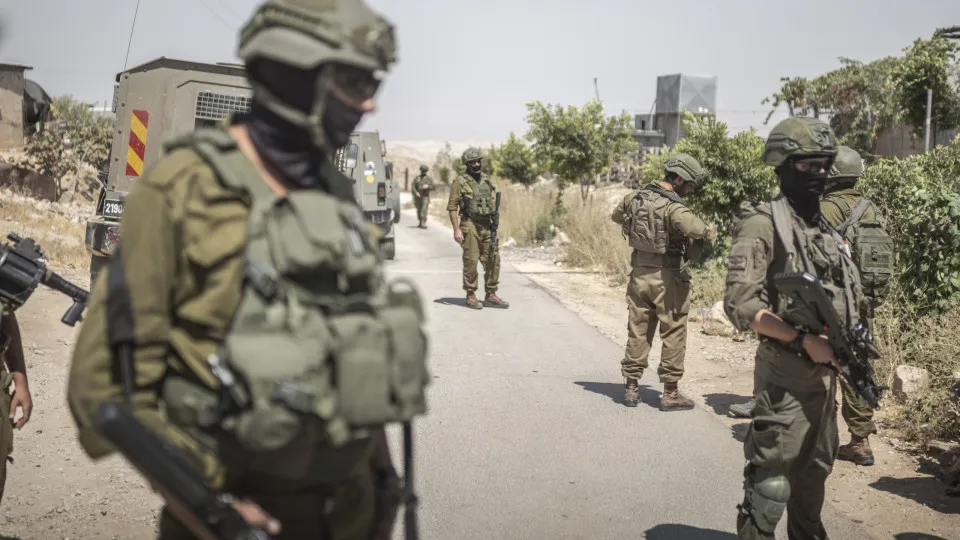
The Israeli Supreme Court ordered the Army and the Ministry of Defense to present a timetable for the return to the home of over 30,000 Palestinians expelled from three refugee camps in the north of the West Bank.
© Ilia Yefimovich/picture alliance via Getty Images
12/10/2026
by
Lusa
O The Israeli Supreme Court ordered the Army and the Ministry of Defense to present a timetable for the return to the home of more than 30,000 Palestinians expelled from three refugee camps in the north of the West Bank.
In a decision dated Sunday and today released, the Supreme Court underlines that it has been a year and nine months since Israel started the so-called Iron Wall Operation, in which its soldiers occupied the refugee camps of Jenin, Tulkarem and Nur Shams (urbanized suburbs of these cities), claiming to be bastions of Palestinian militias.
As a result of the operation — considered the longest of Israel in Palestinian territory since the Second Intifada (2000-2005) — between 30,000 and 40,000 Palestinians in those camps, which were emptied and largely destroyed by the Israeli Army, were unable to return home.
After this period, the Israeli Supreme Court states, in its decision, that “the security conditions for the return of the expelled Palestinians are not yet met,” but orders the Army to present a timetable for this to happen and urges it to speed up the process.
In response to the decision, Defense Minister Israel Katz classified the Israeli military presence in the areas of the West Bank from which the Palestinian population was taken during the Israeli military offensive of 2025 — including the refugee camps of Jenin, Tulkarem and Nur Shams — as “abstain from interfering” in the Army’s activities in the West Bank as “permanent”.
In a statement released today by the Ministry of Defense, Katz claimed that since Israel emptied the refugee camps of those three cities of the West Bank, “the level of terrorism in Judea and Samaria (a biblical term used by the Israeli Government to refer to the West Bank) has fallen by 80%, reaching its historical minimum.”.
“The long-term presence of the FDI (Israel Defense Forces, designation of the country’s Armed Forces) in these camps is not a legal issue, but rather an operational and security need, required to save the lives of Israeli soldiers and civilians,” he said.
He added that he has no “intention to give in to this” because “it is not for the Supreme Court to intervene in security considerations of this nature, just as it is not for him to intervene in operational activities in Gaza, Syria, Lebanon or Iran.”.