
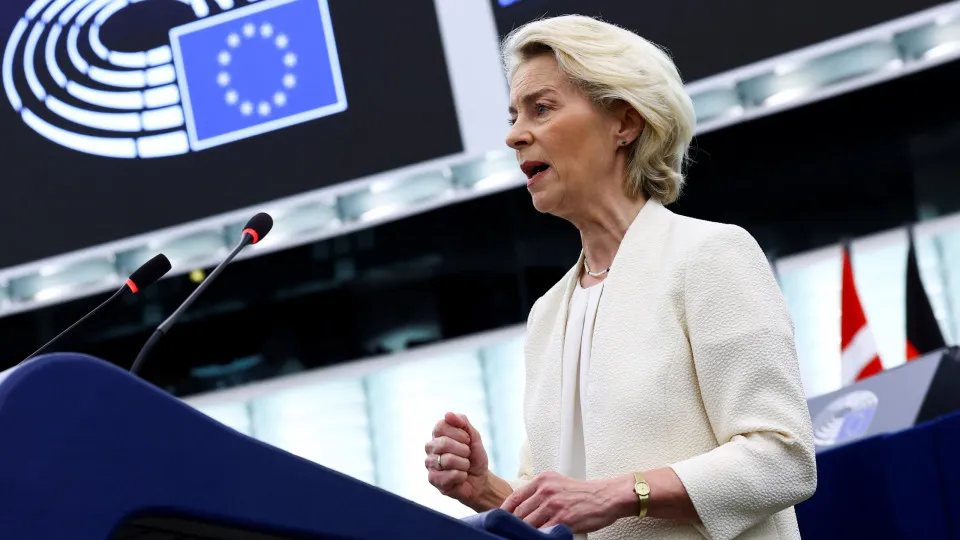
The President of the European Commission, Ursula von der Leyen, advocated strengthening cooperation with Morocco and supporting the Spanish authorities to speed up the return of irregular migrants to Ceuta.
© REUTERS/Yves Herman
13/10/2026
by
Lusa
A president of the European Commission, Ursula von der Leyen, today advocated strengthening cooperation with Morocco, as well as support for the Spanish authorities to ensure the return of migrants who have entered Ceuta illegally and are still in the enclave.
“ We will continue to support the Spanish authorities to ensure the rapid return to Morocco of those who have entered and remain illegally in Ceuta, following Morocco’s commitment to re-admit them all,” says the leader of the EU executive in a letter sent today to the EU Heads of State and Government, anticipating the European summit later this week in Brussels.
At the same time, “we will continue our involvement with Morocco, with a view to a future Strategic and Global Partnership, also drawing lessons from recent events,” she adds.
The European Commissioner therefore calls for enhanced cooperation with Rabat on border management, prevention of irregular departures, exchange of information, readmission of migrants and combating trafficking networks.
The letter appears about two and a half months after the mass entry of migrants into Ceuta on 30 and 31 July, when about 72,000 people irregularly crossed the border between Morocco and the Spanish enclave, according to figures published by the Spanish authorities.
Most returned to Morocco within 48 hours, but thousands of people remain in Ceuta, including unaccompanied minors, according to information disclosed by the Spanish authorities.
The episode, triggered by a sudden and mass arrival of people and accompanied by serious humanitarian consequences, again put pressure on the management of the EU's external borders and migration cooperation between Member States and third countries.
In the letter, Von der Leyen considers that the situation in Ceuta has shown “the rapid arrival of a large number of migrants can exert pressure on the EU’s external borders, with a tragic human cost”.
For this reason, a new European Emergency Response Framework will be created, which, according to the European Commissioner, should allow a coordinated and more flexible response to exceptional situations at the EU's external borders, including asylum and return procedures.
Still, the leader of the EU executive points out that migration pressure has decreased across the EU, and irregular border crossings have fallen 55% over the past two years and more than a third over the past year, while asylum applications and unauthorized secondary movements are also decreasing.
Despite this progress, the President of the European Commission warns of the persistence of pressure in several regions, particularly in the Mediterranean, where illegal migration networks continue to exploit vulnerable people, and at the eastern borders, where migration can be exploited by geopolitical opponents.
The letter appears during the implementation of the Pact on Migration and Asylum, which has been in force since 12 June, establishing common rules for the management of irregular arrivals, asylum applications, solidarity between Member States and the return of persons without the right to remain in the EU.
Migration will be one of the topics of the strategic discussion of EU Heads of State or Government, which meet in Brussels on Thursday and Friday, at a summit which will also have on the agenda the long-term Community budget and the energy crisis caused by tensions in the Middle East.