
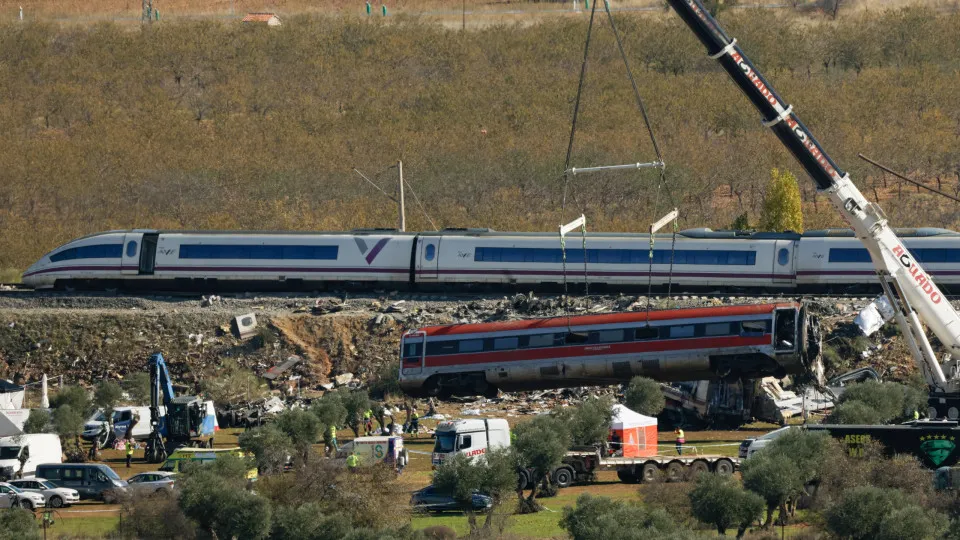
Thirty-four people remain hospitalized in four hospitals in Castile-La Mancha, Spain, after the train accident in Urda, Toledo, which has caused 69 deaths so far.
© Oscar DEL POZO / AFP via Getty Images
31/10/2026
by
Lusa
Tin the early hours of today, four people were admitted to four hospitals in Castile-La Mancha, Spain, due to the train accident in Urda, Toledo, on Wednesday, which has caused 69 fatalities.
Sources from the regional government reported that of the 34 people hospitalized – five less than on Friday – 15 are in intensive care (ICU) and 19 in conventional beds. Since Wednesday, there have been 76 discharges, and a total of 110 people have been treated in the hospitals of Castile-La Mancha.
At Hospital Universitário de Toledo there are 18 patients admitted due to the Urda accident, of which eight in the ICU and 10 in conventional beds, at Hospital Mancha Centro, in Alcázar de San Juan, there are nine inpatients, three in the ICU and six in conventional rooms, six in the Hospital de Ciudad Real, three in the ICU and three in conventional beds, and one in the ICU of Albacete.
The same sources indicated that early today, the number of 69 dead remained.
A team of 27 psychologists is providing assistance to the families of those affected at the Family Support Center, located at the Priestly House in Toledo.
In addition, on Friday night a permanent team of the Castile-La Mancha Health Service was installed at the Family Support Center, composed of a doctor and a nurse.
The Institute of Legal Medicine and Forensic Sciences of Toledo and Ciudad Real has already completed all autopsies and, according to the latest data provided on Friday by the Integrated Data Center (ICD), 36 of the fatalities have been identified, having been reported to families 27 identifications, which correspond to 18 men and 9 women.
At least 69 people, including one Portuguese, died in the accident that occurred when more than 540 people were travelling on two high-speed trains.
According to the Spanish Government and recordings of communications with the control centre, the driver of one of the trains received wrong indications from an operator, who did not comply with the protocols established for the situation in which he was located, eventually colliding more than 180 kilometres per hour with another composition that was standing on the same line.
The two trains, which made the connection between Madrid and Seville, had been stopped due to the failure of the automatic control system of circulation, due to problems of communications between equipment.
The failure of this system, known as LZB, causes the trains to stop automatically and the circulation is coordinated by a control centre.
The control centre instructed trains to proceed with “normal march”, i.e. at high speed, following the wrong protocol for this situation, according to experts and the government itself.
In addition, the control center did not then stop the train behind it, although the other informed that it could not start.