
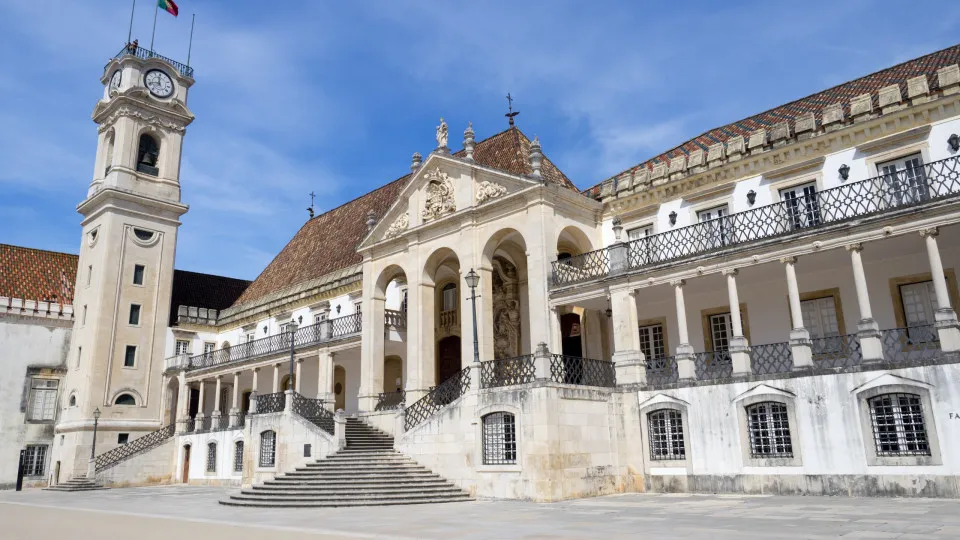
The Macau government showed interest in receiving trainees from the University of Coimbra (UC) in the public service, revealed a leader of the institution.
© Getty Images
29/10/2026
by
Lusa
University of Coimbra
O Macau Government showed interest in receiving in the public service trainees of the Public Administration programs of the University of Coimbra (UC), today it revealed to Lusa a leader of the institution.
UC Vice-Rector for International Relations and Alumni, João Nuno Calvão da Silva, said he met on Wednesday with the director of Education and Youth Development Services (DSEDJ), Kong Chi Meng.
Calvão da Silva said that “the first goal” of the meeting was to try to ensure internships in the Macau public service for students of the degree and master’s degree in Public Administration of the UC.
The leader argued that the possibility of students having in Macau “a part of their training route” would be “good for both parties”, as well as “very important for the internationalization of the University of Coimbra”.
Kong Chi Meng “showed political will to operationalize” the internship program, confirmed Calvão da Silva, adding that his interlocutor ensured “flexibility to also find the best solutions that serve” Macau.
Macau has about 34,000 civil servants. Official statistics do not reveal how many civil servants have Portuguese nationality, only mentioning that 226 were born in Portugal.
Lusa has requested further information from DSEDJ and the Administration and Civil Service Directorate, but has not received any response so far.
The idea, explained Calvão da Silva, is to extend the network of internships available to students in Public Administration of UC, which already has more than 90 entities, not only in Portugal, but also in other Portuguese-speaking countries.
The leader also revealed that the UC offered the Macau Government the possibility of “young qualified managers of the Public Administration” of the Chinese region being able to access the network of professional internships of the institution.
Calvão da Silva also took advantage of the trip to “put into practice” an agreement with the Faculty of Law of the University of Macau (UM), sponsored by MGM casino operator.
The protocol, valid for four years, provides for the annual performance of two international scientific events, one in Coimbra and the other in Macau, said the vice-rector of the UC.
“It will soon also be implemented with research grants,” added Calvão da Silva, allowing UC law students to do master’s or doctorates in Macau and vice versa.
The leader spoke in the margins of the opening of an international conference that will discuss the legal reforms of Macau, jointly organised by UC and UM, with lawyers from Portugal, mainland China, Angola, Mozambique and Brazil.
The conference is an example of the “dialogue between legal cultures”, which, defended Calvão da Silva “will provide Macau with a legal culture of cross-breeding between Portugal and the People’s Republic of China”.
“ Our legal system maintains a deep historical connection to the Portuguese legal tradition”, stressed, at the opening of the event, the director of the Faculty of Law of UM, Gabriel Tong Io Cheng.
After the transition to administration in 1999, “the continuity of the existing legal system has been ensured, which has been progressively adapting to the needs of society,” said Gabriel Tong.
Calvão da Silva said he believed that the Macau legal system “will last far beyond the international commitment” that “unite” the region and Portugal “in this transitional period until 2049”.
At the opening of the conference, also Ng Chi Kin, appointed on Wednesday Director of Justice Affairs Services, described Macau’s right as “a bridge between Chinese and Portuguese law”.
Ng argued that the reform of the Macao Code of Administrative Procedure, currently in public consultation, “cannot be well done behind closed doors”, and benefits from the Portuguese-speaking “visions of jurists”.
The opinion was shared by Macau’s President of the Association of Lawyers, Vong Hin Fai, who called for “collaboration with institutions and lawyers” from China and the Portuguese-speaking countries to “lift the bosses” from administrative law.