
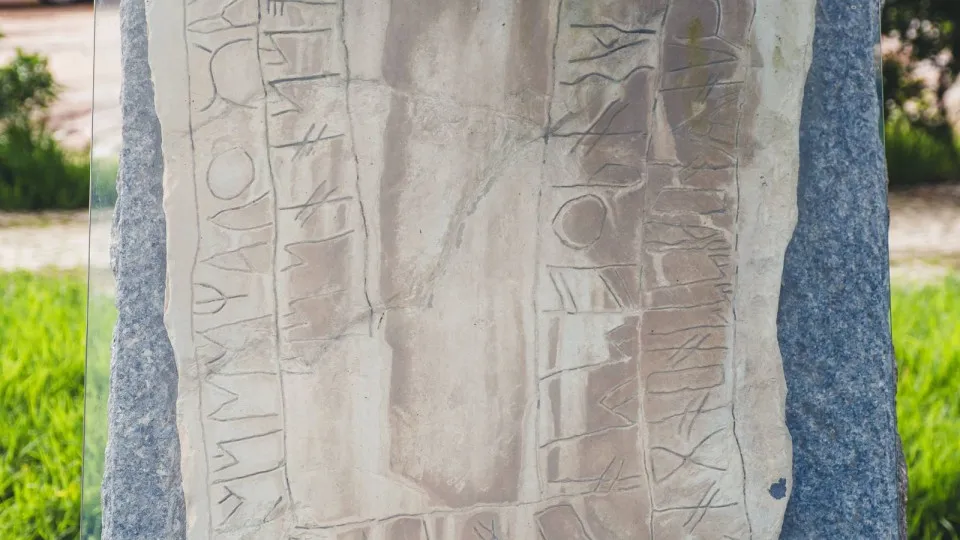
Two necropolis and several steles with writing inscriptions from the Southwest were discovered in Bensafrim, revealing the archaeological wealth of the territory of Lagos, which local associations want to promote through the Rural Routes project.
© Local OSD
22/10/2026
by
Lusa
Bensafrim
Duas necropolises and several stellas with writing inscriptions of the Southwest discovered in the Old Fountain in Bensafrim, testify to the archaeological importance of this territory of Lagos, active that local associations now want to promote through the Rural Routes project.
Among the vestiges of communities that buried their dead here, in the Iron Age and in the Roman era, is a large stele and a gold disc associated with the Iron Age, artifacts that are in the Santos Rocha Municipal Museum, in Figueira da Foz.
The stele was collected at the end of the 19th century during archaeological excavations in the Algarve led by António dos Santos Rocha and Estácio da Veiga. As Santos Rocha was a native of Figueira da Foz and then founded the Archaeological Society, he took the play to his hometown.
“2500 years ago, we knew how to write as few in Europe. We were one of the most innovative in this territory, which covers the Baixo Alentejo and Serra do Algarve ", says archaeologist Pedro Barros, scientific consultant of the project, which aims to value the archaeological, rural and agricultural heritage of Bensafrim, Baron de São João and Odiáxere.
Only in Bensafrim were six steles found, and the largest and best preserved, exposed in Figueira da Foz, is 1.35 meters. It is believed that stellas were related to the funerary world and also served as territorial landmarks in the landscape, but what they say is a mystery, since the writing of the Southwest has not yet been deciphered.
“ As Phoenicia has influence, coming from the eastern Mediterranean, it is written contrary to ours, that is, from bottom to top and from right to left”, explains Pedro Barros, noting that the characters are presented in spiral form, with no separation of words or punctuation.
According to the researcher, the necropolis of the Iron Age of the Old Fountain stands out among the largest in southern Portugal, for its size, for its stellar set and for the characteristics of the burials described in the ancient excavations.
The records left by those who studied it were not enough to find it again. There were attempts in the late 1990s and 2014, crossing old references, place names and distance indications.
“Despite this effort, it was not possible to locate the necropolis of the Old Source of Bensafrim”, recognizes the archaeologist, adding that the gap extends to the inhabited places: “From the ancient excavations we know the spaces of death, but the place where people lived has never been identified.”.
The field books of excavations at the end of the 19th century point to bodies deposited in cysts, structures made with vertical stone slabs that served as coffins. However, ancient methods and records require caution in interpretation.
Next to the market of the village of Bensafrim is a sculpture alluding to the large stele found somewhere nearby, but the discovery was not contextualized, work that Vicentina – Association for the Development of the Southwest is now developing.
In this sense, the association created the Center for Interpretation of the Rural Archaeological Heritage of Bensafrim, inaugurated in October at the headquarters of Vicentina, which consists of a multimedia kiosk that gathers all the information that was dispersed, concerning the discovery process and artifacts found.
“Our goal was to create information that could be understood, because, in fact, the site of Fonte Velha is not visitable from an archaeological point of view,” says Sónia Feliz, general coordinator of the project, developed with the Association for the Protection and Promotion of Rural Heritage.
The Rural Routes project includes an archaeological route and five private agricultural farms that have within their meniral perimeter, large stones embedded in the soil in vertical position of the neolithic, about 6,500 years ago, apparently from an ancient phase of European megalithism, and that will now seek to structure their activity in order to receive visitors.
According to Pedro Barros, according to an investigation by Marta Diaz-Guardamino of the University of Durham, in collaboration with the municipalities of Lagos and Vila do Bispo, at the end of the Iron Age, everything indicates that there was an intentionality for local populations to raise the menhirs, which fell with time.