
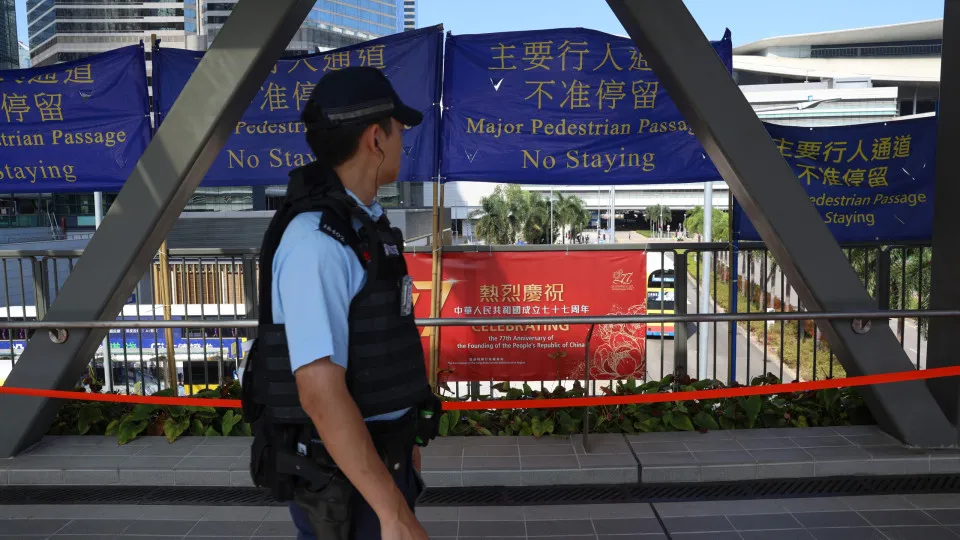
China accused the United Kingdom of interference in domestic affairs following a British report denouncing the deterioration of freedoms in Hong Kong and presented a diplomatic protest in London.
© Lusa
23/10/2026
by
Lusa
A China accused the UK of “serious interference” in its internal affairs, following the publication of a British report denouncing the deterioration of freedoms in Hong Kong, and presented a diplomatic protest to London.
In a statement, the Chinese embassy in the United Kingdom rejected on Thursday the “irresponsible declarations” of the British Government and maintained that the joint Sino-British Declaration of 1984, which established the conditions for Hong Kong’s return to China in 1997, did not give London any right to oversee the affairs of the territory after the transfer of sovereignty.
According to Beijing, the legal framework that currently governs Hong Kong is based on the Chinese Constitution and the Basic Law of the special administrative region, so London urged “to abandon its colonial mentality” and to stop publishing half-yearly reports on the territory.
The embassy also argued that the rights and freedoms of Hong Kong residents are protected by law and rejected any foreign intervention in court proceedings against businessman Jimmy Lai and former leaders of the Hong Kong Alliance, an organization linked to the wakes in memory of the victims of Tiananmen's repression in 1989.
The British report, published on Thursday for the first half of 2026, warns of the “enlargement of scope and application” of national security legislation in Hong Kong and its “increasing impact” on freedom of expression, assembly, association and press.
Among the events highlighted is the conviction, in February, to 20 years in prison of Jimmy Lai, founder of the extinct newspaper Apple Daily and British citizen, whose “immediate release” is required by London.
The document also notes that the legislative amendments adopted in March extended the powers of the police to require passwords for electronic devices, restrict movements and confiscate goods in national security investigations.
The United Kingdom considers that China continues to violate the 1984 Joint Declaration, which provided for a high degree of autonomy for Hong Kong for 50 years after the transfer of sovereignty.
Beijing maintains that the territory benefits from stability under the principle “one country, two systems” governing the administration of the former British colony since 1997.