

The Magic Cube, also known as Rubik's Cube, is a three-dimensional puzzle that challenges the mind and manual dexterity of millions of enthusiasts around the world.
Created by Hungarian architect and professor Ernő Rubik in 1974, the Magic Cube became a global phenomenon, conquering admirers of all ages. In this article, we will explore the fascinating history of this puzzle, its unique features, the challenges involved in solving it and the passionate community that formed around it.
History and Evolution of the Magic Cube
The Magic Cube had its origin in the creative mind of Ernő Rubik, who conceived it as a teaching tool to explain three-dimensional mathematical principles. The first version of the puzzle was patented in 1975 and initially marketed in Hungary as the “B With its growing popularity, the Magic Cube was soon launched internationally and became an iconic symbol of the 1980s.
Since then, the Magic Cube has undergone several iterations and variations. Different sizes, enhanced spinning mechanisms and innovative designs have been introduced by puzzle manufacturers. Thus, it resulted in an impressive variety of models to challenge even the most experienced solvers.
The Intriguing Mechanics of the Magic Cube
One of the most captivating features of the 3x3x3 Magic Cube is the complexity of its resolution mechanics. Composed of 26 small colored cubes in a three-dimensional structure, effective manipulation of the Magic Cube requires not only logical thinking but also fine motor skills. Each face of the cube can be rotated independently, mixing the colors and increasing the difficulty of the challenge.
What is the number of God?
The Magic Cube has an intriguing property called “number of God” – the smallest amount of movements needed to resolve any initial position of the cube.
The “Number of God” is a mathematical constant that highlights the depth of the challenge embedded in the Magic Cube.
Community and Competition: The World Beyond Colorful Faces
The popularity of the Magic Cube is not limited only to casual fun. Yes, a passionate global community is dedicated to improving its skills and participating in competitions. For example, organizations such as the World Cube Association (WCA) regulate competitive events around the world, where solvers compete to reach the fastest times in different categories, such as single resolution, average of five and even blindfolded competitions.
In addition, the Cube inspired the creation of advanced algorithms, efficient resolution methods and even impressive world records. The Magic Cube community has a strong collaborative spirit. Yeah, they share techniques and strategies to achieve excellence in solving the challenging puzzle.
The world record for the current 3x3x3 cube belongs to Max Park, who was able to complete its cube in 3.13 seconds during the 2023 “Pride in Long Beach” race representing the United States. It was 0.34 seconds than the Chinese Yusheng Du in 2018.
Variants in the Magic Cube 3×3
The traditional Magic Cube, also known as Rubik Cube, inspired variants and types, offering unique and interesting challenges for puzzle enthusiasts.
Below are some of the best known variants.
- Cube 2×2:
- It is also called the “Bucket Cube” or “Mini Cube”, a simplified version of the traditional Magic Cube. It has only 2 cubes on each edge, making resolution a more accessible challenge.
- Cube 4×4:
- Known as Rubik's Cube 4x4x4, it presents an additional challenge, as not only the individual faces, but also the parts of the center of the faces can be exchanged. It significantly increases complexity compared to Cube 3×3.
- Cube 5×5:
- Similar to Cube 4×4, Cube 5x5x5 takes the challenge to an even higher level. It has a larger number of pieces and combinations, making resolution a more complex task.
- Cube 6×6 and 7×7:
- These versions further increase the number of pieces and movements possible. Solving them requires advanced strategies and a deep understanding of mechanics.
- Cubes with Irregular Shapes:
- There are cubes with unconventional shapes, such as pyramids, tetrahedrons and octahedrons. Because these variants challenge the solvers to adapt their strategies to different geometric shapes.
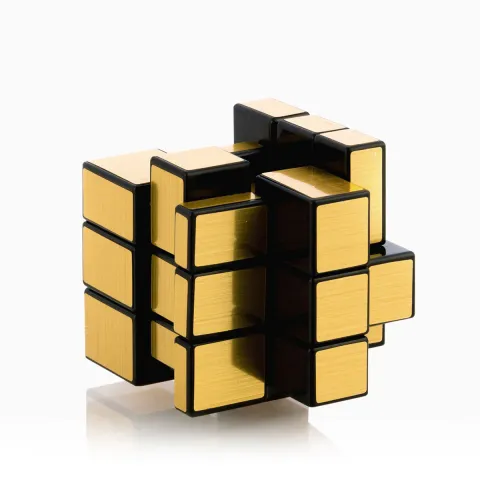
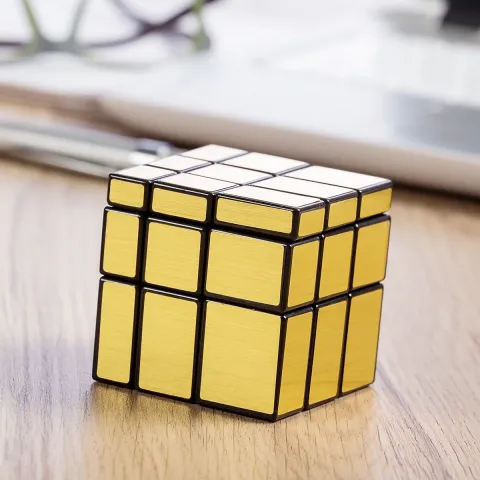
- Mirror Cube:
- In this cube, the pieces have different sizes and shapes, but are solved in the same way as the traditional Cube. The difficulty is in recognizing color patterns in non-uniform parts.
- Cubes with Different Spinning Mechanisms:
- In addition to variations in the number of pieces, some cubes have different turning mechanisms, such as Skewb, Pyraminx and Megaminx. Each has its own unique resolution rules and strategies.
These are just some of the many variants available. The community of enthusiasts continues to explore new possibilities, resulting in a wide range of three-dimensional puzzles for all levels of skill and interest.
The 3×3 3D Magic Cube
Among the various variants of magic cubeThis model is 3D! Yeah, when you spin the pieces, the cube changes shape.
Conclusion
The Cube remains as a lasting icon that transcends generations. Yeah, its apparent simplicity hides complex challenges, encouraging puzzle enthusiasts to explore their cognitive and manual skills.
The rich, intriguing mechanical history and vibrant community make the Cube much more than just a puzzle; it is an experience that continues to captivate and inspire people around the world.
While the fingers rotate the colored faces, he continues to amaze and delight, remaining a timeless wonder in the world of three-dimensional puzzles.
(Credits) Image by jcomp on Freepik)