
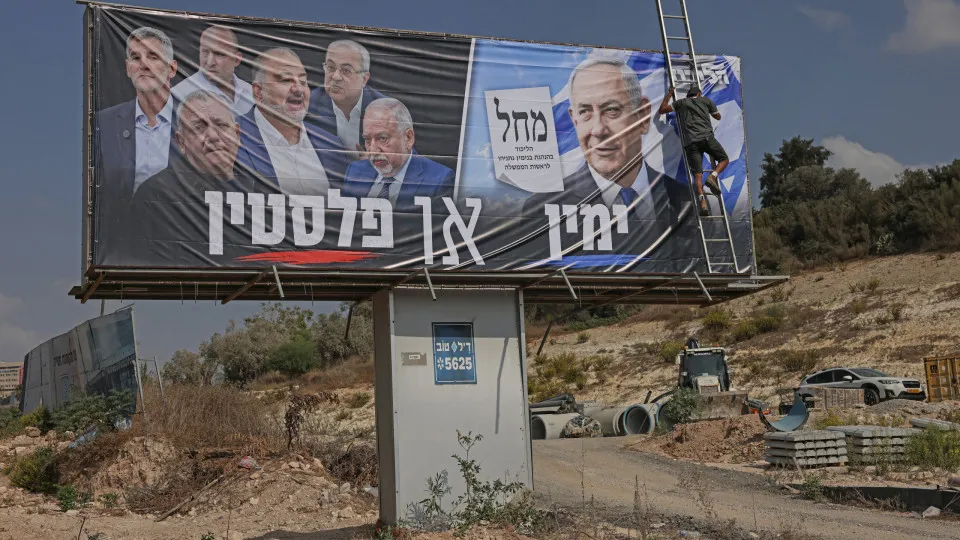
Nazareth, an Arab city of 75,000 inhabitants, can play a crucial role in the Israeli elections on October 27, with Arab forces trying to influence the country's future.
© AHMAD GHARABLI / AFP via Getty Images
22/10/2026
by
Lusa
Nunlucky presents itself as a city abandoned by biblical tourists and undermined by organized crime, but this Arab bastion can play a central role in choosing the next government in Israel. As long as someone wants their votes.
Less than a week from the October 27 legislative polls continue without pointing out a clear winner: neither the Likud Party, the Prime Minister, Benjamin Netanyahu, nor Yashar!, the former Chief of Armed Forces Gadi Eisenkot. Not even through coalitions allowing one or the other to control the 120 seats of the Knesset.
It is in this complex equation of post-election alliances and tiebreakers that the two Arab formations enter, the Joint List (a union of candidates from the Balad, Hadash and Ta’al parties) and Ra’am, a moderate Islamist force, which was unprecedented in the Government that preceded Netanyahu and which, for the first time, launches a surprising Zionist candidate on their lists, the former commander of the Yoav Segalovitz police.
As Israel rises on the map northwards, the landscape is becoming more and more Arab, towards Nazareth and its 75,000 inhabitants, the main city of a vast network of other Palestinian majority settlements and a stronghold of this community representing 21% of the population of Israel.
In the campaign for one of the most uncertain elections of all time, there is a feeling that this is a rare opportunity for Arabs to be the electoral joker and have a say in the future of the country.
“ We will put all our power in this vote”, says Lusa Fadi Ajawi, a member of Ra’am’s political committee, who, as of next week, expects to be in a position to overthrow the current alliance of the head of the government with the far right and, in the light of the polls, risks losing the renewal.
Since the attacks of the Palestinian Islamist group Hamas on 7 October 2023 in Israel, Ra’am’s politician describes that the discrimination of Arab citizens has been degraded in recent years by action of “an increasingly aggressive right-wing government that has left them in danger and completely alone”.
If it is not stopped immediately, he fears that the next step will be “the expulsion of the Arabs themselves” from the country, as he says is “more and more clear” in speeches that “have already lost their shame” and become public.
“That’s why the first step has to be simply to push Netanyahu away, [Itamar] Ben-Gvir and [Bezalel] Smotrich. Then one can see”, he insists, referring to the ultranationalist and anti-Arab leaders who are part of the government bloc.
Less than a month has passed since these expectations were strengthened when the Supreme Court reversed a decision by the Electoral Commission which, at the request of the far right, kept the Arab parties from legislative. At the time, it was reported that many inhabitants of Nazareth were glued to television sets and exalted the decision in those same dirty streets, in crisis and shops without customers.
The challenge “number two” is participation. Four years ago, only 56% of Arab voters voted in the vote that returned Netanyahu to power, after the short-lived government, headed in rotation by Naphtali Bennett and Yair Lapid, and which had unprecedented participation in Ra’am. Now, Fadi Ajawi expects the bar to exceed 75%.
Only then will integration be decided in a possible coalition government with the present opposition forces. The question is, do they want her.
In his statements, Gadi Eisenkot, the main favorite to overthrow Netanyahu, has discarded a government with the Arab forces, plus his pro-Palestinian agenda, which may collide with the intention of continuing the security policy of the current executive and driving away the basis of his centre-right electorate and Jewish majority. Other opposition leaders have also expressed this rejection.
But this does not seem to be a big problem for Fadi Ajawi, who points to a “plan b”, through the parliamentary support of the Arab parties to a minority executive, who guarantees its survival in important votes, as currently happens with Likud and the ultra-orthodox in the Knesset.
Nor does it seem to upset the continuity of an agenda that could compromise the interests of Palestinian neighbours in the West Bank and Gaza Strip, as Ra’am “may be in an initial position to influence policies”. But for this, he must enter “at the center of the decision”, that is, in power, and preserving the moderation of his leader, Mansour Abbas, who claims to miss the other Arab formation, the Joint List.
Sitting next to a dry olive tree, Mbada Seleman, an invalid 58-year-old pensioner, would be tempted to agree to a golden opportunity in the next legislatures, although politicians who appear in that stone garden in the center of Nazareth with a paper in their hand and a flower in the other: “They ask for a vote without saying what. And what do you want me to do with a wilted flower?”.
Despite being ignorant in political matters, this Arab elector has no doubt about the priorities that lie with his community on October 27: “Peace, peace, peace”, after a cycle of “aggressiveness of the right, which, as we know, causes even more instability”.
Unbelieving in electoral cycles, which every four years, or less, “promise changes that never happen”, warns that these elections will only be winners “if the Arabs unite and move away the people who created this situation,” referring to the government coalition and the tension between the communities, especially the Jewish and Islamic ones.
“My son lives in Tel Aviv. He wears different clothes there, because he doesn't want to risk being seen as a radical. He had to change his whole life, even his appearance”, laments in vent: “This has never been so.”.
In the Arab political heart in full Jewish state, “cars have disappeared, trade has closed and no one is seen on the streets,” says Abdallah Ahmed, a 64-year-old unemployed man who describes “an undesirable city”, even for the few who still visit Galilee and the place where the New Testament places the announcement of Jesus’ birth.
“ We used to have thousands of visitors a day, now only a few groups from time to time”, reports Wojciech Bołoz, guardian and rector of the Church of the Annunciation, at the door of one of the most sacred temples in the Christian world, while inside they only prayed two faithful.
As antecedents of this crisis, which also affects the Basilica of the Nativity in Bethlehem and the Church of the Holy Sepulchre in Jerusalem, the Polish official points to the pandemic of covid-19, which barely ended, gave way to the 7th October and to the war that followed in the Gaza Strip, to the south, and on the border with Lebanon, to the north, in addition to the rampant increase of violence in the occupied West Bank.
Mass pilgrimages have been eclipsed and, with them, the engine of an entire city, living “under very great economic pressure”, accompanied by the collapse of the finances of local authorities and the brutal increase in organized crime and armed violence, which in recent years has become one of the main concerns of the inhabitants.
“The crisis and mafias are causing many Christians to leave elsewhere in Israel or neighbouring countries,” according to the church’s guardian, contributing to these departures so that the city becomes “more and more Arab.”.
And it is this population that will be able to awaken on October 27. But until then, it also has to fight so that the power that emerges from the elections will hear it.