
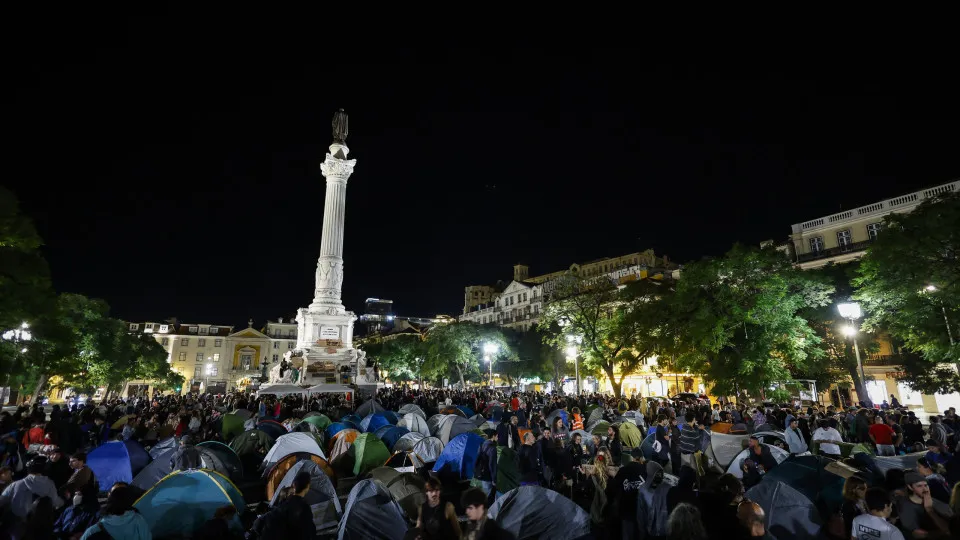
In 15 years, there were at least seven camps, two already during the term of the Government of the Democratic Alliance. In none of them the tents were raised by the authorities or there was police interference. So what's different about this one?
© FILIPE AMORIM / AFP via Getty Images
22/10/2026
by
Acamped protest and social claim gained projection in recent days in Portugal, against the housing crisis, the high cost of living and the difficulties of access to a dignified house.
However, contrary to what seems (and some will think) this type of protest is not original. It has been replicated over time, a little around the world and even in Portugal. But governments never looked at them as a problem. They never mentioned the law to force protestors to remove tents from squares and roses.
Yesterday, at SIC News, journalist and commentator Daniel Oliveira, listed a series of camps that have gone on over the last decade without muscled police intervention and without ministers emphasizing its prohibition. One was even played by the Democratic Social Youth (JSD) and two were already held during the term of the Government of the Democratic Alliance (AD).
Seven camped in 15 years
In may 2011, when the Troika arrived in Portugal, in the government of Pedro Passos Coelho, there was a camp in Largo do Rossio, in Lisbon, for the political, economic crisis and demand for a “true democracy”. It lasted two weeks and counted on about 200 young people.
In september 2018, students displaced in Porto against the serious crisis of student accommodation and the prohibitive prices of the rooms also made a camp, under the motto: “Displaced students = Students on the street”.
A 6 october 2020, during the Covid-19 pandemic, the Social Democratic Youth (JSD) organized a protest with tents in Lisbon, in front of the Ministry of Higher Education for promised beds. The camp in question was then led by the current vice president of the PSD, Alexandre Poço.
In november 2020, even during the pandemic, the restaurant entrepreneurs camped in front of the Assembly of the Republic (AR), in Lisbon, and in Porto, against the restrictions imposed by the State of Emergency. At the time they were visited not only by Members of the Cávez, but by Members of parties who today belong to the Government.
More recently, in april 2023, the teachers camped at Largo do Rossio in Lisbon, and then moved to Camões, where they remained for two weeks.
In september 2024, with Luís Montenegro as Prime Minister, the firefighters set up a tent in front of the City Hall of Porto and stayed there for 42 nights, for the increase in wages, reduction of retirement age and career enhancement.
Already in march this year, also with the current Government, students of the Instituto Superior Técnico (IST) made a camp in Alameda, Lisbon, to claim more rooms and lower values.
“Government would like you to care about the violence of France”
In neither case, the fact that there are attempts mounted in iconic places of the capital and Invicta in protest was a problem during the last 15 years. Therefore, as Daniel Oliveira notes, “of both: either there is a case-by-case management of what we think of camp or this idea that there is absolute rigor in this matter depends on the inconvenience that the camp causes or does not cause the government and protests”.
“There are camped in this Europe outside, in Spain, everywhere. It is not a subject for the camp ", noted the commentator, emphasizing the fact that this was "a political order".
“There is nothing more dangerous than a fragile Minister of Internal Administration (MAI),,” he said, recalling the words of Luís Neves and the fact that the Public Security Police (PSP) intervention on protesters occurred “at the same time in Porto and Lisbon at 6 a.m.”.
“The government has decided to make tents, the question of camping and tents, an arm of iron and there is no day that I do not see from Luís Montenegro to Luís Neves and other ministers saying ‘we cannot import violence’,” he said, recalling that all the camped by the right to housing have been, until now, peaceful.
“ So many times they say this without any act of violence that what I conclude is that they would like to care about the violence of France and would like not to have to talk about housing, so that we can talk about violence, so that we can talk about thugs, that is, what they really want to do is try to corner a movement, which is a movement that they know perfectly well that has a huge echo in the Portuguese population because we are the country that has the worst housing crisis in all of Europe. And it is extraordinary, and I am glad for that, the serenity that these movements have”, concluded the journalist.
“ Camps are over. The law is to be fulfilled”
Remember that Luís Neves said last Tuesday that “the law is to be fulfilled” and that “camps have ended”, also appealing to organizers of the demonstrations so that they do not “let the extremists infiltrate”.
The ruler recognized the “right to manifestation, to the exposition of motives” with “all tranquility, with all normality, with all legality” But he threatened that “anything that goes beyond this legality and goes into violation of the law will have the appropriate answers from the security forces.”.
Luís Neves, who began to congratulate the Public Security Police (PSP) this morning in Praça D. Pedro IV (Rossio), in Lisbon, where 55 protesters were arrested, argued that that security force “acted with all professionalism, with all the knowledge, with all the calm, in order to restore public order”.
“ I have said more than once that the right to demonstration is a legitimate, constitutional right, which has been restored for decades so that people can speak according to what their convictions are. The theme of this wave of demonstrations is about housing. It is an absolutely legitimate, human right, and so there will always be all the acceptance of following these moments”, he insisted.
Then the minister appealed to “promoters of demonstrations”: “Do not let the extremists infiltrate.”
“ If anyone thinks that there are other mimetic effects that will be reflected in our country with violence and trying to spread chaos here, they are completely mistaken because the strength, firmness and robustness of security forces in the restoration of public order will be an absolute reality ", asserted.
The minister also assured that “the law in this country is to prevail”, not only on the subject of housing, but “a global form”.
“The law is to be fulfilled. The strength, firmness and strength of forces are to be exercised when necessary”, he stressed. “All valences of the State – prevention, public order and criminal investigation – will be triggered whenever the law is deregulated.”
“ Let no one dare try to bring chaos here or bring violence. Any extremist and extremist criminal behaviour will of course be repressed,” he said.