
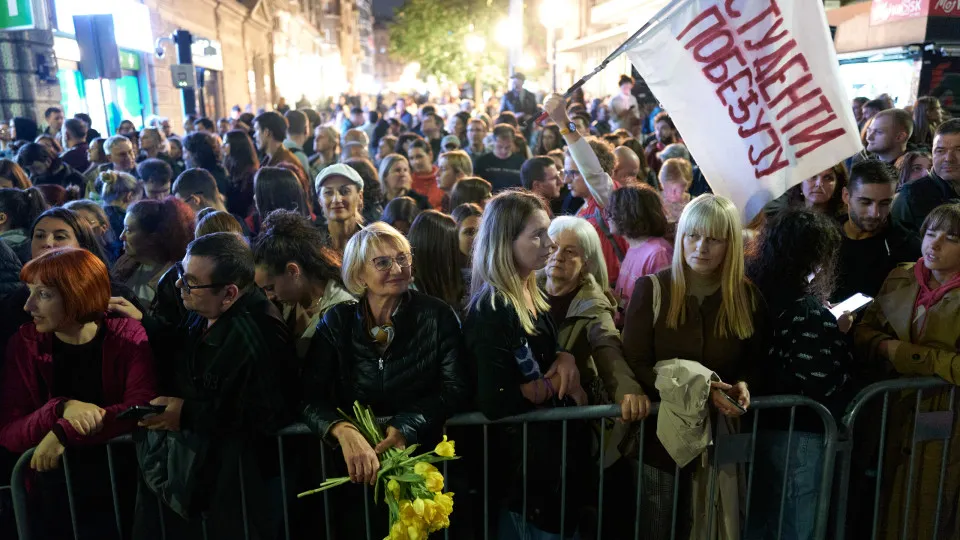
The director of Serbia’s RTS resigned after pressure from the winning student movement of the early elections, which accused the station of partiality in information coverage.
© Getty Images
28/10/2026
by
Lusa
A director of the public media group Radio and Television Serbia (RTS) resigned today, one day after the request made by the student movement winner of the early parliamentary elections on Sunday.
The opposing Student List obtained in the absolute majority ballot in the Balkan country, removing from power the almighty former ultra-conservative president Aleksandar Vucic.
“Manja Grcic resigned from the position of general director of RTS,” reported the station, adding: “His resignation had been demanded by the RTS workers’ union, informal groups of station employees and the Student List.”.
Grcic, who had been in office since February of this year and was considered close to Vucic for years, said he was willing to “provide all the necessary cooperation” to ensure an orderly transition, allowing RTS to continue to operate.
On Tuesday, the student movement requested, through a letter, the resignation of the director-general of RTS, his assistant, the editors responsible for the current coverage, as well as all the editors of the information department.
The student movement accused RTS of partially processing information and of not exercising critical control over political authorities.
On election night, the station interrupted the coverage of events in Belgrade shortly after former nationalist President Aleksandar Vucic recognized defeat, despite the celebrations taking place on the street throughout the country.
The Student List also required the creation of a provisional direction for RTS, a proposal made together with the unions representing the public station workers, accused by their critics of not having fulfilled their public service functions.
“ Citizens are entitled to true, complete and impartial information,” the List said after the election victory.
According to the non-governmental organisation CRTA (Center for Research, Transparency and Responsibility), during a week of the election campaign analyzed, RTS devoted 93% of its time to Vucic and other government representatives, while the opposition obtained only 7% of the time and largely negatively.
In Serbia, the vast majority of the media, including the RTS public station and the private ones, have been controlled by Vucic or by people from its nearby circle.
In 2025, the former Serbian Head of State was included by the Organisation Reporters Without Borders (RSF) on its world list of 34 “Press Freedom Predators”.
In Novi Sad, northern Serbia, the regional public station RTV asked on Monday for an apology for failing to fulfil “for many years” its public service function, and the channel director presented the resignation.
In the early parliamentary elections on Sunday in Serbia, a list supported by students achieved a historic victory over the right-wing nationalist party SNS, Aleksandar Vucic, ending 14 years in power.
This victory took place after two years of protests triggered by the collapse in 2024 of the roof of a porch at the Novi Sad railway station, a tragedy that resulted in 16 deaths.
Widely attributed to corruption, the catastrophe has caused some of the largest demonstrations in Serbia since the fall of authoritarian leader Slobodan Milosevic in 2000.
Throughout the protests, students repeatedly accused RTS of deliberately ignoring and defaming demonstrators.
At the same time, civil society organisations and media associations urged regulatory authorities to withdraw their licence from Informer TV, a private channel aligned with Vucic, alleging repeated violations of press law.