
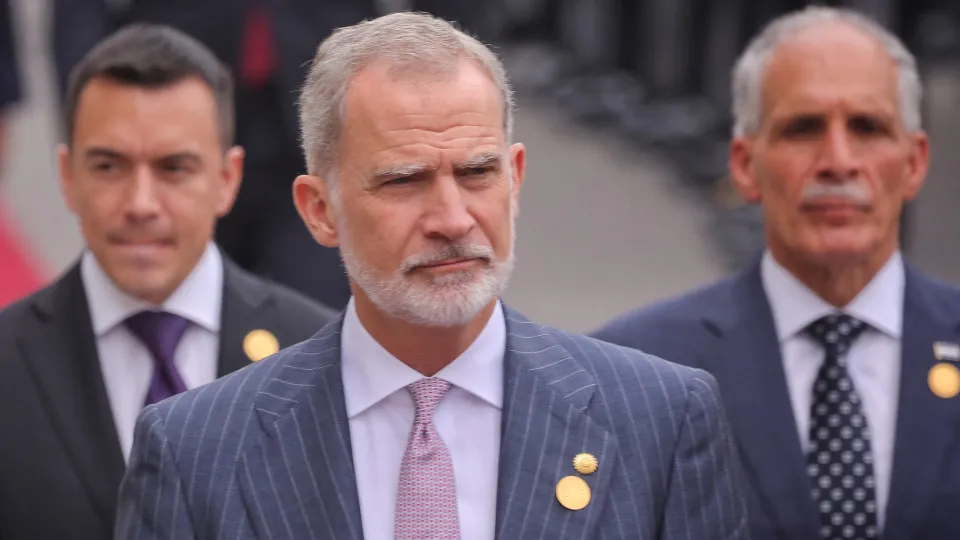
King Philip VI visits Ceuta, a city with migratory tension and sovereignty dispute, on the first visit in 20 years of a Spanish head of state to the region.
© AFP via Getty Images
11/10/2026
by
Lusa
O King Philip VI makes on Tuesday the first visit in 20 years of a Spanish head of state to Ceuta, whose sovereignty is claimed by Morocco and where in July more than 70,000 people entered illegally.
Felipe VI will visit Ceuta for the first time since being proclaimed King in 2014 and will sleep in the city, so he will also be the first head of state of Spain to sleep in the Spanish enclave in North Africa since 1927.
After the passage by Ceuta, Felipe VI and his wife, Letizia Ortiz, follow Melilla, the other enclave of Spain in North Africa and with borders with Morocco.
The last visit of a Spanish head of state to Ceuta and Melilla was in 2007 on the only trips to the enclaves that Juan Carlos I, the father of the current monarch.
The movements of a few hours each of the cities of Juan Carlos I then triggered a diplomatic crisis with Morocco, which temporarily removed the ambassador from Madrid.
The Spanish press, citing several sources of the time, reported that the visits of the previous monarch were announced to Morocco and negotiated with Rabat, with the reaction of the Moroccan authorities to be already expected by Madrid.
This time, the visit of Felipe VI and Letizia Ortiz has as a scenario the crisis triggered in Ceuta with the illegal entry, on 30 and 31 July, of more than 70,000 people in that autonomous territory, in what the Spanish Prime Minister, Pedro Sánchez, described in those days as an attack and a violation of the territorial integrity of Spain.
What happened in Ceuta on 30 and 31 July and the crisis on the ground that triggered – with thousands of people remaining illegally in the city, an increase in tension between the population and migrants and reports of some episodes of violence – remain to this day at the heart of the public and political debate in Spain, with the Government of Sánchez being the target of widespread criticism, from the left and the right.
The executive has been accused of a slow response to the situation on the ground, with thousands of people sleeping on the streets and beaches of Ceuta until a few days ago and subservience to Morocco.
Only more than a month after what happened Sánchez admitted doubts about Morocco's role in this crisis and said he asked Rabat for “actions and explanations”.
As for the situation on the ground, the executive has stressed the scale of the crisis and has left criticism to local authorities, saying that they have made it difficult to provide space for the reception and registration of migrants before the completion of the repatriation or asylum procedures, as required by the European Migration Pact.
Ceuta also jumped to the heart of the European Union's migration and border management debate (EU), which has the only land borders with Africa in this city and in Melilla.
Ceuta and immigration, along with the housing crisis, will be the themes that predictably dominate the campaign for early parliamentary elections on November 29, in the meantime called by Pedro Sánchez.
According to the agenda announced by the Royal House, Felipe VI will receive and meet in Ceuta on Tuesday with local authorities, representatives of civil society and leaders of the various religious communities of the city, who have been proud to be “the city of the four cultures” for centuries (Catholic, Muslim, Hindu and Jewish).
More than 40% of Ceuta's population are Catholic and more than 40% are Muslim.
Felipe VI and Letizia Ortiz will also participate in an ecumenical ceremony at the Muslim cemetery Sidi Embarek de Ceuta, where more than 80 people who died on 30 and 31 July are buried trying to enter the city swimming and whose bodies were rescued on the Spanish side of the border.
“Military sources” quoted by the newspaper El País said that Felipe VI’s visit “will not go unanswered” by Rabat.
According to the most recent figures of the Spanish Government, most of the 70,000 people who illegally entered Ceuta on 30 and 31 July left almost immediately in the following hours and days.
Since August 10, another 11,026, the majority voluntarily left (except for 513 people expelled for crimes and offences).
According to the executive, there are currently more than 7,000 places for temporary accommodation and registration of migrants in Ceuta, with around 6,000 adults remaining in these centers.
As for minors, there are 2,827 in Ceuta reception centers, 86 were regrouped with relatives who already lived in Spain and 179 were transferred to other regions of the country.
The government says there is no estimate at this time of how many people remain in Ceuta illegally and that there will be numbers only when the process of housing, registration and repatriation of all is completed.
The executive's estimate is that by mid-month all the beaches and other spaces of Ceuta no longer have illegal camps and that the situation is normalized in the city by the end of the year.