
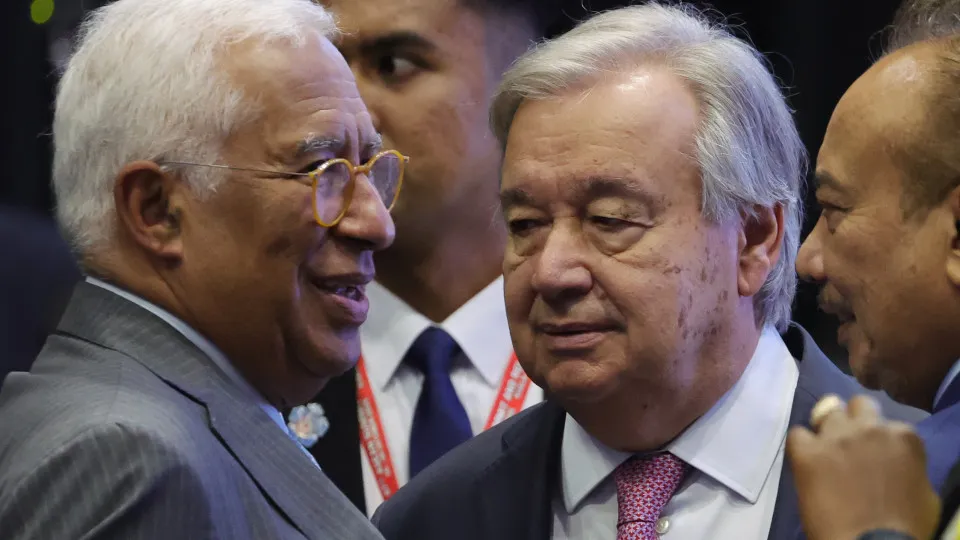
The 30th Ibero-American Summit, which will take place on 4 and 5 November in Madrid, will be attended by UN Secretary-General António Guterres and the President of the European Council, António Costa, as special guests, according to the Ibero-American Secretary-General.
© Lusa
23/10/2026
by
Lusa
A 30th Ibero-American Summit, on 4 and 5 November in Madrid, wants to reaffirm this community of countries and will have the Secretary-General of the UN and the President of the European Council as guests, was announced today.
The Secretary-General of the UN, António Guterres, and the President of the European Council, António Costa, will be the two “very special guests” of a summit where, on the other hand, Angola will be formally accepted as a permanent observer country of this community of 22 Iberian American countries, according to the Ibero-American Secretary-General (known as SEGIB).
The Ibero-American summits take place every two years and Portugal proposed to host the 2030s, which will follow the 2028s in Honduras.
The Portuguese proposal was made last September and was welcomed by the other Ibero-American States, confirmed to Lusa today the Ibero-American Secretary-General, Andrés Allamand.
The 30th Ibero-American Summit will have the motto “Ibero-America. Together we built our commonwealth. Together we project it for the future and for the world” and intends to politically reaffirm this multilateral forum and strengthen cooperation between Member States, according to the organisation.
The Madrid Summit follows that of 2024 in Ecuador, which was marked by the ever smaller participation of Heads of State or Government of the Member States (there were only four: the Presidents of Portugal, Ecuador and Andorra and the King of Spain) and for the first time it was not possible to reach a consensus for a final declaration.
“The Madrid Summit will focus on finding solutions to address the major global challenges” and “these priorities include” agreements and commitments for an “Ibero-American digital alliance”, the creation of an “Ibero-American disaster risk reduction network” or a mechanism for “recognition of studies and diplomas” in order to “facilitate mobility and expand the opportunities of young people”, according to information published by SEGIB.
Another objective is to “relaunch Ibero-American cooperation to make it more efficient and effective”, with “more strategic planning”, in order to be “more concerted and with a global vocation” and for “political consensus” to become “a tool of direct impact for citizens”.
“ It also seeks a greater external projection through alliances and assigns a more relevant role to observers”, reads in the same information released by SEGIB.
The community will have 15 permanent observer countries in Madrid, with the incorporation of Angola, India and Turqia into a group of which make Germany, Belgium, South Korea, the Philippines, France, Haiti, Hungary, Italy, Japan, Luxembourg, Morocco and the Netherlands.
The first Ibero-American Summit took place in 1991 in Guadalajara, Mexico. Meetings were repeated every year until 2014. Since then, they've been every two years.
The community consists of three European countries (Portugal, Spain and Andorra) and 19 Latin Americans (Argentina, Bolivia, Brazil, Chile, Colombia, Ecuador, Paraguay, Peru, Uruguay, Venezuela, Mexico, Costa Rica, El Salvador, Guatemala, Honduras, Nicaragua, Panama, Cuba and the Dominican Republic).
At most summits, Portugal has been represented jointly by the Heads of State and Government, as is planned for this year's meeting in Madrid.
The list of Heads of State or Government who will be at the summit this year has not yet been published, with the organisation only ensuring that all countries will be represented, even at the level of Foreign Ministers.