
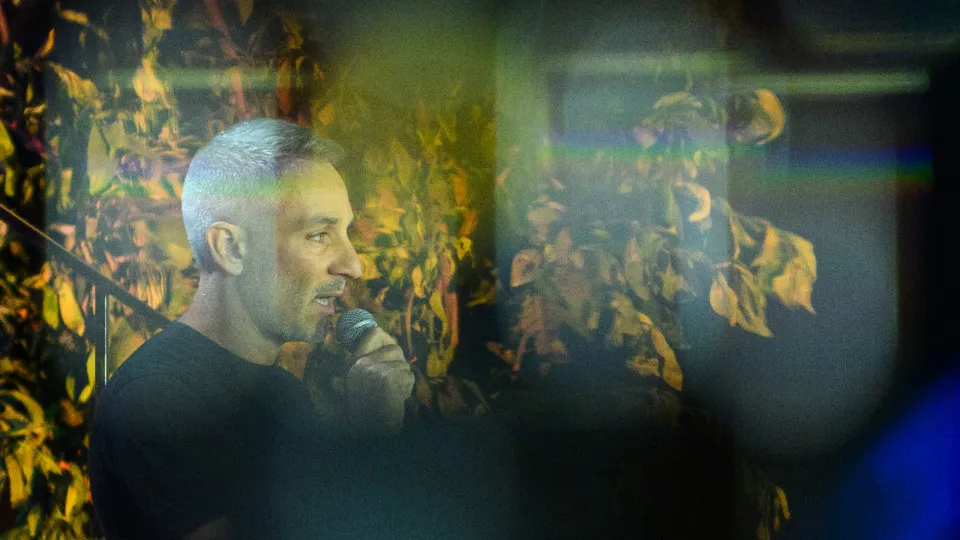
Among the reconstruction of the Kibutz Be’eri, which lost 102 residents on October 7, an educator and activist leads a movement to change the thinking of Israelis and Palestinians, because one cannot live “under the law of the sword”.
© Alexi Rosenfeld/Getty Images
26/10/2026
by
Lusa
ANDamong the reconstruction of the Kibutz Be’eri, who lost 102 residents on October 7, an educator and activist leads a movement to change the thinking of Israelis and Palestinians, because one cannot live “under the law of the sword”.
Omri Shifroni, 41 years old and father of three, was born and raised in Be’eri, educated on a “Zionist, democratic and humanistic” basis, and having “always in mind” that the Palestinians are only about four kilometres from this community of southern Israel and “go nowhere”.
This mentality accompanied his education as an educator and then as a co-founder of the Kumu (erge yourself), a movement that took on a national dimension after it was founded by families hit on October 7 and that intends to start from the events of that morning of 2023 to form “a new generation of leaders”.
On the eve of a legislative election dominated by the uncertainty and weight of the attacks of the Islamist Hamas group, which three years ago killed about 1,200 people in this region, Omri Shifroni expects a change of government in Tuesday's vote. But his work is a long-term marathon that does not end in a four-year political cycle.
“Of course Israel needs a new leadership that takes responsibility and finds new solutions to the situation of the people of Gaza and the Palestinians of the West Bank, because one cannot live forever under the law of the sword,” Lusa said.
But he hopes that “the memory of October 7 will become a starting point to change the way of thinking about Israel and the values of Israel,” he points out in the same house where he hid 12 hours in an air-raid shelter during the attacks of Palestinian militias, who killed two 12-year-old uncles and two twin nephews.
The attacks began shortly after 6:30 that Saturday in Be’eri and other kibutzim in the region, in addition to the Nova music festival, which took place in the vicinity, when, remember, “more than 300 terrorists, perhaps 400, began to go from house to house to commit murders and set fire to buildings”.
One hundred and two people died in this place and another 30 were taken to the Gaza Strip as hostages.
Before it was invaded, the community had about 1,200 inhabitants and only six personal weapons, which were used to defend itself until the arrival of the Israeli military: “They were heroes and saved many families, although, of course, they did not save those who were already lost.”.
Twenty soldiers were also shot down in the fighting that lasted three days.
“My wife and two children were at my father’s house. The terrorists entered, shot inside, but fortunately did not try to open the shelter door ", recalls still, in the reconstruction of that morning.
While staying in the shelter, he had little contact with the outside world, although he was informed of the scale of the attacks in the south of the country, but ignoring that his other four relatives had been reunited in a house less than a hundred metres away in a group of 15 people, of whom only two survived.
Three years later, part of the kibbutz is a shipyard, between machine movements and reconstruction works, exhibiting nearly ready-to-rehab white earth residences and others that remain charred and in ruins.
The kindergarten is closed, but the printery, which is one of Bee’ri’s engines, is producing “and healthy”.
Only about a hundred residents returned. The others are expected when the work is completed and life returns to the arid surface of this sealed place and now protected permanently by the army.
“ No community, no matter how small and lost 100 people in one day, can be the same again. It will be a place full of life, where children run, laugh and play on the grass, and happy to live, but definitely will not be the same”, regrets.
However, geography will not be changed and the Gaza Strip border will continue to remain two pairs of miles from Be’eri.
Omri Shifroni notes that “fear has always been a part of” the lives of these Israelites and will continue to be, as “the Hamas terrorists are still there and continue to rule” the Palestinian enclave, despite the large-scale military campaign of Israeli forces since 2023.
“ The people of Gaza will stay there and we will stay here. Nobody's going anywhere. We must find a way to live, not together, but side by side,” he says, warning that “hate is fostered above all by fear” from one side to another.
But this coexistence, he argues, “cannot happen under the control of a terrorist organisation and it is necessary, first of all, to disarm Hamas, so that we can talk”, an initiative contemplated in the roadmap proposed by the United States, a year after the ceasefire in force on the territory, despite the successive mutual accusations of violation of the truce and continuation of Israeli attacks.
The proposal collided with the refusal of the Prime Minister, Benjamin Netanyahu, to withdraw his troops from the enclave until the Palestinian group handed over its weapons, and the peace negotiations fell to a standstill, a key theme of the forthcoming legislative in Israel.
The latest polls indicate that Yashar!, of the former Chief of the Gadi Eisenkot Armed Forces, has a slight advantage over the Likud, Netanyahu, but in both cases none of them achieves the majority of 61 seats to control the parliament, either through post-election alliances with pro-government forces or the so-called bloc of change, unless the latter understands itself with the Arab parties.
With broader horizons in the calendar, Shifroni believes that it is necessary to “re-educate the people of Gaza, after decades in which he was incited to hate Hamas”, just as, in both Israel and neighbouring territory, “war is certainly not the solution”.
However, he fears that “peace is not the solution at the moment either”, since “it is difficult to achieve it when there is so much hatred”, which calls for “a new education system” on both sides of the border.
“That’s why we’re trying to make all people, all communities, feel part of the story of October 7th. Because this affected everyone ", highlights the activist, about the work of Kumu, which holds the only national memorial ceremony of the bloodiest day in the country.
The polarization in these laws reflects “a very divided society,” according to the Israeli of Be’eri, and the national initiative of October 7 ends up functioning as a starting house to reflect the events of that morning, “whether it be soldiers, members of a party, people of the Kibutzim or in cities such as Ofakim and Sderot”, in the vicinity of the Gaza Strip.
“ We are providing a way to rebuild the values of the country, through its stories – of an Arab person or the religious right – and that really happened, on the basis of the common pain to unite in the coming years,” he explains.
This whole region at the gates of the Negev desert is pursued by the haunting of October 7th, not only Be’eri, but also the kibutzim of Nir Oz and Kfar Aza, in addition to the festival Nova, where about 350 people were killed and dozens taken hostage.
That's where a cab driver from Ashkelon drove when he started getting videos of his brother showing his girlfriend being assaulted.
“ When I got there, I was dead. Later I learned that my brother also died,” he told Lusa Ofir, 52, displaying the flag of Israel and the date of October 7, 2023 tattooed on the right arm.
In addition to the two losses, he says that his son survived but was taken in bad condition to the hospital and he himself managed to escape the vicinity of the festival. But before that he was severely assaulted. When he returned to Ashkelon, his building had been hit by a Hamas rocket.
“There are many stories of these around here,” says the founder of the Kumu movement, reflected in the New Festival enclosure, made a place of memory to the victims of a “ cruel and barbaric attack”, as described at the entrance, as well as visits, reflections and organized enlightenment sessions.
Several dozen visitors walk between artistic facilities, eucalyptuses and acacias resistant to desert aridity, which frame hundreds of tributes to the victims, with their names, portraits, candles and even small biographies.
In some cases, personal objects were left, such as clothing pieces, a book or the scarf of a football club, which belonged to names absent in the electoral notebooks next Tuesday, but which will somehow be present in a decisive vote.