
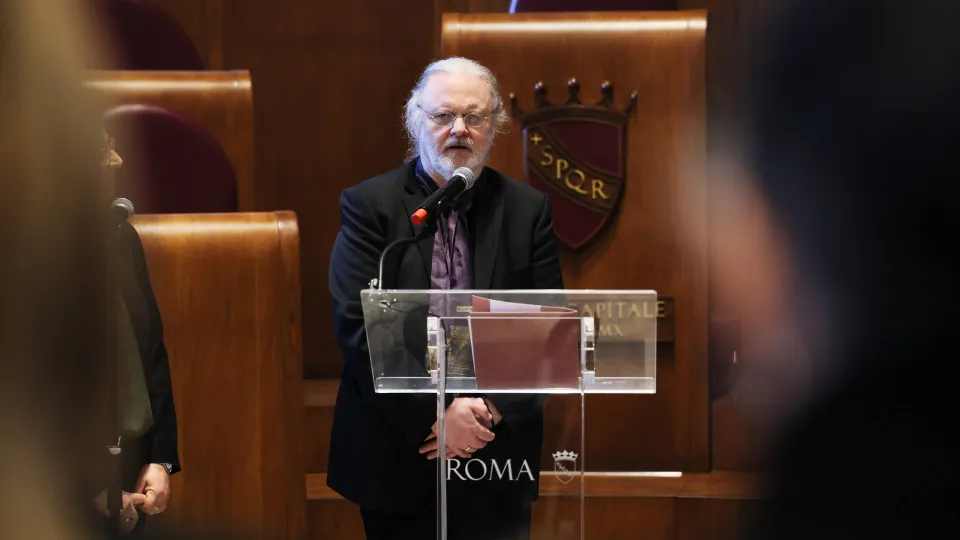
The Nobel Prize in Literature Jon Fosse stated on Saturday, in Folio, in Óbidos, that the prize is a blessing, but also a curse for a shy and reserved writer who cannot leave home without being recognized.
© Ernesto Ruscio/Getty Images
11/10/2026
by
Lusa
Jon Fosse
O Nobel Prize in Literature Jon Fosse stated on Saturday at Folio in Óbidos that the prize is a blessing, but also a curse for a shy and reserved writer who cannot leave home without being recognized.
“The [Nobel of Literature] award is a blessing, but it’s also a curse,” said Jon Fosse, regretting not being able to leave home in Oslo (Norwegian capital), “without being recognized” and having to face “unless people” who approach him to “take selfies”.
For the writer, who on Saturday night shared with the audience of Folio – International Literary Festival of Óbidos, to be “shy and reserved”, this is one of the disadvantages of the prize he received in 2023 for the novels and pieces that the Swedish academy considered to give “voice to the unspeakable”.
The “indictable” was also the theme of the author’s table where he spoke of his writing, marked by “rhythms, pauses and silences” that help to transpose into the books “the unspeakable that cannot be said by words”.
In a tent of overcrowded authors, the Norwegian writer retreated to childhood and adolescence to remember having been a “bad student” he found in the song “a refuge”.
The same refuge he later found in writing that led him to try to pass on to the paper a near-death experience following an accident he suffered at the age of seven.
“ It took me years to think that it had been this accident that somehow shaped me as an ‘artist’, or made me an ‘artist’, when I saw myself outside the body, in a typical near-death experience”, he said, admitting that “at seven years was a remarkable experience”, which will have contributed to his “writing perspective”.
Little given to self-fiction, as a reader and as a writer, argues that “God must be present on the first page of a good text”.
In his books is notorious the impact of the landscape of the western region of Norway, where he grew up, near a fjord.
It was in this “imposite landscape” that he says he learned basic words such as “rain, stone or road” and it is to this landscape that he returns when he writes works such as the extensive septology that portrays the life of two men with the same name, Asle, one of them a widowed and lonely painter who reflects on art, God, mourning, childhood and his relationship with a double, the other Asle, alcoholic and destructive.
The work, in which it uses “elements used in other plays and other novels, but which are presented in a new context, from a new perspective”, is, so far, the most extensive of the writer with more than 70 books published, but for whom life continues to be “a huge mystery”.
“ The more I write, the more I learn, the more I read, the more mysterious everything becomes ", said Jon Fosse, that somewhere in this path he converted to Catholicism and seized the concept of "God", although, as a writer of the "indictable", assume that he cannot define it.
“It’s all a mystery and we have to accept”, he said, assuming “totally against all kinds of dogmatism and simplistic answers to these mysterious questions.”.
Without mysteries before readers who filled the tent of authors to listen to the Nobel Prize in Literature, Fosse spoke of books and life with the same “simplicity and depth” that he believes to be the apanage of his writing.
On Sunday, he talks to Folio readers again in a “life interview”.
The Folio – Literary Festival of Óbidos takes place until the 18th, under the motto “Beyond the skin”, with 450 authors who participate in about 300 initiatives around the literature.