
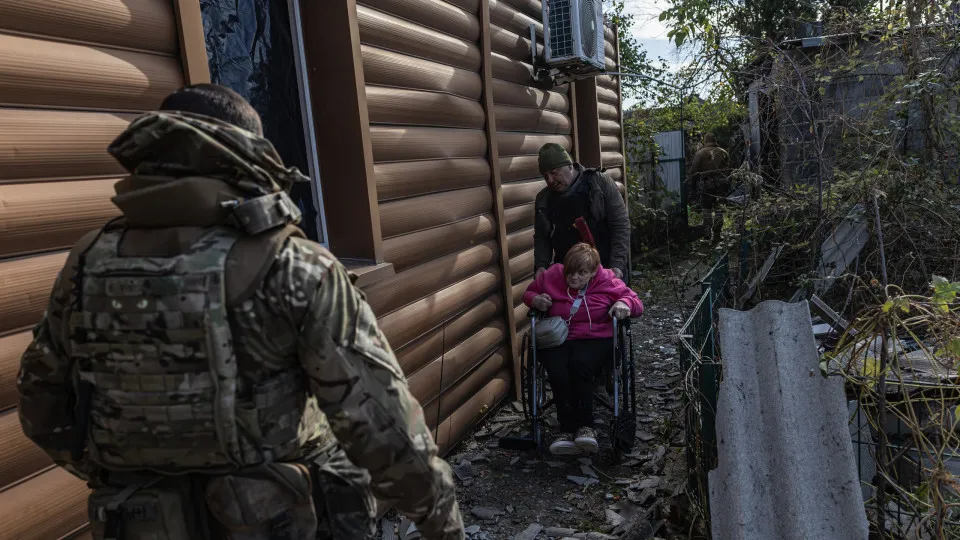
The UN called on the international community to maintain support for Ukrainians in the country and refugees abroad in the face of attacks on energy infrastructure and winter.
© Diego Herrera Carcedo/Anadolu via Getty Images
27/10/2026
by
Lusa
A The UN has today called on the international community to maintain its commitment and continue to support both Ukrainians in the country and refugees abroad in the face of the attacks on energy infrastructure and bringing it closer to winter.
Philippe Leclerc, Regional Director for Europe of the United Nations Refugee Agency (UNHCR), said today, through a statement, that Russian attacks on Ukraine are being relentless, taking place day and night, and target critical energy infrastructures.
These attacks bring “the risk of prolonged power cuts, leaving millions of people without heating, electricity and limited access to water and other essential goods.”.
The increase in attacks with long-range missiles and drones means that there is no safe place in Ukraine, stressed the head of UNHCR, according to which civilians, including those far from the front line, face threats to their security and their homes and often find it difficult to access basic services.
“The UNHCR, together with a solid network of non-governmental organisations (NGOs) Ukrainian partners, continues to provide emergency assistance and protection, which includes support for shelters, legal assistance, mental health advice and financial assistance,” said the head.
However, it indicated that its partners have faced recurrent attacks affecting their teams, vehicles and facilities.
“ Between 1 September and 14 October, 10 security incidents hit UNHCR officials or partners, including drone attacks and air bombings against — or near — humanitarian teams, offices, warehouses and vehicles clearly identified as transporting assistance,” he said.
Such actions, according to the UNHCR statement, put humanitarian workers at risk and damage essential resources used to provide assistance.
The UNHCR urged Russia to cease attacks on civilians and reiterated that workers and humanitarian resources should be protected and could in no case be treated as targets.
According to the UN agency, internal displacement is expected to continue, since removals from areas near the front line have increased significantly – since January 2026, more than 136,000 people have been welcomed into traffic centres supported by UNHCRm a number about 70% higher than those almost 80 thousand who have been in communities on the front line during 2025.
This represents only a portion of the total number of people removed from conflict zones, as many do not seek support in these transit facilities.
Many of those who have been forced to flee are in a situation of great vulnerability: almost 40% are elderly and a significant number are disabled people.
In all, 10.8 million people within Ukraine need humanitarian assistance, the United Nations agency underlines.
At the same time, there are almost 5.2 million Ukrainian refugees in several countries in Europe. With the start of the large-scale conflict in 2022, European nations reacted with extraordinary solidarity, guaranteeing millions of people immediate access to protection and assistance.
Mechanisms such as Temporary Protection — and other similar arrangements — allowed millions of refugees to gain, in an agile manner, legal status as well as access to rights and services.
Over time, the response has evolved from emergency assistance to focus on labour market integration, integration into national services and strengthening refugee autonomy, the UNHCR said.
Progress towards long-term inclusion in national systems is apparent: according to an interinstitutional survey released on Monday, in 2025, 67% of adult Ukrainian refugees in nine countries were employed, and 84% of refugee children were enrolled in national schools.
Increasing employability among refugees has contributed to labour supply, local consumption and tax collection. A recent Deloitte survey revealed that in 2025 Ukrainian refugees accounted for 2.4% of Poland's Gross Domestic Product (GDP), which is equivalent to around $24.4 billion.
On the other hand, after four and a half years of travel, signs of wear and tear begin to appear as pressure on the host countries and communities grows.
In view of the increase in anti-refugee rhetoric and hostility in some parts of Europe, it is essential to maintain solidarity and support for both refugees and the communities that welcome them, the UN agency defends.
Many Ukrainian refugees continue to face difficulties in finding affordable housing or a job that matches their skills and qualifications, among other problems, said UNHCR.
The UNHCR thus concludes that “this is not the time to distance itself, it is the time to protect the advances already made and to remain with the Ukrainians while preparing for the uncertainties of the coming months.”.