
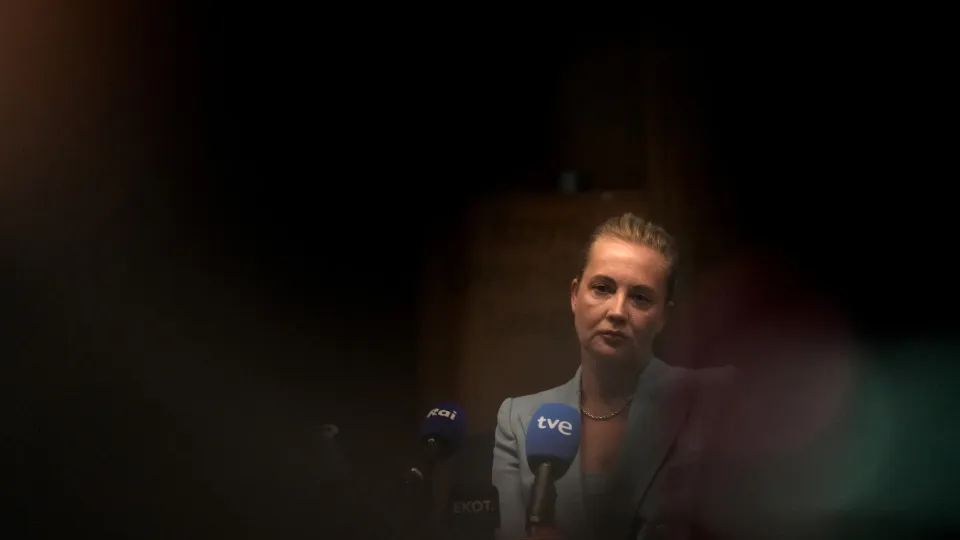
The exiled Russian opponent Yulia Navalnaya warned that the dictatorships of the 21st century are becoming smarter and collaborate with each other, defending a scientific approach to combat them.
© CARLOS JASSO / AFP via Getty Images
27/10/2026
by
Lusa
A russian opposer exiled Yulia Navalnaya warned today that the dictatorships of the 21st century are becoming “smarter and more cunning”, cooperating with each other, and defended that fighting them requires “a truly scientific approach”.
“ Unfortunately, in the 21st century, dictators became smarter and more cunning. They learn from each other, work together and help each other,” said during the launch of the report “Indice of Authoritarian Collaboration: Trend Report of October 2026” in London.
According to the widow of the Russian opposition activist Alexei Navalny, authoritarian regimes exploit and know how to exploit the financial and legal systems of Western countries and circumvent restrictions and sanctions.
“They always interpret the very idea of the rule of law in a peculiar way, using the laws to suppress their opponents,” he added, warning that they are “very dangerous” and that “never under any circumstances should they be underestimated.”.
For Yulia Navalnaya, “an effective fight against dictators is impossible without serious analysis, without a truly scientific approach”.
It was for this purpose that the Human Rights Foundation (HRF), to which it presides and is responsible for the Tiranny Tracker project, partnered with the Action for Democracy (A4D), which developed the Authoritarian Collaboration Index (ACI).
The Tiranias Tracker evaluates political freedom in 179 countries and territories, through indicators related to electoral competition, political freedom and institutional accountability, distinguishing democracies, hybrid authoritarian regimes and fully authoritarian regimes.
Among the Lusophone countries, Portugal, Brazil and East Timor are classified as democracies, while Angola, Mozambique and Guinea-Bissau are part of the category of fully authoritarian regimes, according to the respective platform charts.
Cape Verde and São Tomé and Príncipe are not classified.
The classification of the regimes carried out by HRF will now serve as a reference to the “Index of Authoritarian Collaboration”, which accompanies transnational relations between authoritarian governments, governments with authoritarian tendencies and parties that A4D considers authoritarian orientation in democratic countries.
The report released today refers to the formation of alliances by European “liberal” parties, including bilateral and multilateral contacts between far-right parties, such as the British Reform Party (UK), Nigel Farage, and the French National Union, Marine Le Pen, as well as the deepening of links between the Alternative for Germany (AfD) and the Kremlin.
Among the 139 actors monitored in October are Angola, Guinea-Bissau, Equatorial Guinea, and Mozambique, as well as the Portuguese Communist Party (PCP).
The report, which analyses the period from 1 March to 1 October 2026, identifies China and Russia as the main drivers of authoritarian cooperation networks.
Russia is presented as a protagonist in the supply of arms, training and troops to increase influence with African regimes such as Mozambique, which, according to the document, received weapons and military training from Moscow to combat Islamic insurgents in the north of the country.
The Communist Party of Vietnam, according to ACI, does something similar, promoting programs for the formation of ruling parties in Angola and Mozambique, the MPLA and FRELIMO.
For Navalnya, the partnership between HRF and A4D is important because “the dictators who cooperate can only be defeated if those who fight for freedom also cooperate”.
In the intervention, the activist expressed hope for political change in Russia, stating that the country's classification as fully authoritarian will not be permanent, invoking this year's political changes in Hungary and Serbia.
“ This morning, I consulted the Tiranias Tracker and said Serbia is a hybrid authoritarian regime. The yellow light is on and it seems that it will soon pass green, after the historical defeat of the party of Alexander Vujic the day before yesterday [Sunday]”, welcomed.