
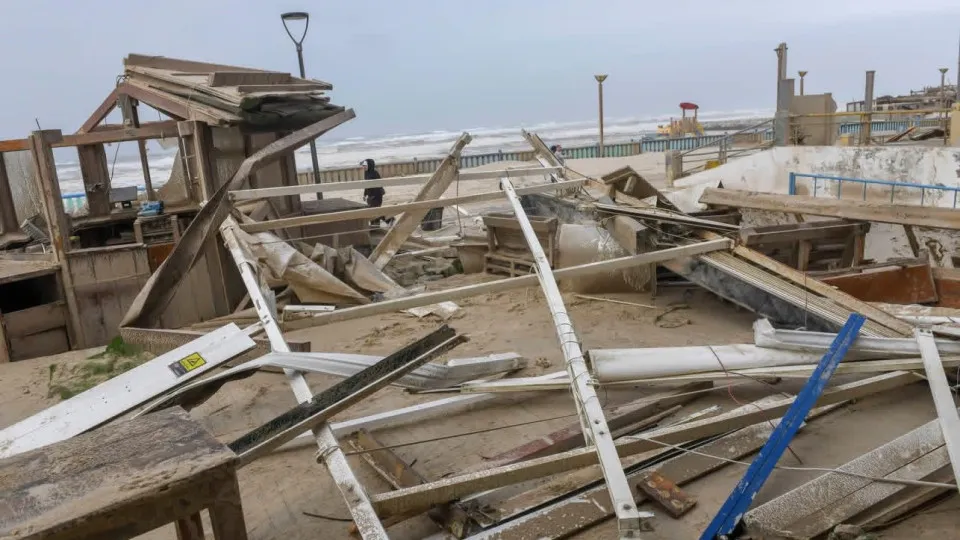
The Iberian Peninsula was hit by an “exceptional sequence” of seven atmospheric rivers in January and February, according to a study by the University of Évora.
© Vieira De Leiria – Praia da Vieira, Marinha Grande / Facebook
11/10/2026
by
Lusa
A Iberian Peninsula was hit by an “exceptional sequence” of seven atmospheric rivers in less than a month, between January and February of this year, a phenomenon observed and studied by the University of Évora, was today published.
“ We had an exceptional sequence of atmospheric rivers in this period, with very significant consequences in the territory,” said the director of the Research Center for Science and Technology for the Earth and Energy System (CREATE) of the University of Évora (UÉvora), Miguel Potes.
According to the researcher, quoted in a statement from the Alentejo academy sent to the Lusa agency, this sequence of episodes was, at the same time, “a unique opportunity to observe the atmospheric processes associated with the transport of moisture”.
To study what was happening above the surface, the university participated in an international campaign of “study of physical and dynamic processes” that “detach strong winds and precipitation and dry air intrusions in the North Atlantic and the Euro-Mediterranean region,” also analyzing “they are represented in the weather forecast models,” UÉvora explained.
This campaign, he stressed, “had the happy coincidence of occurring in a winter with several exceptional episodes of wind and precipitation in Europe and especially in the Iberian Peninsula”, hit by “seven atmospheric rivers” in that period.
The episodes of January and February left saturated soils and filled albufeiras and caused floods, UÉvora recalled.
At the same time, he stressed, they offered “a rare opportunity to observe, at altitude, the atmosphere that carried large amounts of moisture from the Atlantic”.
In Alentejo, “the rain has left a particularly expressive mark”. In February, CREATE stations recorded 252.8 millimeters of precipitation in Portel, 243.8 in Évora and 252.1 in the Mitra Pole station, 12 kilometres from this city.
“ The values are part of an episode of exceptionally intense precipitation in continental Portugal that, according to the Portuguese Institute of the Sea and Atmosphere (IPMA), made February 2026 the most rainy February month of the last 47 years and the fifth most rainy since 1931”, can be read in the statement.
Under the EUROP — European University Radionde Partnership project, 14 radios were launched from the Centre for Atmospheric Sciences of CREATE in Évora.
“ The radiosondes are small instruments carried by a balloon filled with helium that rise through the atmosphere and measure, among other variables, temperature, humidity, pressure and wind ", explained the investigator.
The objective is “to realize what is happening in the atmosphere at altitude, following the structure and transport of moisture during the passage of these systems”.
The data collected “have a second life beyond research”, because they are used for numerical models of weather forecasting, which makes the research have consequences for the future.
“ The question is not only whether an atmospheric river will reach the Iberian Peninsula. It is necessary to predict its trajectory, the amount of moisture it transports and how this moisture will interact with other air masses to produce precipitation ", highlighted Miguel Potes.
The CREATE team of UÉvora, composed of researchers and PhD students, is preparing for a new campaign in the coming winter, intending to carry out new radios “during the passage of meteorological systems of interest” for research.