
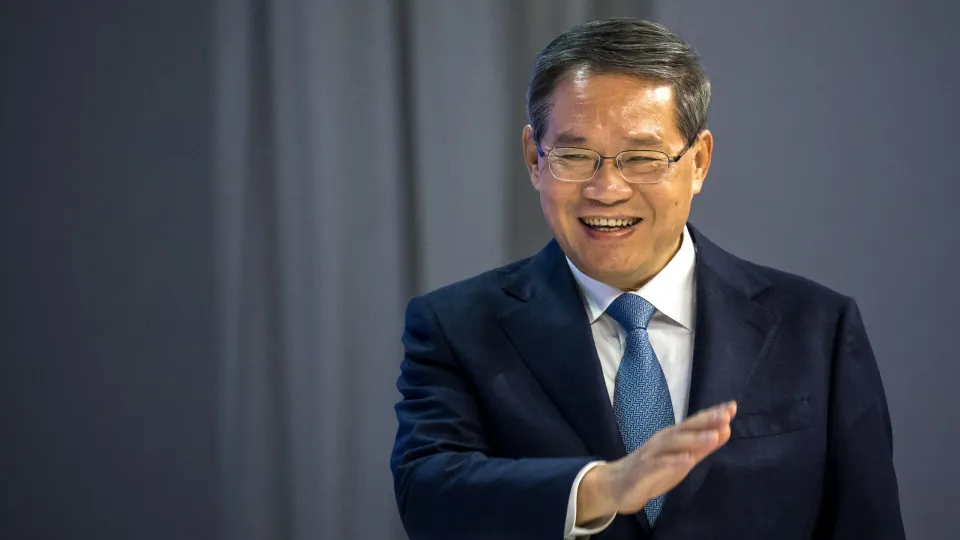
Chinese Prime Minister Li Qiang rejected the construction of a “digital iron curtain” and defended international cooperation in artificial intelligence in a context of technological rivalry with the US.
© FABRICE COFFRINI/AFP via Getty Images
03/11/2026
by
Lusa
O chinese Prime Minister Li Qiang today rejected the construction of a “digital iron curtain” and advocated greater international cooperation in artificial intelligence (IA), in a context of technological rivalry with the United States.
Li made these statements at the opening of the World Internet Conference in Wuzhen, Zhejiang Province, East China, where he called for an “open technological innovation”, knowledge sharing and “more equitable” international digital governance, according to official news agency Xinhua.
The head of the Chinese Government also advocated technology transfer and knowledge sharing with other countries, demonstrating opposition to the construction of a “digital iron curtain”.
Li also warned about the importance of preserving the “human primacy” on technology and advocated that machines remain reliable tools under human control, without “enhancing inequalities”.
“The Internet increasingly converges with technologies such as artificial intelligence and has evolved beyond a mere infrastructure, becoming an entirely new life form; it is no longer just a technical tool, but an industrial transformation engine,” the Prime Minister said.
The statements arise in a context of US restrictions on China's access to advanced semiconductors for AI, which led companies such as Huawei and Alibaba to accelerate the development of their own processors in order to reduce dependence on foreign suppliers such as Nvidia.
In recent months, Chinese technology companies such as DeepSeek, Moonshot and Alibaba have also strengthened their stake in open AI models, in contrast to the predominantly closed approach of US competitors such as OpenAI and Anthropic.
Despite this competition, Beijing and Washington agreed in September to establish a bilateral channel of dialogue on the risks and benefits of AI, as well as communication mechanisms for possible incidents related to this technology.
According to Xinhua, about 1,800 people, including government representatives, international organizations and technology companies, participated in the inaugural session.
China has organised this conference since 2014, promoting international digital cooperation, despite keeping blocked various services such as Google, WhatsApp, Facebook, Instagram and TikTok, and exercising strict control of content on the Internet.