
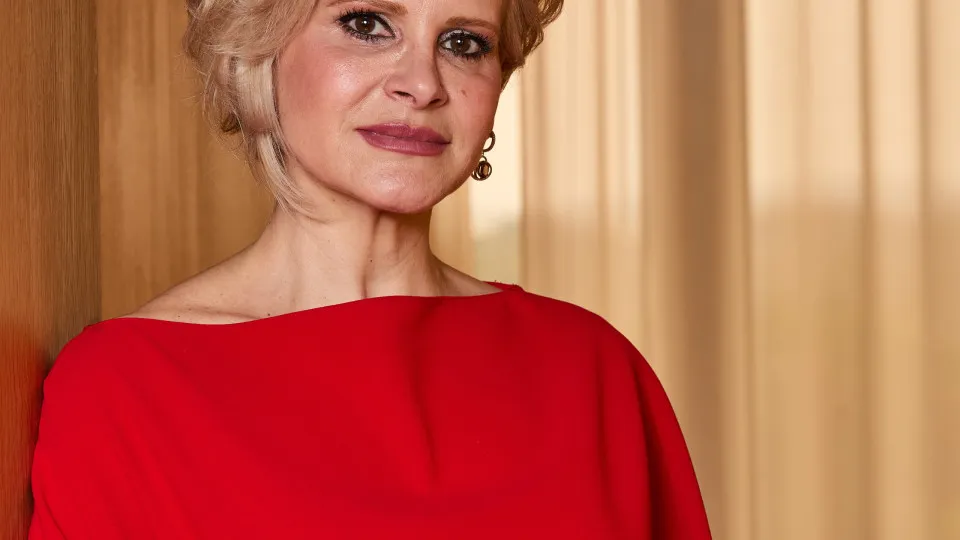
The opinion space of Sónia Soares Coelho, Clinical psychologist, Psychotherapist and Psychoanalyst, recognized by the Order of Portuguese Psychologists, over more than 30 years of career.
© Rui Bandeira
22/10/2026
by
News to Minutes
His a phrase that I often hear in the office, especially adults who have received a late diagnosis: “All of a sudden, everything made sense.” In the last few weeks, it's been dictated by an Olympic champion. Chloe Kim, the American snowboarder with three Olympic medals on the halfpipe, told her that she recently discovered having PHDA. “For years, I had a hard time, but when I finally opened up with my doctor, it was like everything suddenly fit together.” He explained that he lives on lists, alarms on his phone and fixed routines, and that in the halfpipe he cannot be distracted in the air. The news arrived a few days ago to the Portuguese press.
Before you think about the phrase, you should tell me where it was said. Kim released the diagnosis as part of a paid partnership with the pharmacist who markets the medicine she takes, announced in a statement at the end of August. None of this makes your suffering less true, nor the relief less real. But remember that a diagnosis, when it passes into the public space, rarely circulates alone: it takes with it interests, treatments and a certain illusory promise that, found the name, the rest is resolved. In the European Union, advertising to the public of prescription medicines is prohibited. In the United States, it's allowed.
Relief deserves to be taken seriously. Many neurodivergent adults spent their lives hearing that they were distracted, lazy, disorganized or strange. They built explanations about themselves from those words of others, and almost always overwhelming explanations. A well-made diagnosis can undo part of that charge. What was once read as a character flaw comes to another reading. For those who have spent years blaming themselves, this is not despicable.
Freud often used a word to describe the way psyche deals with time: Nachträglichkeit, which is usually translated “a posteriori” or “only-after”. Experiences and traces of ancient memory are later remodeled, when a new experience or a new phase of life gives them another meaning and another efficacy. The adult diagnosis resembles this movement. The grades of the school, the works delivered at the last hour, the feeling of always being one step behind: none of this happened otherwise, but the memory that one has of them changes meaning and weight. That's why the phrase "everything fit in" is so common. Whoever says it is discovering something new about something old and at the same time rewriting history itself. There is, however, a difference: in Freud, this work is mostly unconscious and often focuses on childhood experiences; in diagnosis, it is a conscious word, coming from outside, that reorganizes the past. It's an analogy, and you should read it as such.
Here, however, the work begins.
A rewrite can release or it can close too fast. When all the pieces fit together, the temptation is to stop looking at them. The PHDA begins to explain the difficulty in starting tasks, but also the anger with the father, the relationship that ended, the fear of failure. Some of these things will in fact be related to how attention works. Others ask for another reflection. A name that explains everything stops helping you think.
There's still a second movement, more subtle. In 1921 “Psychology of the masses and analysis of the self”, Freud described a form of identification that can be born from the perception of a common quality with another person, without this person being the object of sexual drives. The more important this common quality is, he wrote, the more successful this partial identification can be, and may thus be at the origin of a new bond. This is what is happening today in communities that form around a diagnosis, on social networks and outside of them. They have a lot of good: they break the isolation and give words to those who did not have them. But Freud called it a partial identification: it is based on one quality. When a person comes to recognize himself above all by him, the rest of him risks running out of place.
High competition sport offers a rare example here. For years, Chloe Kim has been described as a prodigy, capable of maneuvers that require absolute precision in the air. After all, what seemed a natural gift also had a permanent organizational effort behind it. This says a lot about what many neurodivergents do every day without anyone seeing: they compensate, adapt, “attack”. There is an enormous intelligence and strength in this effort. However, there is also a brutal tiredness. Often, it is when this effort stops coming – in a change of employment, at the birth of a child, at the end of a career – that the person seeks help and the diagnosis appears.
The diagnosis can open the door to a space where this tiredness, finally, can be said and elaborated: the psychotherapeutic space. It may also be the moment when someone, relieved, decides that he already knows everything there is to know about himself. The difference between one thing and another is not in the name, in the diagnosis, but in what one does with it.
In the clinic, what interests me most after a diagnosis is the following question: and now, what do you want to do with it? For some, it's permission to ask for help without shame. For others, it is the possibility of talking to those who live the same. For many, it is the beginning of a conversation about what remained unsaid during the years when the explanation was another. It was thinking about this that we created online therapeutic groups for neurodivergent adults at Mentanalysis: a place where common quality serves to bond, without anyone being reduced to it, and where one thinks together what diagnosis explains and what it leaves unexplained. The name goes down. The path remains undone.
Statement of interest: The author is the clinical director of Mentanalysis, which has online therapeutic groups for neurodivergent adults referred to in this text.