
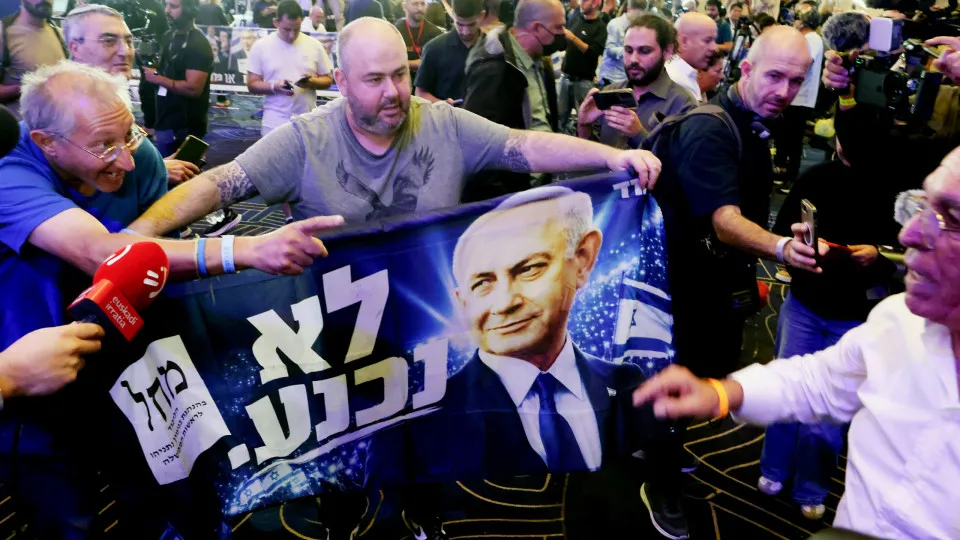
The projections of the Israeli elections point to a victory of Benjamin Netanyahu, but without a parliamentary majority to form a government, leaving the political future of the country uncertain.
© Amnon Gutman/Bloomberg via Getty Images
28/10/2026
by
Lusa
Othe inhabitants of Tel Aviv will sleep ignoring who will rule Israel for the next four years, after the projections of the laws carried out today point to a victory of the Prime Minister's party, Benjamin Netanyahu, but without a majority to control parliament.
The polls at the mouth of the polls indicate that the parties of the opposition bloc, which includes Yashar!, former General Gadi Eisenkot and second in the projections, also do not reach the 61 seats needed for a parliamentary majority that enables a government.
But they open a way out through the two Arab political forces, through their integration into the executive, which was previously rejected by Eisenkot and other leaders of the so-called bloc of change, or parliamentary support for a minority government, which several analysts consider most likely and would mean the removal of the Likud party and its leader, Netanyahu.
At 22:00 locals (less than two hours in Lisbon), the city practically stopped to follow the first projections, culminating in an intense day of festive campaign in full national holiday, which went through arteries, squares and gardens, especially from supporters of opposition groups, and to the voting assemblies themselves.
More than 7.3 million Israelis have been called to the polls today and the day ends with a record share in the last 25 years of 77.7%, almost eight points higher than that recorded in the previous elections of 2022, and with a bitter victory of Netanyahu or his far-right and ultra-orthodox allies.
On the other hand, the leaders of the moving bloc claimed a defeat of Likud and the head of government.
Gadi Eisenkot and former Prime Minister Naphtali Bennett, who runs the coalition Together (and third force in the projections) with the former head of the Yair Lapid government, signaled the constitution of a Zionist base executive with the support of the two Arab formations.
The President of Ra’am, Mansour Abbas, said today, however, that he is in contact with figures from both the opposition bloc and the pro-government bloc, implying that he was approached by Likud.
“ Everyone is talking to us, not just the ‘block of change’,” said the leader of the Arab party quoted by Channel 12.
Benjamin Netanyahu has not yet spoken and Likud has instructed his ministers not to give interviews, communications minister Shlomo Karhi said to journalists at the entrance to the party headquarters in Jerusalem, according to The Times of Israel.
The leader of the party Otzma Yehudit (Jewish Power) and Minister of National Security, ultranationalist Itamar Ben-Gvir, who may elect ten deputies, warned on his side that “the night is still a child.”.
The uncertainty about the political exit to enable a government led the inhabitants of Tel Aviv to return home on the eve of a working day.
The noisy election day gave way to silence, only interrupted the occasional passage of cars with music in maximum volume, some of which carrying Israeli flags on windows but without party signature.
Anti-Netanyahu activists even manifested themselves in Habima Square, one of the places likely to be celebrated, but there were few.
The Diangoff square, in the heart of Tel Aviv, was, during the day of the vote, one of the centers of electoral animation, with supporters of opposition parties occupying the room, in separate campaigns and dominated by the blue that is common to all. Just like the feeling of inevitability to get along the next day if you want to be government.
In a vote seen as a referendum on the governance of Benjamin Netanyahu and the first since the attacks of the Islamist Hamas group on October 7, 2023, which triggered several fronts of war in various directions, the square was abandoned as the night fell on the city.
In the same place, on the wall of the central fountain of the square, there were only hundreds of portraits of victims of the bloodiest day of Israel, one of the essential themes of these legislatives.