
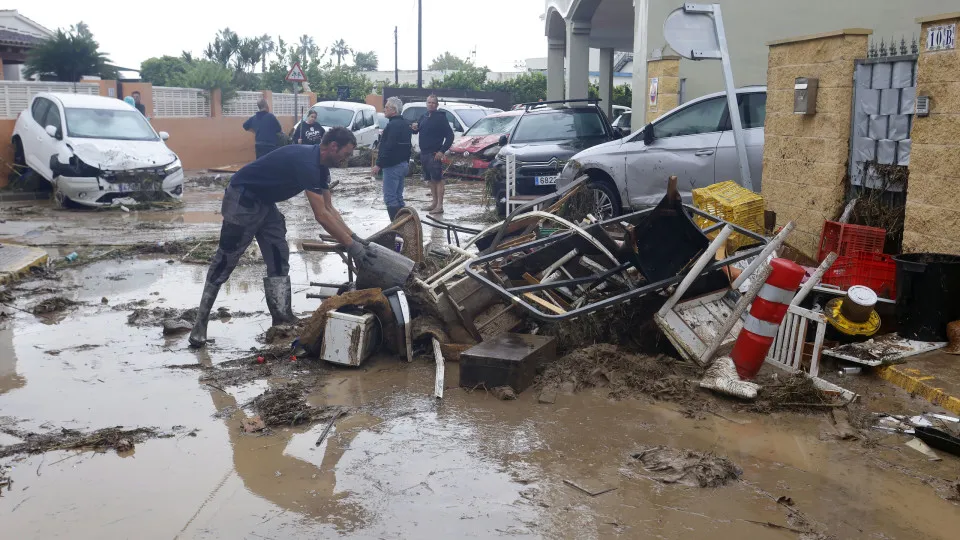
Experts argue that climate change should be declared a global health emergency, according to a report released today. The study points out that health impacts are advancing faster than actions to combat climate change.
© Lusa
28/10/2026
by
Lusa
Aclimate change must be declared a global health emergency, as its impacts on it are advancing faster than actions to combat them, and defend specialists in a report released today.
The Lancet Countdown report on Health and Climate Change indicates that some of the health damage caused by climate change has intensified more rapidly in the decade following the entry into force of the Paris Agreement (2016–2020) than in the previous decade (2006–2015).
And this is due, according to experts, to the fact that measures to combat climate change do not advance “at the necessary pace”, says a press release from the scientific journal Lancet.
The authors of the report, led by University College London (UCL) in collaboration with the World Health Organization (WHO), thus argue that “climate change should be officially recognised and treated as a global health emergency and that health should guide both policies and funding priorities to combat those changes.”.
Investments in clean energy, more resilient health systems, more comprehensive health protection legislation and an increasing number of scientific evidence since the signature of the Paris Agreement in 2015, “have brought concrete benefits” to the health of the population, but these advances are “too slow, insufficient and inconsistent” to compensate for “the increasing damage caused by climate change caused by the use of fossil fuels,” the statement explains.
According to the report, “heat was associated with an estimated average of 540,800 deaths per year between 2016 and 2023, 68% of them (369,900) caused by climate change, an increase from 55% (219,100) per year in the period 2006 to 2015.”.
At the 21st Conference of the Parties to the Framework Convention on Climate Change (COP21) held in Paris, the countries of the world agreed to prevent global temperatures from rising above 2°C (Celsius grades) in relation to the pre-industrial period, and preferably not exceeding 1.5°C.
“ A decade after the Paris Agreement, our conclusions are clear: health damage caused by climate change is growing faster than the overall response to climate change and, in many cases, until it accelerates,” said Marina Romanello, executive director of Lancet Countdown, quoted in the statement.
The report represents the work of 146 multidisciplinary researchers from more than 100 institutions in a three-year range of countries and their numbers “point to a clear emergency”, it goes.
“ It is not a gradual worsening, it is a drastic change that needs to be recognized as the global health emergency that it is,” Marina Romanello said.
Published just over a week from the start of COP31, which runs from 9 to 20 November in Turkey, the report monitors 54 indicators on the impacts of climate change and measures to combat it on health.
The 10th Lancet Countdown report notes that “progress in the climate transition, which provides for the gradual abandonment of fossil fuels (oil, gas and coal) and their replacement by renewable energy sources (solar, wind and water) to limit global warming, continues to fall short.
It also points out that national governments, international organisations and the private sector are now less committed to health issues and climate change, reversing previous progress, as well as that funding for adaptation to climate change is well below what is needed.
“ This report is a strong warning that climate change represents a health emergency. What is missing is not evidence, but political will to act,” says Helen Clark, New Zealand’s former Prime Minister and president of the Lancet Countdown Council, quoted in the statement.
“ Governments should strengthen their climate action commitments and resume international cooperation. This should be accompanied by rapid emission reductions and significantly greater support for adaptation, particularly for communities less responsible for climate change and more vulnerable to their impacts.”.